 Indietro
Blood Flow Distribution and Capillary Exchange: Study Notes for Anatomy & Physiology
Guida di studio - Note intelligenti
 Appunti personalizzati basati sui tuoi materiali, ampliati con definizioni chiave, esempi e contesto.
Blood Flow and the Control of Blood Pressure
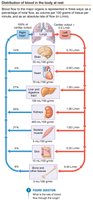
Distribution of Blood to the Tissues
The distribution of blood throughout the body is dynamically regulated to meet the metabolic needs of individual tissues. This process is governed by both local control mechanisms and homeostatic reflexes, allowing for precise adjustment of blood flow.
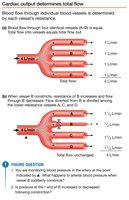
Local Control Mechanisms: Arterioles are arranged in parallel, enabling each to regulate its own blood flow. If one arteriole constricts, others compensate to maintain total flow.
Myogenic Autoregulation: Vascular smooth muscle responds to stretch by opening mechanically gated channels, leading to contraction and resistance to stretching. This helps maintain consistent blood flow.
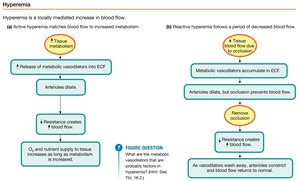
Active Hyperemia: Increased tissue metabolism leads to the release of metabolic vasodilators, causing arterioles to dilate and increase blood flow.
Reactive Hyperemia: Occurs after a period of occlusion; blood flow increases as accumulated vasodilators cause arterioles to dilate once the occlusion is removed.
Homeostatic Reflexes: These reflexes adjust blood flow based on systemic needs, such as during exercise or stress.
Cerebral and Coronary Blood Flow: Cerebral blood flow remains nearly constant, while coronary blood flow parallels the work of the heart. Low oxygen in heart tissue triggers the release of adenosine, dilating coronary arteries to increase blood supply.
Exchange at the Capillaries
Capillaries are the primary sites for exchange between plasma and cells. Their structure and function are closely related to the metabolic activity of tissues.
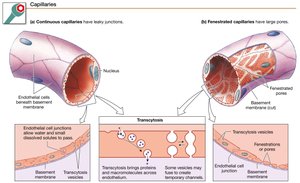
Capillary Structure: Capillaries have the thinnest walls, consisting of a single layer of flattened endothelial cells supported by a basal lamina.
Types of Capillaries:
Continuous Capillaries: Have leaky junctions and are found in most tissues.
Fenestrated Capillaries: Have large pores, found in organs requiring rapid exchange (e.g., kidneys, intestines).
Sinusoids: Modified capillaries found in bone marrow, liver, and spleen, allowing passage of larger molecules.
Capillary Density: Higher in tissues with greater metabolic activity.
Velocity of Blood Flow in Capillaries
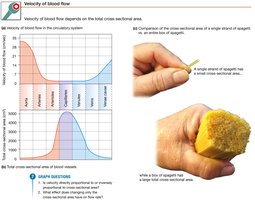
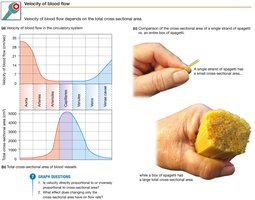
The velocity of blood flow is lowest in the capillaries, which is crucial for efficient material exchange. The primary determinant of velocity is the total cross-sectional area of all capillaries.
Flow Rate and Velocity: At a constant flow rate, velocity is higher in smaller diameter tubes. However, because capillaries collectively have a large cross-sectional area, blood flow slows down.
Fastest Flow: Occurs in arteries.
Slowest Flow: Occurs in capillaries and venules.
Mechanisms of Capillary Exchange
Capillary exchange occurs primarily through diffusion and transcytosis, allowing for the movement of various substances between plasma and interstitial fluid.
Diffusion: Small dissolved solutes and gases move across capillary walls based on lipid solubility and concentration gradients.
Paracellular Pathway: Movement occurs between cells through leaky junctions.
Endothelial Transport: Substances move through endothelial cells.
Transcytosis: Larger solutes and proteins are transported via vesicles across the endothelial cells.
Capillary Filtration and Absorption
Bulk flow is the mass movement of fluid as a result of hydrostatic or osmotic pressure gradients. This process determines whether fluid leaves or enters the capillaries.
Filtration: Fluid movement out of capillaries, driven by hydrostatic pressure. Hydrostatic pressure decreases over the length of the capillary due to friction.
Absorption: Fluid movement into capillaries, driven by colloid osmotic (oncotic) pressure, which is due to plasma proteins.
Net Pressure: Determines the direction of bulk flow. Net filtration occurs at the arterial end, while net absorption occurs at the venous end.
Process | Driving Force | Direction |
|---|---|---|
Filtration | Hydrostatic Pressure | Out of Capillaries |
Absorption | Colloid Osmotic Pressure | Into Capillaries |
Key Equations
The net filtration pressure (NFP) can be calculated as:
Summary Table: Types of Capillaries
Type | Structure | Location |
|---|---|---|
Continuous | Leaky junctions | Most tissues |
Fenestrated | Large pores | Kidneys, intestines |
Sinusoids | Large gaps | Liver, spleen, bone marrow |
Learning Objectives
Explain how the body uses local and long-distance signaling to direct blood flow.
Define myogenic autoregulation and its role in local blood flow.
List and describe major paracrine factors in local blood flow control.
Describe control of blood flow to the brain and heart.
Describe types of capillaries and their locations.
Explain why capillary blood flow velocity is lowest.
Explain diffusion and transcytosis in capillary exchange.
Explain forces influencing capillary filtration and absorption.
