 Indietro
Blood: Structure, Function, and Formation in Anatomy & Physiology
Guida di studio - Note intelligenti
 Appunti personalizzati basati sui tuoi materiali, ampliati con definizioni chiave, esempi e contesto.
Blood and the Cardiovascular System
Overview of the Cardiovascular System
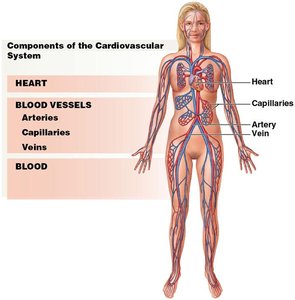
The cardiovascular system is composed of the heart, blood vessels, and blood. Blood is the fluid connective tissue that circulates throughout the body, delivering essential substances and removing wastes.
Heart: Pumps blood throughout the body.
Blood Vessels: Include arteries (carry blood away from the heart), veins (return blood to the heart), and capillaries (permit exchange between blood and interstitial fluids).
Blood: The transport medium for oxygen, nutrients, hormones, and wastes.
Functions of Blood
Transport Functions
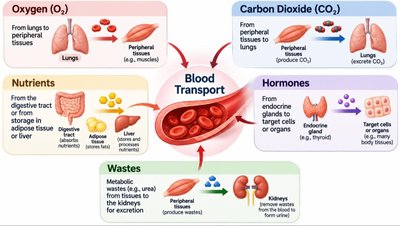
Blood is responsible for transporting a variety of substances throughout the body.
Oxygen: From lungs to peripheral tissues.
Carbon Dioxide: From tissues to lungs for exhalation.
Nutrients: From digestive tract or storage sites to cells.
Hormones: From endocrine glands to target organs.
Wastes: To kidneys for excretion.
Regulation and Protection
Blood helps regulate pH, ion composition, and restricts fluid loss at injury sites.
Regulation: Maintains pH (7.35–7.45), absorbs/neutralizes acids, and balances ion concentrations via diffusion.
Protection: Initiates clotting to restrict fluid loss and defends against pathogens.
Properties and Composition of Blood
Physical Properties
Viscosity: Blood is five times as viscous as water.
pH: Slightly alkaline, with a pH between 7.35 and 7.45.
Blood Components
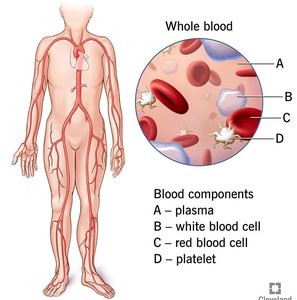
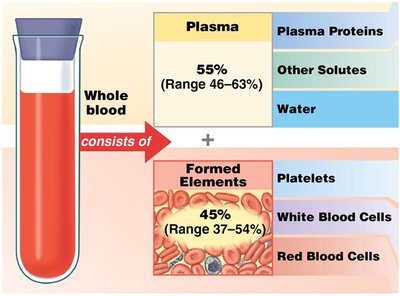
Blood consists of plasma (liquid matrix) and formed elements (cells and cell fragments).
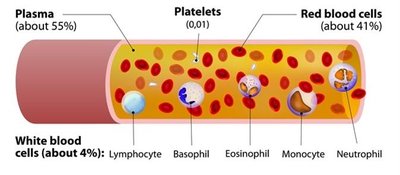
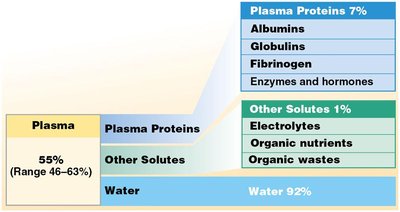
Plasma: Makes up about 55% of blood volume; mostly water (90%), with proteins, electrolytes, nutrients, hormones, and wastes.
Formed Elements: Include platelets, white blood cells (WBCs), and red blood cells (RBCs).
Plasma Composition
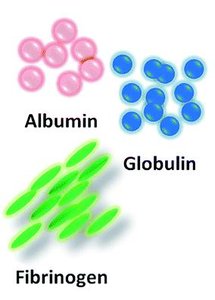
Plasma Proteins (7%): Albumins (osmotic pressure), globulins (antibodies), fibrinogen (clotting).
Other Solutes (1%): Electrolytes (Na+, K+, Ca2+, Mg2+, Cl-), organic nutrients (lipids, carbohydrates, amino acids), organic wastes (urea, uric acid, creatinine).
Water (92%): Main solvent for transport.
Formed Elements
Platelets: <0.1% of formed elements; involved in clotting.
White Blood Cells (WBCs): <0.1% of formed elements; body defense.
Red Blood Cells (RBCs): 99.9% of formed elements; oxygen transport.
Hemopoiesis (Blood Cell Formation)
Overview of Hemopoiesis
Hemopoiesis (hematopoiesis) is the process of blood cell formation, occurring in red bone marrow.
Hemocytoblasts: Stem cells that produce lymphoid and myeloid stem cells.
Lymphoid Stem Cells: Produce lymphocytes.
Myeloid Stem Cells: Produce RBCs, other WBCs, and platelets.
Myeloid Stem Cell Differentiation
Monoblasts: Differentiate into promonocytes, then monocytes.
Myeloblasts: Differentiate into myelocytes, then band cells, then neutrophils, eosinophils, basophils.
Megakaryocytes: Fragment to form platelets.
Proerythroblasts: Differentiate into erythroblasts, reticulocytes, then mature RBCs.
Erythropoietin (EPO)
EPO: Protein produced by kidneys; stimulates RBC production in response to hypoxia (low oxygen).
Hematology and Blood Tests
Hematology
Hematology is the study of blood and blood-forming tissues, providing important information about health and detecting disorders.
Blood Tests: Determine blood type, evaluate RBCs, WBCs, and platelets.
Complete Blood Count (CBC): Measures RBC count, WBC count, hemoglobin, hematocrit.
WBC Differential Count: Identifies numbers of each WBC type.
RBC Tests: Assess number, size, shape, maturity of RBCs.
Red Blood Cells (Erythrocytes)
Characteristics and Functions
Red blood cells are the most common formed elements, responsible for oxygen transport.
Hemoglobin: Protein that carries oxygen; each RBC contains ~280 million Hb molecules.
Surface Area: Large surface area-to-volume ratio for efficient gas exchange.
Rouleaux: Form stacks to facilitate transport in small vessels.
Flexibility: Can move through narrow capillaries.
Anucleate: Mature RBCs lack nuclei and ribosomes; cannot divide or repair.
Life Span: Less than 120 days.
Hemoglobin Structure and Oxygen Transport
Quaternary Structure: Two alpha and two beta chains, each with a heme molecule.
Oxyhemoglobin (HbO2): Formed when iron in heme binds oxygen; makes blood bright red.
Deoxyhemoglobin: Hemoglobin not bound to oxygen; blood is dark red.
Oxygen Binding: Reversible; ~98.5% of oxygen in blood is bound to Hb.
RBC Production and Breakdown
Erythropoiesis: Formation of RBCs in red bone marrow.
Breakdown: Old RBCs are engulfed by macrophages; heme is converted to biliverdin, then bilirubin, which is excreted in bile.
Jaundice: Caused by increased bilirubin levels due to blocked bile ducts or liver dysfunction.
Urine and Feces Color: Bacteria convert bilirubin to urobilins and stercobilins; excreted in urine and feces.
Blood Types and Compatibility
Blood Type Determination
Blood type is determined by surface antigens (A, B, Rh) on RBC membranes.
ABO Blood Group: Based on presence/absence of A and B antigens.
Rh Blood Group: Based on presence/absence of Rh antigen; Rh+ or Rh-.
Agglutination and Cross-Reactions
Agglutination: Clumping of RBCs when exposed to corresponding antibodies; can cause dangerous blockages.
Blood Typing Tests: Mix blood with antibodies to determine type; necessary for safe transfusions.
White Blood Cells (Leukocytes)
Types and Functions
White blood cells are involved in body defense and immunity.
Five Types: Neutrophils, lymphocytes, monocytes, eosinophils, basophils.
Properties: Emigration (diapedesis), positive chemotaxis, phagocytosis.
Classification
Granular Leukocytes (Granulocytes): Neutrophils, eosinophils, basophils; have cytoplasmic granules.
Agranular Leukocytes (Agranulocytes): Monocytes, lymphocytes; few granules.
WBC Type | Nucleus Appearance | Main Function | % of WBCs |
|---|---|---|---|
Neutrophil | Round, Multilobed | Phagocytosis of bacteria and debris; first to respond to infection | ~50–70% |
Eosinophil | Round, Bilobed | Attack parasites; reduce inflammation and allergic reactions | ~2–4% |
Basophil | Round, Deeply purple, obscured by granules | Release histamine and heparin; promote inflammation | <1% |
Monocyte | Very Large, Kidney-shaped | Phagocytosis; become macrophages in tissues | ~2–8% |
Lymphocyte | Generally Round, Larger than RBC | B cells (antibodies), T cells (cell attack), NK cells (kill abnormal cells) | ~20–40% |
Hemostasis (Stopping of Bleeding)
Phases of Hemostasis
Hemostasis is the process that stops blood loss and establishes a framework for tissue repair.
Vascular Phase: Lasts ~30 minutes after injury; exposed endothelium releases chemicals (endothelins) causing vascular spasms and promoting repair.
Platelet Phase: Platelets attach to exposed surfaces and release chemicals essential for clot formation and vessel repair.
Coagulation Phase: Starts 30 seconds or more after damage; involves conversion of fibrinogen to insoluble fibrin, trapping blood cells and platelets in a clot. Requires calcium and 11 different proteins (procoagulants).
Summary Table: Blood Composition
Component | Percentage | Main Functions |
|---|---|---|
Plasma | ~55% | Transport, regulation, contains proteins and solutes |
Platelets | <0.1% | Clotting |
White Blood Cells | <0.1% | Defense |
Red Blood Cells | 99.9% | Oxygen transport |
Key Equations
Blood pH Range
Oxygen Carrying Capacity
Hematocrit Calculation
Summary
Blood is a vital fluid connective tissue with complex structure and functions, including transport, regulation, and protection. Its components—plasma and formed elements—are produced through hemopoiesis and play essential roles in health and disease. Understanding blood composition, function, and formation is fundamental in Anatomy & Physiology.
