 Indietro
Blood Vessels and Circulation: Structure, Function, and Clinical Applications
Guida di studio - Note intelligenti
 Appunti personalizzati basati sui tuoi materiali, ampliati con definizioni chiave, esempi e contesto.
Blood Vessels: Overview and Classification
Introduction to Blood Vessel Systems
Blood vessels are essential components of the cardiovascular system, responsible for transporting blood throughout the body. They are classified into three main types: arteries, veins, and capillaries, each with distinct structural and functional characteristics. - Arterial System: Carries oxygenated blood away from the heart to tissues. - Venous System: Returns deoxygenated blood from tissues to the heart. - Capillaries: Facilitate exchange of gases, nutrients, and waste between blood and tissues. 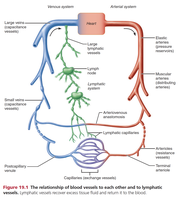
Blood Vessel Structure
Layers of Blood Vessel Walls
The wall of a typical blood vessel consists of three layers, each contributing to its function and integrity. - Tunica Interna (Intima): The innermost layer, composed of endothelium and connective tissue, lines the lumen and regulates exchange. - Tunica Media: The middle layer, primarily smooth muscle, controls vessel diameter and blood flow. - Tunica Externa (Adventitia): The outer layer, mainly collagen fibers, provides structural support and protection. 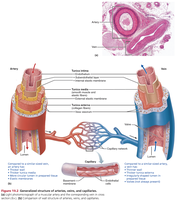
Blood Vessel Anatomy: Comparative Summary
Structural Differences Among Vessel Types
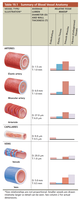
Blood vessels vary in thickness, composition, and function depending on their type and location.
Vessel Type | Wall Thickness | Muscle Content | Elasticity | Function |
|---|---|---|---|---|
Elastic Artery | Thick | High | High | Conducts blood from heart |
Muscular Artery | Moderate | Moderate | Moderate | Distributes blood to organs |
Arteriole | Thin | Low | Low | Regulates blood flow to capillaries |
Capillary | Very thin | None | None | Exchange of substances |
Venule | Thin | Low | Low | Collects blood from capillaries |
Vein | Moderate | Low | Low | Returns blood to heart |
Functional Characteristics of Arteries and Veins
Arterial System
Arteries have thicker tunica media and higher pressure due to ventricular contraction. - Elastic arteries (e.g., aorta) expand and recoil to maintain blood flow during cardiac cycles. - Muscular arteries distribute blood to specific organs.
Venous System
Veins have thinner walls and lower pressure. - One-way valves prevent backflow, especially in limbs. - Skeletal muscle contraction assists venous return against gravity. 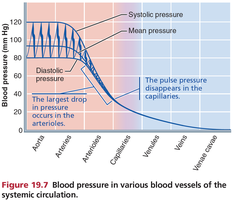
Capillary Structure and Permeability
Endothelial Lining and Fluid Exchange
Capillaries are composed of a single layer of endothelial cells, allowing selective movement of water and ions. - Interstitial space: Fluid leaks from capillaries into surrounding tissues, facilitating nutrient and waste exchange. 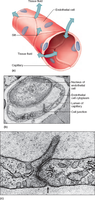
Types of Capillaries
Classification Based on Permeability
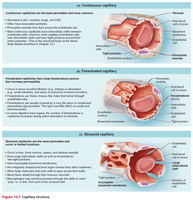
Capillaries differ in their permeability, depending on their location and function.
Type | Structure | Location | Permeability |
|---|---|---|---|
Continuous | Tight junctions | Muscle, skin, CNS | Low |
Fenestrated | Pores (fenestrations) | Kidneys, intestines | Moderate |
Sinusoid | Large gaps | Liver, bone marrow | High |
Blood Flow and Regulation
Pathway of Blood Through Vessels
Blood flows from arteries to arterioles, then to capillary beds, and returns via venules and veins. - Arterioles regulate blood flow by constricting or dilating. - Capillary beds are sites of gas and nutrient exchange.
Clinical Applications
Deep Venous Thrombosis (DVT) and Embolus
- DVT: Blood clots form in veins due to immobility, potentially causing pain and swelling. - Embolus: A clot that travels through the bloodstream, possibly causing pulmonary embolism or stroke.
Atherosclerosis and Myocardial Infarction
- Atherosclerosis: Plaque buildup in arteries restricts blood flow, increasing risk of heart attack. - Cholesterol: LDL increases risk, HDL decreases risk.
Aneurysms
- Aneurysm: Localized vessel wall bulge, risk of rupture and severe bleeding.
Blood Pressure
Measurement and Regulation
Blood pressure is the force exerted by blood on vessel walls, measured as systolic and diastolic values. - Systolic: Pressure during ventricular contraction. - Diastolic: Pressure during ventricular relaxation. - Normal values: 100-120 mmHg systolic, 60-80 mmHg diastolic. 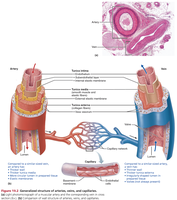
Factors Affecting Blood Pressure
- Cardiac output: Increased heart rate or stroke volume raises blood pressure. - Blood volume: More blood increases pressure. - Vasodilation/Vasoconstriction: Changes vessel diameter, affecting resistance. - Blood viscosity: Thicker blood increases pressure.
Regulation by Baroreceptors
Baroreceptors in the carotid sinus and aortic arch detect changes in blood pressure and adjust autonomic nervous system activity to maintain homeostasis.
Pulse Locations
Clinical Relevance
Pulse is felt at major arteries; the further from the heart, the lower the pressure required. Example: Radial, carotid, femoral, and dorsalis pedis arteries are common pulse points.
Summary Table: Blood Vessel Anatomy
Comparison of Vessel Types
Vessel Type | Wall Thickness | Muscle Content | Elasticity | Function |
|---|---|---|---|---|
Elastic Artery | Thick | High | High | Conducts blood from heart |
Muscular Artery | Moderate | Moderate | Moderate | Distributes blood to organs |
Arteriole | Thin | Low | Low | Regulates blood flow to capillaries |
Capillary | Very thin | None | None | Exchange of substances |
Venule | Thin | Low | Low | Collects blood from capillaries |
Vein | Moderate | Low | Low | Returns blood to heart |
Key Equations
Blood Pressure Calculation
Blood pressure is determined by cardiac output and peripheral resistance:
Cardiac Output
Conclusion
Understanding the structure and function of blood vessels is fundamental to the study of human anatomy and physiology. Clinical conditions such as DVT, atherosclerosis, and aneurysms highlight the importance of vascular health. Blood pressure regulation and pulse assessment are essential skills for healthcare professionals. Additional info: Academic context was added to clarify vessel types, clinical applications, and regulatory mechanisms.
