 Indietro
Body Membranes: Structure, Types, and Functions
Guida di studio - Note intelligenti
 Appunti personalizzati basati sui tuoi materiali, ampliati con definizioni chiave, esempi e contesto.
Body Membranes
Overview of Body Membranes
Body membranes are essential structures that cover body surfaces, line body cavities, and form protective sheets around organs. They play critical roles in protection, secretion, and lubrication. There are two major categories: epithelial membranes and connective tissue membranes.
Epithelial membranes: Include cutaneous, mucous, and serous membranes.
Connective tissue membranes: Include synovial membranes.
Functions:
Cover and protect body surfaces
Line internal body cavities
Form protective sheets around organs
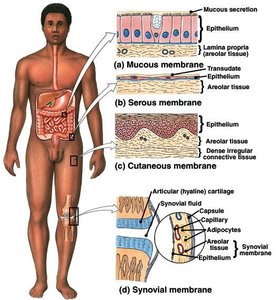
Epithelial Membranes
Cutaneous Membrane
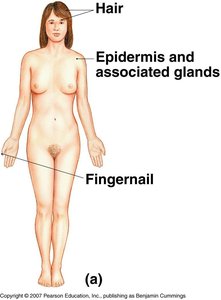
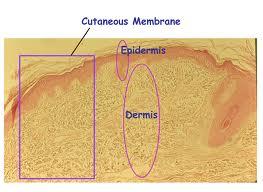
The cutaneous membrane, commonly known as the skin, is the body's largest organ and serves as a dry, protective barrier. It consists of two main layers:
Superficial epidermis: Made of keratinizing stratified squamous epithelium, providing waterproofing and protection.
Deeper dermis: Composed of dense fibrous connective tissue, offering structural support.
Key Properties:
Exposed to the external environment
Dry membrane
Protects against mechanical injury, pathogens, and dehydration
Mucous Membranes
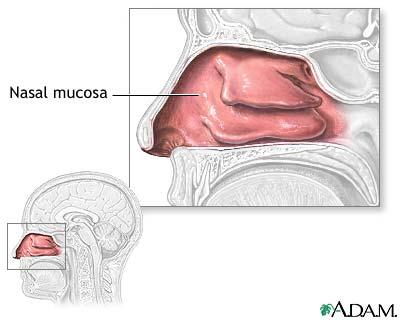
Mucous membranes line all body cavities that open to the exterior, such as the digestive, respiratory, urinary, and reproductive tracts. They consist of an epithelial layer overlying a loose connective tissue called lamina propria.
Epithelial tissue: Can be stratified squamous or simple columnar, depending on location.
Lamina propria: Supports the epithelium and provides flexibility.
Wet membranes: Secrete mucus for protection and lubrication (except urinary mucosae).
Functions:
Protect underlying tissues
Trap pathogens and particles
Facilitate movement of materials
Serous Membranes
Serous membranes line body cavities that are closed to the exterior, such as the thoracic and abdominal cavities. They consist of a layer of simple squamous epithelium on a thin layer of areolar connective tissue.
Locations: Peritoneum (intestines), pleura (lungs), pericardium (heart)
Structure: Occur in pairs—parietal layer (lines cavity) and visceral layer (covers organ)
Serous fluid: Separates layers, allowing organs to slide smoothly
Functions:
Reduce friction between organs
Provide a smooth, lubricated surface
Connective Tissue Membranes
Synovial Membranes
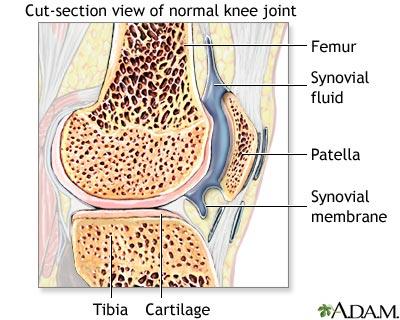
Synovial membranes are specialized connective tissue membranes found lining the fibrous capsules around joints, bursae, and tendon sheaths. They are composed primarily of areolar connective tissue.
Location: Joints such as the knee, shoulder, and fingers
Function: Secrete synovial fluid for lubrication and cushioning
Structure: No epithelial cells, only connective tissue
Functions:
Reduce friction in joints
Provide nutrients to articular cartilage
Absorb shock during movement
Comparison of Body Membrane Types
The following table summarizes the main characteristics of each body membrane type:
Membrane Type | Location | Structure | Function |
|---|---|---|---|
Cutaneous | External body surface (skin) | Stratified squamous epithelium + dense connective tissue | Protection, waterproofing |
Mucous | Body cavities open to exterior (digestive, respiratory, etc.) | Epithelium + lamina propria | Protection, secretion, lubrication |
Serous | Closed body cavities (thoracic, abdominal) | Simple squamous epithelium + areolar tissue | Reduce friction, allow organ movement |
Synovial | Joint cavities, bursae, tendon sheaths | Areolar connective tissue | Lubrication, cushioning |
Key Terms and Definitions
Epithelium: Tissue forming the outer layer of body surfaces and lining internal cavities.
Lamina propria: Loose connective tissue supporting the epithelium in mucous membranes.
Serous fluid: Lubricating fluid secreted by serous membranes.
Synovial fluid: Viscous fluid secreted by synovial membranes for joint lubrication.
Summary
Body membranes are vital for maintaining the integrity, protection, and function of various body systems. Understanding their structure and roles is fundamental in anatomy and physiology, especially in the context of tissue and organ function.
