 Indietro
Bone Development and Remodeling: From Embryo to Adulthood
Guida di studio - Note intelligenti
 Appunti personalizzati basati sui tuoi materiali, ampliati con definizioni chiave, esempi e contesto.
Bone Development
Embryonic and Fetal Bone Formation
Bone development begins in the embryo with the formation of a cartilage model, which is gradually replaced by bone tissue through a process called ossification. This process is essential for the proper formation and growth of the skeletal system.
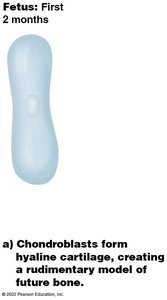
Chondroblasts produce hyaline cartilage, creating the framework for future bones.
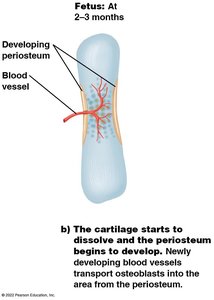
During the fetal stage (2-3 months), the periosteum and blood vessels begin to develop.
Cartilage dissolves and is replaced by bone material as chondroblasts die and the matrix breaks down.
Blood vessels transport osteoblasts to the site, initiating ossification.
Osteoblast Activity and Ossification
Osteoblasts play a critical role in bone formation by secreting proteins and enzymes that facilitate mineralization. As bone tissue hardens, osteoblasts become embedded and mature into osteocytes.
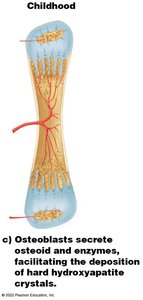
Osteoblasts secrete osteoid, a protein mixture forming the internal structure of bone.
Enzymes secreted by osteoblasts facilitate the production of hydroxyapatite, the mineral component of bone.
Osteoblasts become embedded in the matrix and mature into osteocytes, which maintain bone tissue.
Bone Growth During Childhood and Adolescence
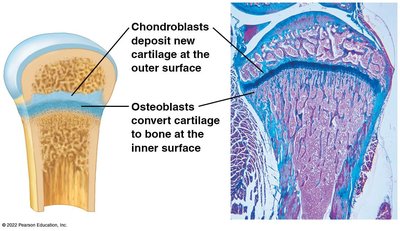
Bone growth is regulated by hormones and occurs at the epiphyseal (growth) plates. Chondroblasts and osteoblasts work together to lengthen and strengthen bones.
Growth hormone and sex hormones stimulate bone growth.
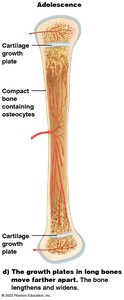
The epiphyseal plate remains at each epiphysis, allowing continued growth.
Chondroblasts produce new cartilage at the outer surface, while osteoblasts convert cartilage to bone at the inner surface.
Bone lengthens as the two epiphyseal plates grow apart.
Bone Remodeling
Bone Remodeling Process
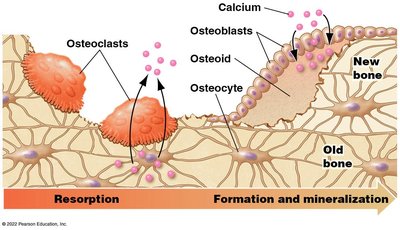
Bone remodeling is a continuous process involving the removal of mature bone and the creation of new bone. This process is essential for maintaining bone strength and adapting to mechanical stress.
Osteoclasts are specialized cells that break down bone tissue by secreting enzymes that dissolve hydroxyapatite and digest the osteoid matrix.
Calcium and phosphate ions are released into the blood during resorption.
New osteoblasts are attracted to the area, stimulating the deposition of new bone matrix and hydroxyapatite crystals.
Bone Remodeling and Mechanical Stress
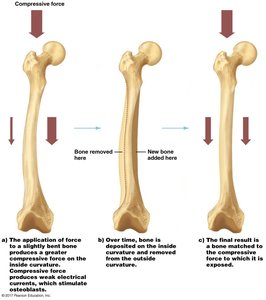
Bone adapts to mechanical stress by remodeling its structure. Areas exposed to high compressive force develop more bone, while areas with low stress undergo resorption.
Constant remodeling allows bone to change shape and size.
Bone is created in areas of high compressive stress and removed in areas of low stress.
Weight-bearing exercises increase bone mass and strength.
Bone Cells and Their Functions
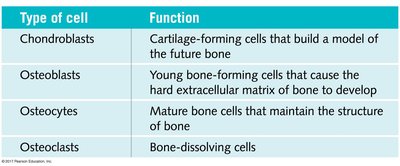
Four main types of bone cells are involved in bone development and remodeling, each with distinct functions.
Type of cell | Function |
|---|---|
Chondroblasts | Cartilage-forming cells that build a model of the future bone |
Osteoblasts | Young bone-forming cells that cause the hard extracellular matrix of bone to develop |
Osteocytes | Mature bone cells that maintain the structure of bone |
Osteoclasts | Bone-dissolving cells |
Hormonal Regulation of Bone Growth
Calcitonin and Parathyroid Hormone
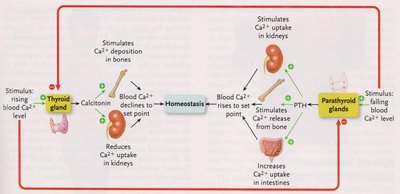
Bone growth and remodeling are regulated by hormones that maintain calcium homeostasis. Calcitonin and parathyroid hormone (PTH) act in opposition to control blood calcium levels.
Calcitonin is secreted by the thyroid gland when blood calcium levels rise. It stimulates osteoblast activity and inhibits osteoclast activity, promoting calcium deposition in bones and reducing calcium absorption in the intestines and kidneys.
Parathyroid hormone (PTH) is secreted by the parathyroid gland when blood calcium levels fall. It stimulates osteoclast activity, releasing calcium and phosphate from bones into the blood, increases calcium absorption in the kidneys, and enhances vitamin D production for increased intestinal calcium absorption.
Imbalances can lead to bone demineralization and conditions such as osteoporosis.
Key Equations
Calcium homeostasis is maintained by the balance between bone deposition and resorption:
Deposition:
Resorption:
Summary
Bone development and remodeling are complex processes regulated by cellular activity and hormonal control. Understanding these mechanisms is essential for comprehending skeletal growth, maintenance, and adaptation throughout life.
