 Indietro
Bone Tissue: Structure, Function, and Metabolism
Guida di studio - Note intelligenti
 Appunti personalizzati basati sui tuoi materiali, ampliati con definizioni chiave, esempi e contesto.
Bone Tissue: Structure, Function, and Metabolism
Introduction to Bone Tissue
Bone is a dynamic, living tissue that plays a crucial role in support, protection, movement, and metabolic regulation. It is composed of both organic and inorganic materials and is constantly remodeled throughout life. Bone also serves as a metabolic organ, regulating acid-base balance, calcium and phosphate levels, hormone secretion, and blood formation.
Support and Protection: Provides structural framework and shields vital organs.
Movement: Facilitates muscle attachment and movement.
Metabolic Functions: Regulates minerals, acid-base balance, and produces blood cells.
Bone Remodeling: Adapts to activity, nutrition, and hormonal changes.
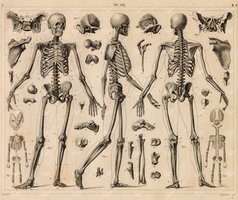
Classification and Anatomy of Bones
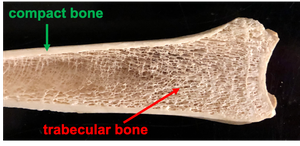
The human skeleton consists of 206 bones, classified by shape and function. Each bone contains an outer cortical (compact) layer and an inner trabecular (spongy) region.
Flat Bones: Cranial vault, scapula.
Long Bones: Limbs (femur, humerus).
Short Bones: Carpals, tarsals.
Irregular Bones: Vertebrae, parts of skull.
Sesamoid Bones: Embedded in tendons (patella).
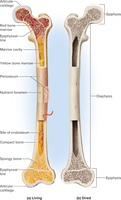
Long Bone Anatomy
Long bones have distinct anatomical regions that contribute to their growth and function.
Diaphysis: Shaft of the bone.
Epiphysis: Ends of the bone.
Articular Cartilage: Surface for joint contact.
Epiphyseal Plate: Growth plate for adolescent bone elongation.
Periosteum: Tough outer layer.
Endosteum: Inner lining.
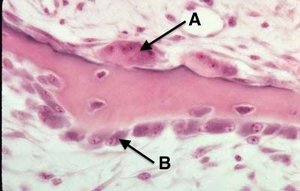
Bone Cells and Their Functions
Bone tissue is maintained by three main cell types, each with specialized functions.
Osteoblasts: Build bone by secreting matrix (osteoid).
Osteocytes: Mature bone cells embedded in matrix, maintain bone tissue.
Osteoclasts: Break down bone, derived from myeloid lineage.
Structure of Compact Bone: Osteons and Lamellae
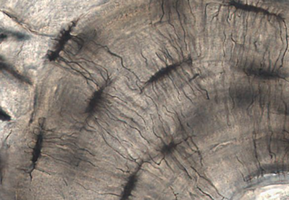
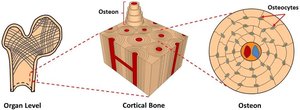
Compact bone is organized into osteons, the basic structural unit. Each osteon consists of concentric rings called lamellae, with osteocytes communicating via canaliculi.
Osteon: Cylindrical unit of compact bone.
Lamellae: Concentric rings of bone matrix.
Canaliculi: Tiny channels for cell communication.
Central Canal: Contains blood vessels and nerves.
Structure of Trabecular (Spongy) Bone
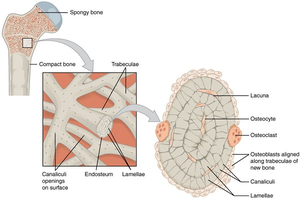
Trabecular bone is found at the ends of long bones and within flat bones. It consists of a network of trabeculae, which are slivers of bone that help disperse force and reduce weight.
Trabeculae: Lattice-like structures within bone.
Marrow Spaces: Filled with red or yellow marrow.
Spicules: Small projections of bone.
Remodeling: Orientation and density change in response to stress.
Bone Modeling and Remodeling
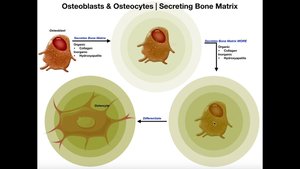
Bone is composed of organic (collagen, proteins) and inorganic (hydroxyapatite, calcium carbonate, calcium phosphate) materials. Bone modeling and remodeling are governed by the coordinated activity of osteoblasts, osteocytes, and osteoclasts.
Osteoblasts: Secrete osteoid, become osteocytes when trapped.
Osteocytes: Maintain bone, communicate via projections.
Osteoclasts: Dissolve minerals and collagen.
Bone Formation: Ossification Processes
Bone forms through two main processes: intramembranous and endochondral ossification. These processes are essential for fetal development and adolescent growth.
Intramembranous Ossification: Bone forms from stem cells and fibrous tissue (cranial bones, clavicle).
Endochondral Ossification: Bone forms from a cartilaginous blueprint (spine, limb bones, pelvis).
Growth Plate: Site of bone elongation until adulthood.
Bone Growth: Interstitial and Appositional
Bones grow in length (interstitially) at the growth plate and in thickness (appositionally) at periosteal and endosteal surfaces. Growth plate consists of five zones: resting, proliferation, hypertrophy, calcification, and bone deposition.
Interstitial Growth: Elongation at growth plate.
Appositional Growth: Thickening via new lamellae.
Growth Plate Closure: Occurs after adolescence.
Calcium and Phosphate Metabolism
Bone serves as a reservoir for calcium and phosphate, which are tightly regulated by hormones. These minerals are essential for muscle contraction, nerve function, and cellular signaling.
Mineralization: Bone formation recruits serum calcium and phosphate.
Resorption: Bone breakdown releases minerals.
Key Hormones: Parathyroid hormone (PTH), Calcitriol (Vitamin D), Calcitonin.
Hormonal Regulation of Calcium
Hormone | Source | Effect on Calcium | Target Organs | Cell Types Involved |
|---|---|---|---|---|
Parathyroid Hormone (PTH) | Parathyroid glands | Increases serum calcium | Bone, kidneys | Osteoblasts, osteoclasts |
Calcitriol (Vitamin D) | Skin, liver, kidneys | Increases serum calcium | Intestine, bone, kidneys | Osteoblasts, osteoclasts |
Calcitonin | Thyroid gland | Decreases serum calcium | Bone | Osteoblasts, osteoclasts |
Bone Fractures and Healing
Bone fractures can occur due to trauma or disease. They are classified by their pattern and severity. Healing involves four major steps: hematoma formation, soft callus formation, hard callus formation, and remodeling.
Stress Fractures: Due to trauma.
Pathological Fractures: Due to disease.
Classification: Greenstick, comminuted, non-displaced, displaced.
Healing Steps: Hematoma, soft callus, hard callus, remodeling.
Bone Diseases
Several diseases affect bone tissue, impacting its structure and function.
Osteomyelitis: Inflammation due to infection.
Osteogenesis Imperfecta: Collagen mutation, brittle bones.
Osteosarcoma: Bone cancer.
Osteoporosis: Low mineralization, increased fracture risk.
Paget’s Disease: Disordered bone remodeling.
Rickets/Osteomalacia: Deformation due to low vitamin D.
