 Indietro
Bone Types and Structures: Anatomy & Physiology Study Notes
Guida di studio - Note intelligenti
 Appunti personalizzati basati sui tuoi materiali, ampliati con definizioni chiave, esempi e contesto.
Bone Types and Structures
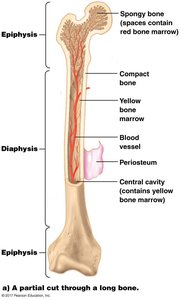
Long Bone Anatomy
Long bones are a fundamental component of the skeletal system, characterized by their elongated shape and structural complexity. Understanding the anatomy of a long bone is essential for grasping its function in support, movement, and hematopoiesis.
Diaphysis: The cylindrical shaft of the bone, composed primarily of compact bone, providing strength and support.
Epiphysis: The expanded ends of the bone, containing spongy bone filled with red bone marrow and stem cells, crucial for blood cell production.
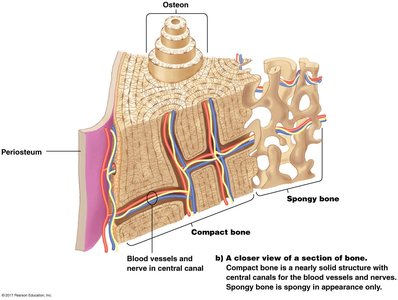
Compact Bone: Dense outer layer covering both diaphysis and epiphysis, offering protection and structural integrity.
Spongy Bone: Found within the epiphysis, characterized by a porous structure that houses red bone marrow.
Periosteum: Tough connective tissue layer enveloping the bone, containing nerves, blood vessels, and bone-forming cells (osteocytes).
Central Cavity: Located within the diaphysis, filled with yellow bone marrow, which stores fat.
Microscopic Structure of Bone: Osteons and Osteocytes
The microscopic architecture of bone is organized into cylindrical units called osteons, which are essential for nutrient delivery and structural support. Osteocytes, the mature bone cells, reside within these structures and maintain bone tissue.
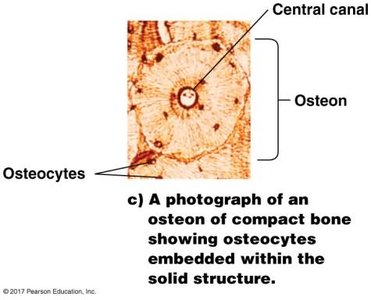
Osteon: The fundamental structural unit of compact bone, consisting of concentric rings (lamellae) surrounding a central canal (Haversian canal).
Haversian Canal: Central channel within each osteon, containing blood vessels and nerves for nutrient and waste exchange.
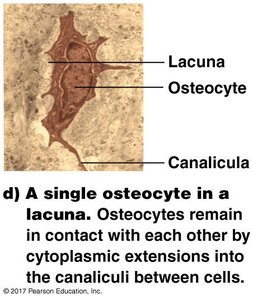
Osteocytes: Mature bone cells embedded in the matrix, responsible for maintaining bone tissue.
Lacunae: Small cavities within the bone matrix where osteocytes reside.
Canaliculi: Tiny canals connecting lacunae, allowing communication and nutrient exchange between osteocytes.
Functions of Bone Structures
Each component of bone anatomy plays a distinct role in the overall function of the skeletal system, including support, protection, movement, and hematopoiesis.
Support and Protection: Compact bone provides rigidity and shields internal organs.
Movement: Long bones act as levers for muscle attachment and movement.
Hematopoiesis: Red bone marrow in the epiphysis produces blood cells.
Fat Storage: Yellow bone marrow in the diaphysis stores lipids.
Bone Remodeling: Osteocytes regulate bone formation and resorption through signaling pathways.
Summary Table: Key Structures and Functions of a Long Bone
Structure | Location | Function |
|---|---|---|
Diaphysis | Shaft | Support, strength |
Epiphysis | Ends | Blood cell production, joint articulation |
Compact Bone | Outer layer | Protection, rigidity |
Spongy Bone | Epiphysis interior | Hematopoiesis |
Periosteum | Outer surface | Bone growth, repair |
Osteon | Compact bone | Nutrient delivery |
Osteocyte | Lacunae | Bone maintenance |
Canaliculi | Between lacunae | Cell communication |
Additional info:
Bone tissue is highly vascularized, allowing efficient nutrient and waste exchange.
Osteocytes communicate via gap junctions, ensuring coordinated bone remodeling.
Calcium phosphate deposition hardens the bone matrix, providing strength.
