 Indietro
Bones and Skeletal Tissue: Structure, Classification, and Microscopic Anatomy
Guida di studio - Note intelligenti
 Appunti personalizzati basati sui tuoi materiali, ampliati con definizioni chiave, esempi e contesto.
Bones and Skeletal Tissue
Introduction to Bones and Skeletal Tissue
The skeletal system forms the structural framework of the human body, providing support, protection, movement, blood cell production, and mineral storage. Bones are dynamic organs composed of various tissues, including bone tissue, cartilage, and connective tissue.
Support and Protection: The skeleton supports the body and protects vital organs.
Movement: Bones act as levers for muscles, enabling movement.
Mineral Storage: Bones store calcium and phosphate, essential for physiological processes.
Blood Cell Formation: Hematopoiesis occurs in the bone marrow.

Classification of Bones
Types of Bone Tissue
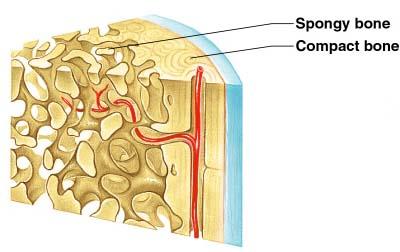
There are two main types of bone tissue: compact bone and spongy bone.
Compact Bone: Dense and forms the outer layer of bones, providing strength and protection.
Spongy Bone: Consists of a network of trabeculae, reducing bone weight and housing bone marrow.
Bone Classification by Shape
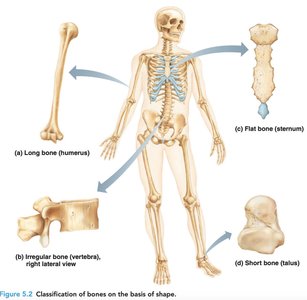
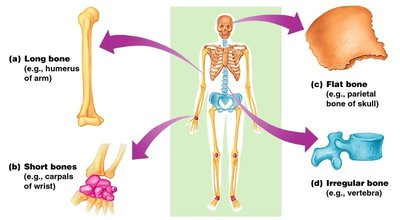
Bones are classified into several categories based on their shapes and functions:
Long Bones: Longer than they are wide; crucial for leverage and movement (e.g., femur, humerus).
Short Bones: Cube-shaped; provide stability and support with limited motion (e.g., carpals, tarsals).
Flat Bones: Thin, flattened, and often curved; protect organs and provide muscle attachment (e.g., skull, ribs, sternum).
Irregular Bones: Complex shapes; protect and support while allowing for complex articulations (e.g., vertebrae, hip bones).
Sesamoid Bones: Embedded in tendons; protect tendons and improve joint function (e.g., patella).


Gross Anatomy of a Long Bone
Major Structures
Long bones have a characteristic structure that supports their function in movement and weight-bearing.
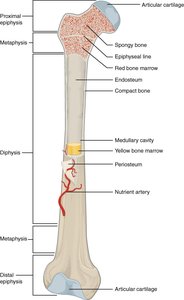
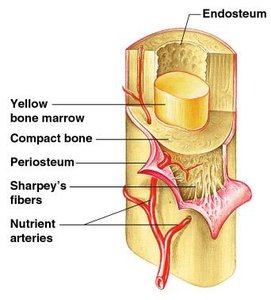
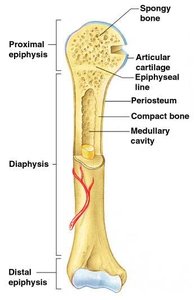
Diaphysis: The shaft, composed of compact bone, providing length and strength.
Epiphyses: The ends, composed of spongy bone covered by compact bone; articulate with other bones.
Metaphysis: The region between diaphysis and epiphysis, containing the epiphyseal (growth) plate in growing bones.
Periosteum: Outer fibrous membrane covering the diaphysis; contains blood vessels and nerves.
Endosteum: Thin membrane lining the medullary cavity.
Medullary Cavity: Central cavity containing yellow marrow (fat storage) in adults and red marrow (hematopoiesis) in infants.
Articular Cartilage: Hyaline cartilage covering epiphyses, reducing friction at joints.


Microscopic Anatomy of Bone
Compact Bone Structure
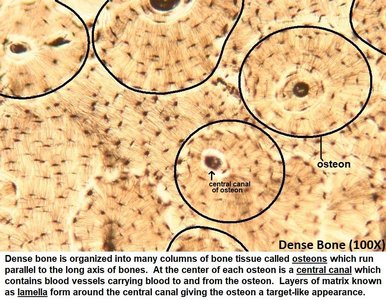
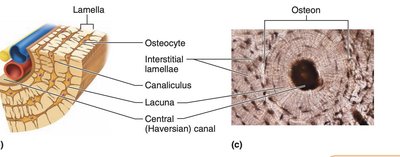
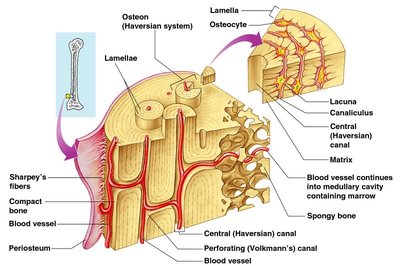
Compact bone is organized into structural units called osteons (Haversian systems), which provide strength and facilitate nutrient delivery.
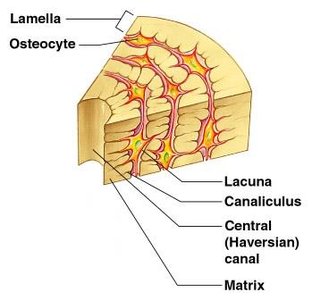
Osteon: Cylindrical unit with concentric lamellae (layers) surrounding a central (Haversian) canal.
Central Canal: Contains blood vessels and nerves.
Lacunae: Small spaces housing osteocytes (mature bone cells).
Canaliculi: Tiny canals connecting lacunae, allowing for nutrient and waste exchange.
Lamellae: Rings of bone matrix around the central canal.
Perforating (Volkmann's) Canals: Perpendicular channels connecting osteons and facilitating vascular and nerve supply.


Spongy Bone Structure
Spongy bone consists of a network of trabeculae, providing structural support and housing bone marrow.
Trabeculae: Lattice-like structures that align along lines of stress.
Bone Marrow: Fills spaces between trabeculae; red marrow is involved in hematopoiesis, while yellow marrow stores fat.


Bone Marrow: Red vs. Yellow
Functions and Locations
Red Bone Marrow: Found in spongy bone and flat bones; responsible for blood cell production (hematopoiesis).
Yellow Bone Marrow: Found in the medullary cavity of long bones; primarily stores fat and can convert to red marrow if needed.

Summary Table: Bone Types and Features
Bone Type | Shape | Example | Main Function |
|---|---|---|---|
Long | Longer than wide | Femur, humerus | Leverage, movement |
Short | Cuboidal | Carpals, tarsals | Stability, support |
Flat | Thin, flat, curved | Skull, ribs, sternum | Protection, muscle attachment |
Irregular | Complex | Vertebrae, hip bones | Protection, support |
Sesamoid | Embedded in tendons | Patella | Protect tendons, improve joint function |
Key Terms and Definitions
Osteon: The fundamental unit of compact bone.
Lamellae: Concentric rings of bone matrix.
Lacunae: Small spaces containing osteocytes.
Canaliculi: Channels for communication and nutrient exchange between osteocytes.
Trabeculae: Lattice-like structures in spongy bone.
Periosteum: Outer fibrous covering of bone.
Endosteum: Membrane lining the medullary cavity.
Summary
The human skeleton is composed of various bone types, each with specialized structures and functions. Understanding the gross and microscopic anatomy of bone is essential for comprehending how bones support, protect, and facilitate movement, as well as how they contribute to overall health through mineral storage and blood cell production.
