 Indietro
Cardiovascular Physiology: Blood Flow, Pressure, and Capillary Exchange
Guida di studio - Note intelligenti
 Appunti personalizzati basati sui tuoi materiali, ampliati con definizioni chiave, esempi e contesto.
Cardiovascular System Overview
Functions and Structure
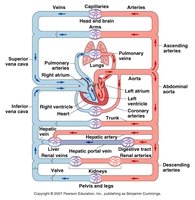
The cardiovascular system is responsible for transporting essential substances throughout the body, including oxygen, nutrients, hormones, and waste products. It consists of a series of tubes (blood vessels) connected to a pump (the heart), which generates pressure to drive blood flow.
Arteries: Carry blood away from the heart.
Veins: Return blood to the heart.
Heart: Divided into left and right sides, each with an atrium and ventricle.
Transport in the Cardiovascular System
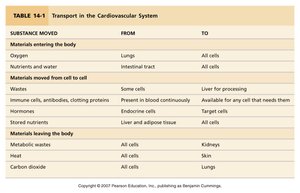
Blood transports materials entering the body, between cells, and leaving the body. The following table summarizes these transport functions:
Substance Moved | From | To |
|---|---|---|
Oxygen | Lungs | All cells |
Nutrients and water | Intestinal tract | All cells |
Wastes | Some cells | Liver for processing |
Immune cells, antibodies, clotting proteins | Present in blood continuously | Available for any cell that needs them |
Hormones | Endocrine cells | Target cells |
Stored nutrients | Liver and adipose tissue | All cells |
Metabolic wastes | All cells | Kidneys |
Heat | All cells | Skin |
Carbon dioxide | All cells | Lungs |
Blood Flow and Pressure
Pressure Gradients and Flow
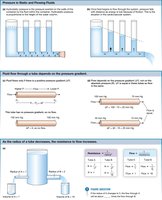
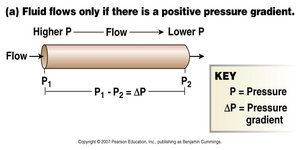
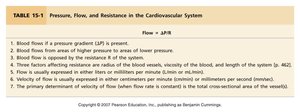
Blood flows from regions of higher pressure to regions of lower pressure, driven by pressure gradients created by the heart. The flow of blood is directly proportional to the pressure gradient (ΔP) and inversely proportional to resistance (R).
Dynamic pressure: Kinetic energy of flowing blood.
Hydrostatic pressure: Pressure exerted on vessel walls by blood at rest.
Principles of Fluid Flow
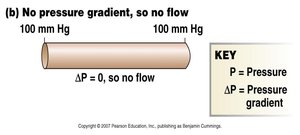
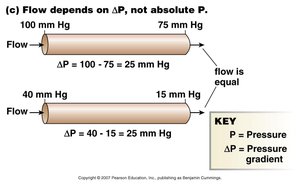
Fluid flows only if there is a positive pressure gradient. Absolute pressure is less important than the difference in pressure between two points.
Equation:
Flow:
Resistance to Flow
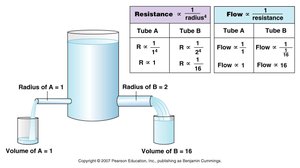
Resistance is determined by vessel radius, length, and blood viscosity. The radius of the vessel is the most significant factor; resistance decreases as radius increases.
Equation:
Resistance:
Velocity of Blood Flow
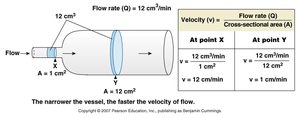
The velocity of blood flow depends on the total cross-sectional area of the vessels. Narrower vessels have faster flow, while capillaries, with their large cross-sectional area, have slower flow.
Equation: , where is velocity, is flow rate, and is cross-sectional area.
Blood Vessel Structure and Function
Types of Blood Vessels
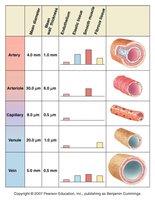
Blood vessels are specialized for different functions:
Arteries: Pressure reservoirs; thick, elastic walls.
Arterioles: Variable resistance; regulate blood flow to tissues.
Capillaries: Exchange materials between blood and tissues; thin walls.
Venules: Collect blood from capillaries; begin venous return.
Veins: Volume reservoirs; contain valves to prevent backflow.
Metarterioles and Precapillary Sphincters
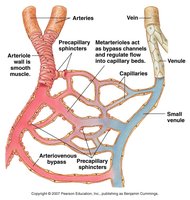
Metarterioles act as bypass channels, and precapillary sphincters regulate blood flow into capillary beds. When sphincters are relaxed, blood flows through all capillaries; when constricted, blood bypasses capillaries via metarterioles.
Capillary Exchange
Types of Capillaries
Capillaries are classified based on their permeability:
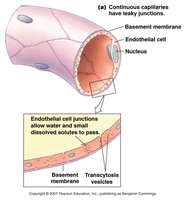
Continuous capillaries: Have leaky junctions; allow passage of water and small solutes.
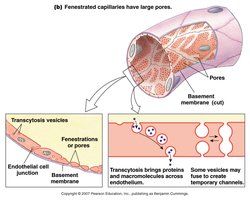
Fenestrated capillaries: Have large pores; allow passage of proteins and macromolecules.
Mechanisms of Exchange
Exchange occurs via diffusion, transcytosis, and bulk flow:
Diffusion: Small solutes and gases move down concentration gradients.
Transcytosis: Large solutes and proteins are transported across endothelial cells.
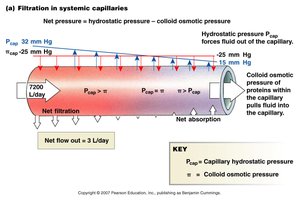
Bulk flow: Mass movement of fluid driven by hydrostatic and osmotic pressure gradients.
Bulk Flow: Filtration and Absorption
Bulk flow is regulated by hydrostatic pressure (forces fluid out) and colloid osmotic pressure (pulls fluid in). Net filtration occurs at the arterial end, and net absorption at the venous end of capillaries.
Blood Pressure Regulation
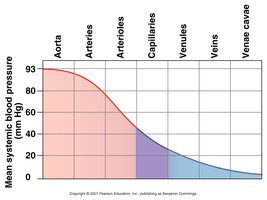
Pressure Changes Across the Systemic Circulation
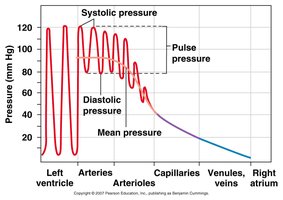
Blood pressure is highest in the arteries and decreases as blood flows through the circulatory system, reaching its lowest point in the veins.
Pulse Pressure and Mean Arterial Pressure
Pulse Pressure: Difference between systolic and diastolic pressure.
Mean Arterial Pressure (MAP): Average pressure driving blood into tissues.
Factors Influencing Mean Arterial Pressure
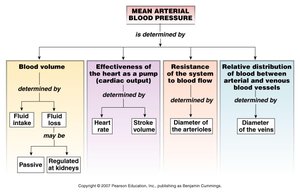
MAP is determined by cardiac output, resistance in arterioles, blood volume, and distribution of blood between arterial and venous vessels.
Regulation Mechanisms
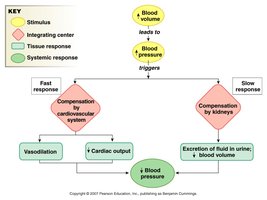
Blood pressure is regulated by fast responses from the cardiovascular system (vasodilation, increased cardiac output) and slow responses from the kidneys (excretion of fluid).
Arteriolar Resistance
Control of Arteriolar Diameter
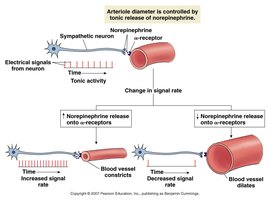
Arteriolar resistance is controlled by sympathetic reflexes, local factors, and hormones. Norepinephrine release from sympathetic neurons causes vasoconstriction; decreased release causes vasodilation.
Summary Table: Pressure, Flow, and Resistance
The following table summarizes key principles:
Principle | Explanation |
|---|---|
Flow | Occurs if a pressure gradient is present |
Direction | From higher to lower pressure |
Resistance | Determined by vessel radius, length, and blood viscosity |
Velocity | Depends on total cross-sectional area |
Conclusion
The cardiovascular system is a complex network responsible for the transport of vital substances, regulation of blood flow and pressure, and exchange of materials at the capillary level. Understanding the principles of pressure gradients, resistance, and vessel structure is essential for comprehending cardiovascular physiology.
