 Indietro
Cellular Immune Response and Immune System Disorders
Guida di studio - Note intelligenti
 Appunti personalizzati basati sui tuoi materiali, ampliati con definizioni chiave, esempi e contesto.
Cellular Immune Response
T Cells and Their Role in Immunity
The cellular immune response is a critical component of the adaptive immune system, primarily mediated by T cells. T cells defend the body against intracellular antigens, such as cells infected with viruses or bacteria, cancerous or abnormal cells, and foreign (transplanted) cells. Some T cells directly kill infected or abnormal cells, while others release chemicals to regulate the immune response.
Intracellular Antigens: Includes viruses, bacteria, and abnormal cells.
T Cell Functions: Direct killing and regulation of immune responses.
Example: T cells target virus-infected cells and cancer cells.
Major Types of T Cells
T cells are classified based on their functions and surface markers. The main types include:
Helper T (TH) cells: Activate both humoral and cellular responses.
Cytotoxic T (TC) cells: Directly kill infected or abnormal cells.
Regulatory T (Treg) cells: Suppress immune responses to prevent overactivity.
Memory T cells: Provide long-term immunity by mediating secondary responses.
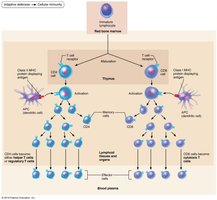
Activation and Differentiation of T Cells
T cell activation is a two-step process that ensures specificity and prevents unwanted immune responses. The steps are:
Antigen Binding: T cell receptors bind to an antigen-protein complex presented by antigen-presenting cells (APCs). Double recognition is required: the T cell must recognize both the complex protein and the foreign antigen it displays. This binding triggers intracellular signaling pathways that initiate T cell activation.
Co-stimulation: Complete activation requires binding to co-stimulatory signals. Without co-stimulation, T cells become tolerant (anergy), unable to divide or respond. This safeguard prevents inappropriate activation.
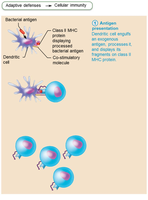
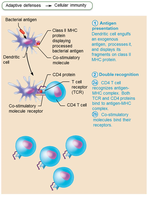
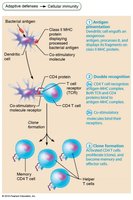
Proliferation and Differentiation: Activated T cells enlarge, proliferate, and differentiate according to their class. The primary response peaks within a week.
Apoptosis: Occurs between days 7 and 30 to prevent excessive inflammation.
Memory T Cells: Remain to mediate secondary responses.
Clonal Selection of T Cells
Clonal selection involves simultaneous recognition of self and nonself antigens. T cells undergo clonal expansion, producing effector and memory cells.
Self-recognition: Ensures tolerance to the body's own cells.
Nonself-recognition: Targets foreign antigens for immune response.
Cytokines in T Cell Activation
Cytokines are signaling molecules that regulate immune responses. Key cytokines include:
Interleukin 1 (IL-1): Released by macrophages, stimulates T cells to release IL-2.
Interleukin 2 (IL-2): Key growth factor, encourages rapid division of activated T cells.
Other Cytokines: Amplify and regulate both innate and adaptive responses.
Roles of Specific Effector T Cells
Helper T cells play a central role in adaptive immunity. Once primed, they:
Activate B cells and other T cells
Induce proliferation of T and B cells
Secrete cytokines to recruit other immune cells
Without helper T cells, the immune response is severely impaired
Immune System Disorders
Immunodeficiencies
Immunodeficiencies are conditions that impair the function or production of immune cells or molecules. They can be congenital or acquired.
Severe Combined Immunodeficiency (SCID): Genetic defect with marked deficits in B and T cells. Treatment involves bone marrow transplants.
Acquired Immune Deficiency Syndrome (AIDS): Caused by HIV, which cripples the immune system by interfering with helper T cells. Characterized by severe weight loss, night sweats, swollen lymph nodes, and opportunistic infections.
Autoimmune Diseases
Autoimmune diseases occur when the immune system loses the ability to distinguish self from foreign antigens.
Rheumatoid arthritis: Destroys joints
Myasthenia gravis: Impairs nerve-muscle connections
Multiple sclerosis: Destroys white matter myelin
Graves’ disease: Causes hyperthyroidism
Type 1 diabetes mellitus: Destroys pancreatic cells
Systemic lupus erythematosus (SLE): Affects multiple organs
Glomerulonephritis: Damages kidney
Hypersensitivities
Hypersensitivities are exaggerated immune responses to antigens (allergens).
Immediate (Type I) Hypersensitivity: Allergies begin seconds after contact with allergen. Initial contact is asymptomatic but sensitizes the person. Later encounters cause histamine release and inflammatory response.
Symptoms: Runny nose, itchy hives, watery eyes
Local Reaction: Involves mast cells of skin or mucosa
Systemic Reaction (Anaphylactic Shock): Bronchioles constrict, vasodilation leads to low blood volume and possible circulatory collapse. Treatment: epinephrine.
Developmental Aspects of the Immune System
Immune System Development and Aging
Immune system stem cells develop in the liver and spleen during weeks 1–9 of embryonic development. Bone marrow becomes the primary source of stem cells later and throughout adult life. Lymphocyte development continues in bone marrow and thymus.
With Age: Immune system wanes, leading to greater susceptibility to immunodeficiency, autoimmune diseases, and cancer.
Possible Causes: Atrophy of thymus and decreased production of naive T and B cells.
