 Indietro
Cellular Immunity and Immune Disorders: Study Notes for Anatomy & Physiology
Guida di studio - Note intelligenti
 Appunti personalizzati basati sui tuoi materiali, ampliati con definizioni chiave, esempi e contesto.
Cellular Immune Response
Overview of T Cell Activation and Differentiation
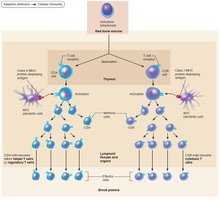
The cellular immune response is a critical component of adaptive immunity, involving T cells that recognize and respond to antigens presented by other cells. T cells differentiate into various effector types, including cytotoxic T cells (TC), helper T cells (TH), and regulatory T cells, each with distinct roles in immune defense.
CD8 cells become cytotoxic T cells (TC) capable of destroying cells harboring foreign antigens and also form memory T cells for long-term immunity.
CD4 cells become helper T cells (TH) that coordinate immune responses.
Naive T cells are termed CD4 or CD8 cells before activation.
MHC Proteins and Antigen Presentation
Role of MHC Proteins in Cellular Immunity
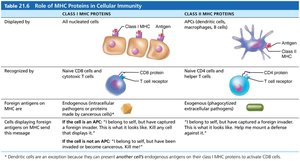
Major histocompatibility complex (MHC) proteins are essential for antigen presentation to T cells. T cells only respond to processed fragments of antigens displayed on cell surfaces by MHC proteins. There are two main classes of MHC proteins:
Class I MHC proteins: Displayed by all nucleated cells except red blood cells (RBCs). Crucial for CD8 cell activation.
Class II MHC proteins: Displayed by antigen-presenting cells (APCs) such as dendritic cells, macrophages, and B cells. Recognized by helper T cells (CD4).
Both types are synthesized in the endoplasmic reticulum (ER) and bind to peptide fragments.
MHC Restriction
MHC restriction refers to the requirement that CD4 and CD8 cells recognize antigens only when presented by specific MHC classes:
CD4 cells (TH): Restricted to binding only class II MHC proteins, typically on APC surfaces.
CD8 cells (TC): Restricted to binding only class I MHC proteins found on all cell surfaces, including APCs.
Clonal Selection of T Cells
Mechanism of Clonal Selection
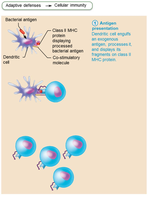
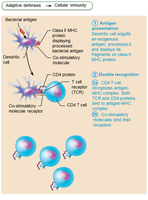
Clonal selection involves the simultaneous recognition of self and nonself antigens by T cells. This process ensures that only T cells specific to foreign antigens are activated and proliferate.
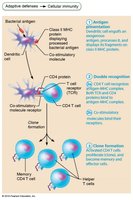
Antigen presentation: Dendritic cells engulf antigens, process them, and display fragments on MHC proteins.
Double recognition: T cell receptors and co-stimulatory molecules bind to the antigen-MHC complex.
Clonal formation: Activated T cells proliferate and differentiate into effector and memory cells.
Roles of Specific Effector T Cells
Helper T (TH) Cells
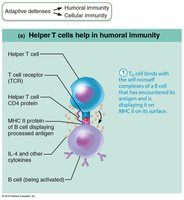
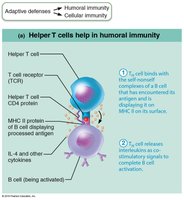
Helper T cells are central to both humoral and cellular immunity. Once primed by APC presentation of antigen, they:
Help activate B cells and other T cells
Induce T and B cell proliferation
Secrete cytokines that recruit other immune cells
Helper T Cells in Cellular Immunity
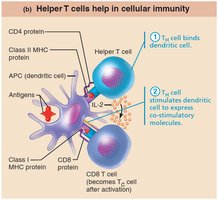
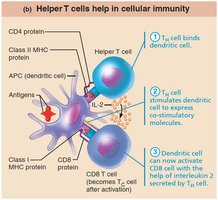
Helper T cells also assist in activating cytotoxic T cells by stimulating dendritic cells to express co-stimulatory molecules and secrete interleukin-2 (IL-2).
TH cell binds dendritic cell
Stimulates dendritic cell to express co-stimulatory molecules
Dendritic cell can then activate CD8 cell with IL-2
Cytotoxic T (TC) Cells
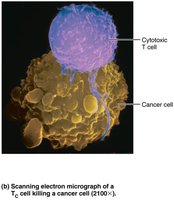
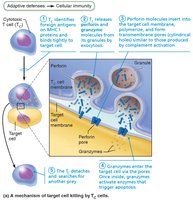
Cytotoxic T cells directly attack and kill other cells, targeting:
Virus-infected cells
Cells with intracellular bacteria or parasites
Cancer cells
Foreign cells (transfusions or transplants)
Organ Transplants and Prevention of Rejection
Allografts and Immunosuppressive Therapy
Organ transplants (allografts) require matching of ABO, other blood antigens, and MHC antigens to minimize rejection. After surgery, patients receive immunosuppressive therapy, which has severe side effects and increases susceptibility to infections.
Best circumstances: rejection after 10 years in 50% of patients
Immunosuppression increases risk of bacterial and viral infections
Immune Problems
Immunodeficiencies
Immunodeficiencies are conditions that impair the function or production of immune cells or molecules.
Severe combined immunodeficiency (SCID): Genetic defect with marked deficit in B and T cells; fatal if untreated. Treatment: bone marrow transplants.
Hodgkin’s disease: Acquired immunodeficiency causing cancer of B cells and depression of lymph node cells.
Acquired immune deficiency syndrome (AIDS): Caused by HIV, which cripples the immune system by interfering with helper T cells. Characterized by severe weight loss, night sweats, swollen lymph nodes, and opportunistic infections.
HIV and AIDS
HIV enters via blood transfusions, contaminated needles, sexual contact, or mother to fetus.
HIV destroys TH cells, depressing cellular immunity.
HIV multiplies in lymph nodes during asymptomatic period (~10 years if untreated).
No cure for AIDS; combination antiviral therapy can help but may fail due to resistance.
Autoimmune Diseases
Loss of Self-Tolerance
Autoimmune diseases occur when the immune system loses the ability to distinguish self from foreign, resulting in the production of autoantibodies and sensitized TC cells that destroy body tissues.
Rheumatoid arthritis: Destroys joints
Myasthenia gravis: Impairs nerve-muscle connections
Multiple sclerosis: Destroys white matter myelin
Type 1 diabetes mellitus: Destroys pancreatic cells
Treatment of Autoimmune Diseases
Suppress entire immune system
Anti-inflammatory drugs (corticosteroids)
Blocking cytokine action
Blocking co-stimulatory molecules
Hypersensitivities
Types and Mechanisms
Hypersensitivities are immune responses to perceived (otherwise harmless) threats that cause tissue damage. Types are distinguished by their time course and whether antibodies or T cells are involved.
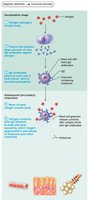
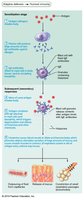
Immediate hypersensitivity: Antibodies cause acute (type I) hypersensitivities (allergies), beginning seconds after contact with allergen.
Subacute hypersensitivity: Antibody-mediated, but slower onset.
Delayed hypersensitivity: T cell-mediated, slower onset.
Mechanism of Acute Allergic (Immediate Hypersensitivity) Response
Allergic reactions can be local or systemic.
Local reaction involves mast cells of skin or respiratory/gastrointestinal mucosa.
Systemic response is anaphylactic shock, usually seen with injected allergens (e.g., bee sting).
Bronchioles constrict, making breathing difficult; vasodilation results in low blood volume and possible circulatory collapse.
Treatment: epinephrine
Summary Table: Role of MHC Proteins in Cellular Immunity
Class I MHC Proteins | Class II MHC Proteins |
|---|---|
Displayed by all nucleated cells | Displayed by APCs (dendritic cells, macrophages, B cells) |
Recognized by CD8 protein and cytotoxic T cells | Recognized by CD4 protein and helper T cells |
Endogenous (intracellular) pathogens or cancer antigens | Exogenous (phagocytosed) pathogens |
"Self" part recognized by T cells | Signals CD4 cells that help is required |
Key Equations and Concepts
Immunological Synapse Formation
The interaction between T cell receptors and MHC-antigen complexes is essential for T cell activation.
Equation for antigen presentation:
Equation for clonal expansion:
Equation for immune deficiency:
Equation for hypersensitivity:
Equation for autoimmune disease:
Additional info: Academic context was added to clarify mechanisms, provide definitions, and summarize key concepts for exam preparation.
