 Indietro
Cellular Structure and Transport Mechanisms: Study Notes for Anatomy & Physiology
Guida di studio - Note intelligenti
 Appunti personalizzati basati sui tuoi materiali, ampliati con definizioni chiave, esempi e contesto.
Cellular Level of Organization
An Introduction to Cells
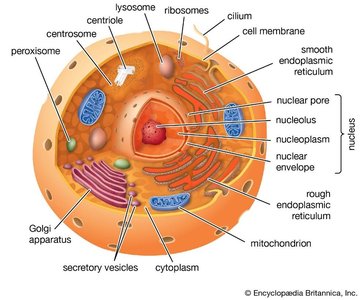
Cytology, a branch of cell biology, is the study of cells, which are the fundamental units of life. Cells are classified as sex cells (germ cells or reproductive cells, such as sperm and oocytes) and somatic cells (all other body cells).
Sex cells: Specialized for reproduction.
Somatic cells: Perform all other functions in the body.
Cytoplasm: The material inside the cell, excluding the nucleus, containing cytosol and organelles.
Plasma Membrane Structure and Function
Plasma Membrane Overview
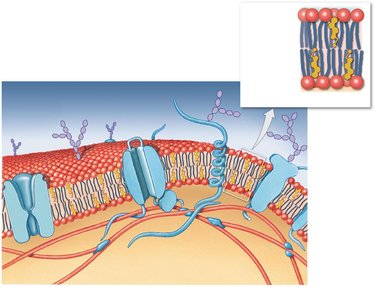
The plasma membrane (cell membrane) separates the cytoplasm from the extracellular fluid and is essential for maintaining cellular integrity and function. It is composed primarily of a phospholipid bilayer with embedded proteins, cholesterol, and carbohydrates.
Phospholipid bilayer: Hydrophilic heads face outward; hydrophobic tails face inward, forming a barrier to ions and water-soluble compounds.
Membrane proteins: Include receptor proteins (bind ligands), carrier proteins (transport solutes), and channels (regulate passage of water and solutes).
Functions: Physical isolation, regulation of exchange, sensitivity to environment, structural support.
Cellular Organelles
Types and Functions of Organelles
Organelles are specialized structures within cells that perform distinct functions. They are classified as nonmembranous (direct contact with cytosol) and membranous (enclosed by membranes).
Nonmembranous organelles: Cytoskeleton, centrioles, ribosomes, proteasomes, microvilli, cilia, flagella.
Membranous organelles: Endoplasmic reticulum (ER), Golgi apparatus, lysosomes, peroxisomes, mitochondria.
Golgi Apparatus
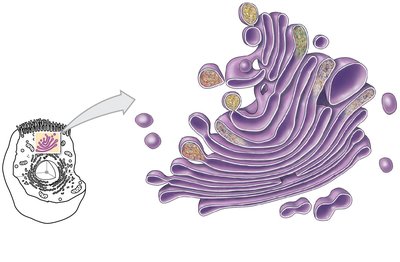
The Golgi apparatus modifies, sorts, and packages proteins and lipids for secretion or delivery to other organelles.
Nucleus
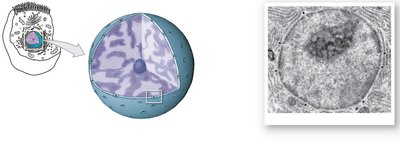
The nucleus is the largest organelle and serves as the cell's control center. It is surrounded by a double membrane called the nuclear envelope, which contains nuclear pores for communication.
Nucleoplasm: The substance within the nucleus.
Chromatin: DNA and associated proteins.
Nucleolus: Site of ribosome synthesis.
Transport Across the Plasma Membrane
Diffusion and Osmosis
The plasma membrane is selectively permeable, allowing some substances to pass while restricting others. Transport mechanisms include passive and active processes.
Diffusion: Movement of particles from high to low concentration.
Osmosis: Diffusion of water across a selectively permeable membrane toward higher solute concentration.
Selective permeability: Based on size, charge, shape, and lipid solubility.
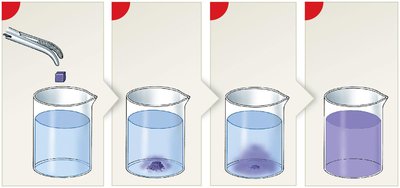
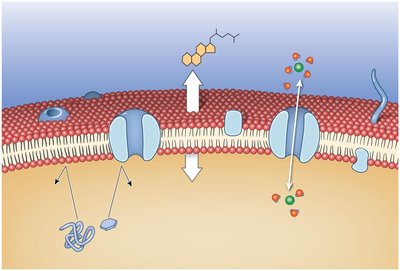
Diffusion Across the Plasma Membrane
Lipid-soluble molecules: Diffuse directly through the membrane.
Small water-soluble molecules and ions: Diffuse through membrane channels.
Large molecules: Require carrier mechanisms.
Osmolarity and Tonicity
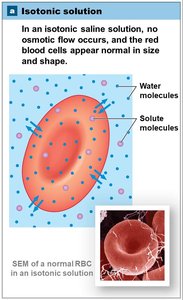
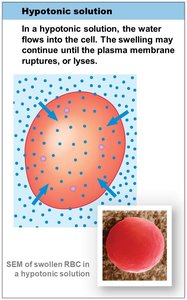
Osmolarity is the total solute concentration in a solution. Tonicity describes how a solution affects cell volume, depending on solute concentration relative to the cell.
Isotonic solution: No net osmotic flow; cell remains unchanged.
Hypotonic solution: Lower solute concentration; cell gains water and may rupture (hemolysis).
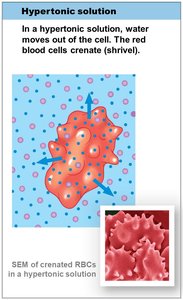
Hypertonic solution: Higher solute concentration; cell loses water and shrinks (crenation).
Solution Type | Effect on Cell |
|---|---|
Isotonic | Cell remains normal |
Hypotonic | Cell swells and may burst |
Hypertonic | Cell shrivels |
Carrier-Mediated and Vesicular Transport
Carrier-Mediated Transport
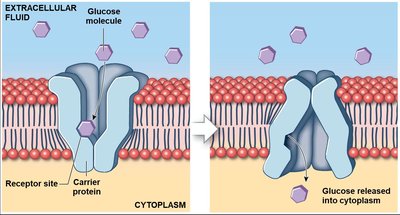
Carrier-mediated transport involves proteins that facilitate the movement of substances across the membrane. It can be passive (facilitated diffusion) or active (requires energy).
Facilitated diffusion: Carrier proteins transport molecules too large for channels (e.g., glucose, amino acids).
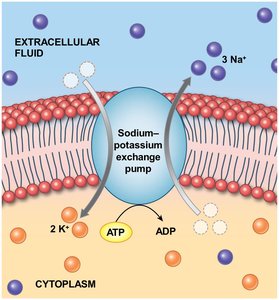
Active transport: Proteins move substrates against concentration gradients, requiring ATP.
Ion pumps: Move ions such as Na+, K+, Ca2+, Mg2+.
Exchange pumps: Move two ions in opposite directions simultaneously.
Primary Active Transport: Sodium–Potassium Pump
The sodium–potassium exchange pump uses ATP to move three sodium ions out of the cell and two potassium ions in, maintaining essential gradients for cell function.
Equation:
Secondary Active Transport
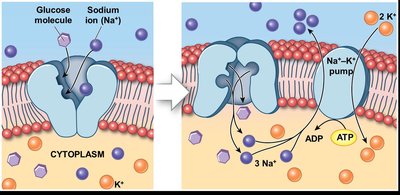
Secondary active transport uses ATP to establish a concentration gradient for one substance, which then drives the passive transport of another. For example, the Na+ gradient drives glucose transport into cells, and ATP is used to pump Na+ back out.
Additional info: These notes cover the cellular level of organization, focusing on cell structure, membrane function, and transport mechanisms, which are foundational for understanding physiology and the function of tissues and organs.
