 Indietro
Central Nervous System Study Guide – Anatomy & Physiology
Guida di studio - Note intelligenti
 Appunti personalizzati basati sui tuoi materiali, ampliati con definizioni chiave, esempi e contesto.
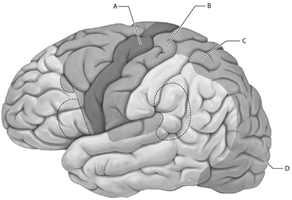
Q10. Select the letter that represents the location of the primary motor cortex.
Background
Topic: Brain Anatomy – Functional Areas
This question tests your knowledge of the anatomical location of the primary motor cortex, which is responsible for voluntary movement control.
Key Terms:
Primary motor cortex: Region of the cerebral cortex involved in planning, control, and execution of voluntary movements.
Precentral gyrus: The specific gyrus where the primary motor cortex is located.
Step-by-Step Guidance
Examine the provided diagram of the brain and identify the labeled regions (A, B, C, D).
Recall that the primary motor cortex is found in the precentral gyrus, which is located just anterior to the central sulcus.
Compare the location of each label to the anatomical landmarks: the frontal lobe, parietal lobe, and central sulcus.
Determine which label corresponds to the precentral gyrus based on its position relative to the frontal lobe and central sulcus.
Try solving on your own before revealing the answer!
Final Answer: A
Label A marks the precentral gyrus, which is the location of the primary motor cortex. This area is responsible for initiating voluntary movements.
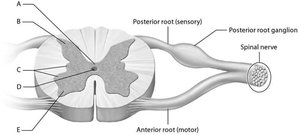
Q: Match the following with the spinal cord cross section.
Background
Topic: Spinal Cord Anatomy
This question tests your ability to identify key anatomical structures in a cross-section of the spinal cord and understand their functions.
Key Terms:
Gray commissure: Thin strip of gray matter surrounding the central canal.
Lateral horn: Contains cell bodies for autonomic motor control.
Posterior horn: Processes somatic and visceral sensory information.
Step-by-Step Guidance
Review the labeled diagram of the spinal cord cross-section (A–E).
Recall the functions and locations of the gray commissure, lateral horn, and posterior horn.
Identify the thin strip of gray matter surrounding the central canal (gray commissure).
Locate the lateral projection of gray matter (lateral horn) and the region towards the back (posterior horn).
Try solving on your own before revealing the answer!
Final Answers:
The structure that contains cell bodies for motor control of the viscera via the autonomic nervous system: C (lateral horn).
The gray commissure: A.
Cell bodies for processing somatic and visceral incoming sensory information: B (posterior horn).
These regions are critical for sensory and motor integration in the spinal cord.
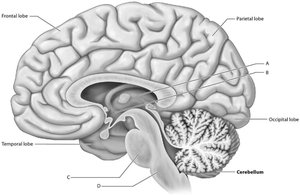
Q: Match the following with the sagittal section of the brain.
Background
Topic: Brain Anatomy – Sagittal Section
This question tests your ability to identify major brain structures and their functions in a sagittal view.
Key Terms:
Hypothalamus: Regulates homeostatic functions.
Pons: Part of the brainstem involved in relaying signals.
Thalamus: Edits, sorts, and routes sensory stimuli.
Step-by-Step Guidance
Examine the sagittal section diagram with labeled parts A–D.
Recall the location and function of the hypothalamus, pons, and thalamus.
Identify the egg-shaped structure in the middle (thalamus), the small area below it (hypothalamus), the stem-like structure (pons), and the cerebellum.
Match each function to the correct labeled structure based on its anatomical position and description.
Try solving on your own before revealing the answer!
Final Answers:
Structure that regulates body temperature, sleep/wake cycle, hunger, and thirst: B (hypothalamus).
Pons: C.
Structure that edits, sorts, and routes stimuli and controls entry into the cerebral cortex: A (thalamus).
These structures are essential for homeostasis, sensory processing, and signal relay in the brain.
