 Indietro
Chapter 1: Introduction to Anatomy and Physiology – Structured Study Notes
Guida di studio - Note intelligenti
 Appunti personalizzati basati sui tuoi materiali, ampliati con definizioni chiave, esempi e contesto.
Introduction to Anatomy and Physiology
Science and Its Role in Understanding the Human Body
Science is a systematic approach to observing and measuring natural phenomena to explain them. Through scientific inquiry, our understanding of the human body has greatly expanded.
Human Anatomy: The study of the structure or form of the human body.
Human Physiology: The study of the functions of the body.
Relationship of Structure and Function: The body’s structure and function are closely related, a principle known as complementarity.
Core Study Strategies for Anatomy & Physiology
Effective Learning Techniques
Mastering Anatomy & Physiology requires strategic study methods to transfer information from short-term to long-term memory.
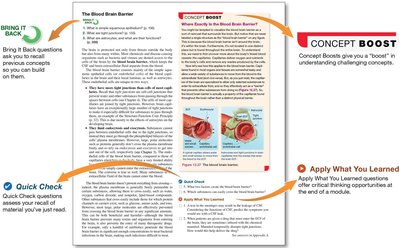
Bring It Back: Use self-quizzing, flashcards, and teaching concepts to others to consolidate material.
Space It Out: Allow time between study sessions to promote memory consolidation.
Mix It Up: Vary study techniques and topics to enhance learning.
Mnemonics: Use mental cues for memorization.
Concrete Examples: Relate material to real-world scenarios.
Elaborative Questioning: Ask detailed questions about the material.
Dual Coding: Combine text and figures for deeper understanding.

How to Use Textbooks and Associated Materials
Textbooks are structured to facilitate learning through modules, learning outcomes, and various study aids.
SQ3R Method: Survey, Question, Read, Recite, Review.
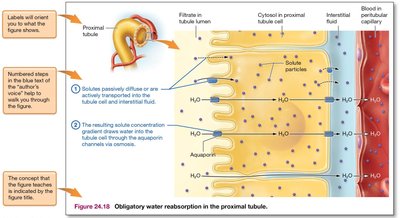
Figure Analysis: Break figures into parts, understand each, then synthesize.
Learning Outcomes: Use as review points and quiz material.
Active-Learning Workbook: Engage with labeling, drawing, and interactive activities.
Online Practice Tools: Utilize flashcards, quizzes, and media resources.
Study Scheduling and Exam Preparation
Consistent study habits and time management are essential for success.
Make a Schedule: Plan study sessions throughout the week.
Growth Mindset: Focus on learning goals and view challenges as opportunities for improvement.
Form Study Groups: Collaborate with peers for mutual benefit.
Self-Care: Manage stress and seek help when needed.

Characteristics of Living Organisms
Properties Shared by All Living Things
Living organisms exhibit several distinct properties that define life.
Cellular Composition: Cells are the smallest units of life.
Metabolism: Chemical processes, including Anabolism (building) and Catabolism (breaking down).
Growth: Increase in size and/or number of cells.
Excretion: Removal of waste products.
Responsiveness: Ability to sense and react to stimuli.
Movement: Movement of organisms or individual cells.
Reproduction: Production of new cells or organisms.
Levels of Structural Organization and Body Systems
Hierarchical Organization of the Human Body
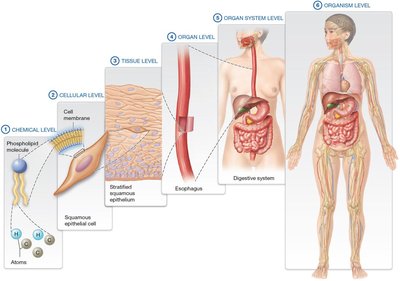
The human body is organized into progressively larger structural levels.
Chemical Level: Atoms and molecules.
Cellular Level: Molecules form cellular structures.
Tissue Level: Groups of cells and extracellular matrix.
Organ Level: Two or more tissue types form organs.
Organ System Level: Organs work together for broad functions; there are 11 organ systems.
Organism Level: All organ systems function together as a living organism.
The 11 Organ Systems of the Human Body
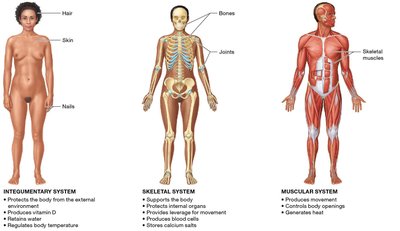
Each organ system has specialized functions essential for life.
Integumentary System: Protection, vitamin D production, water regulation, temperature regulation.
Skeletal System: Support, protection, movement, calcium storage.
Muscular System: Movement, heat generation.
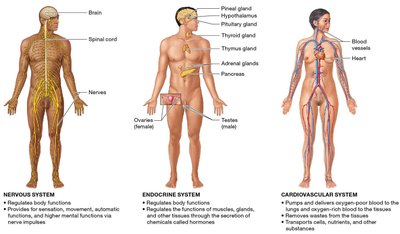
Nervous System: Sensation, movement, automatic functions, higher mental functions.
Endocrine System: Regulation via hormones.
Cardiovascular System: Blood transport, nutrient and waste exchange.
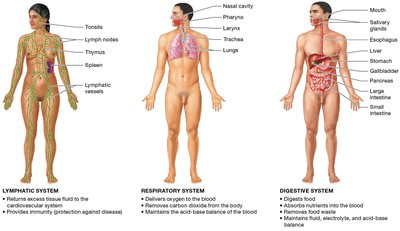
Lymphatic System: Fluid return, immunity.
Respiratory System: Oxygen delivery, carbon dioxide removal, acid-base balance.
Digestive System: Food digestion, nutrient absorption, waste elimination.
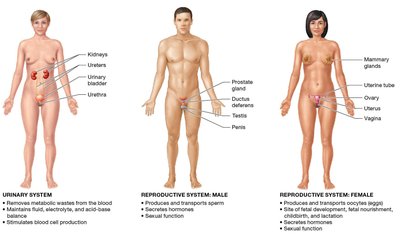
Urinary System: Waste removal, fluid and electrolyte balance, blood cell production.
Reproductive System: Production of gametes, hormone secretion, sexual function.
Types of Anatomy and Physiology
Approaches to Studying Anatomy
Anatomy can be studied from various perspectives:
Systemic Anatomy: Study of individual organ systems.
Regional Anatomy: Study of body regions.
Surface Anatomy: Study of surface markings.
Gross Anatomy: Study of structures visible to the naked eye.
Microscopic Anatomy: Study of cells (Cytology) and tissues (Histology).
Subfields of Physiology
Physiology is classified by organ systems or structural levels:
Neurophysiology: Study of nervous system function.
Cardiophysiology: Study of heart function.
Other levels: chemical, cellular, and tissue physiology.
The Language of Anatomy: Word Parts
Building Scientific Terms
Scientific terminology is constructed from word roots, prefixes, and suffixes.
Word Root: Core component with specific meaning.
Prefix: Added to the beginning, modifies meaning.
Suffix: Added to the end, modifies meaning.
Example: "Anencephalic" combines an- (without), encephala- (brain), -ic (condition of).
Anatomical Position and Directional Terms
Anatomical Position
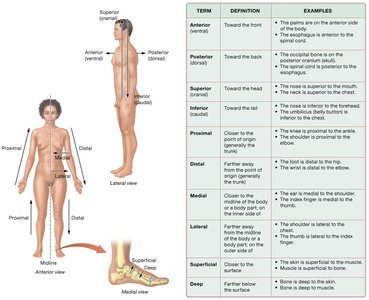
The anatomical position is a standardized frame of reference for describing body parts and regions.
Body standing upright, feet shoulder-width apart, upper limbs at sides, head and palms facing forward.

Directional Terms
Directional terms describe the relative locations of body parts for precise communication.
Anterior/Posterior: Front/back.
Superior/Inferior: Toward head/tail.
Proximal/Distal: Closer/farther from point of origin (limbs).
Medial/Lateral: Closer/farther from midline.
Superficial/Deep: Closer/farther from surface.
Regional Terms
Body Regions and Their Names
The body is divided into axial (head, neck, trunk) and appendicular (limbs) regions, with further subdivisions.
Regions are named as nouns (e.g., brachium) or adjectives (e.g., brachial region).
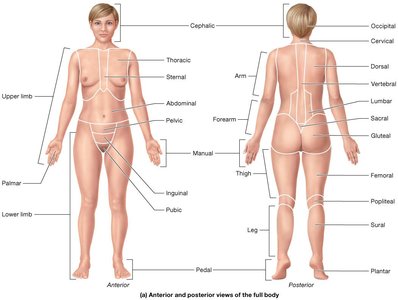
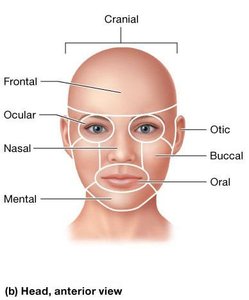
Table: Regional Terms of the Trunk
Region | Pertaining To |
|---|---|
Abdominal | The abdomen |
Cervical | The neck |
Gluteal | The buttocks |
Inguinal | The groin |
Lumbar | The lower back |
Pelvic | The pelvis |
Pubic | The pubis |
Sacral | The sacrum |
Sternal | The sternum |
Thoracic | The chest |
Vertebral | The spinal column |
Table: Regional Terms of the Head and Face
Region | Pertaining To |
|---|---|
Buccal | The cheek |
Cranial | The skull |
Cephalic | The head |
Frontal | The forehead |
Mental | The chin |
Nasal | The nose |
Occipital | The back of the head |
Ocular | The eye |
Oral | The mouth |
Otic | The ear |
Table: Regional Terms of the Upper Limb
Region | Pertaining To |
|---|---|
Acromial | The point of the shoulder |
Antebrachial | The forearm |
Antecubital | The anterior surface of the elbow |
Axillary | The armpit |
Brachial | The arm |
Carpal | The wrist |
Digital | The fingers (or toes) |
Manual | The hand |
Metacarpal | The metacarpals (bones of the hand) |
Palmar | The palm |
Pollex | The thumb |
Table: Regional Terms of the Lower Limb
Region | Pertaining To |
|---|---|
Coxal | The hip |
Crural | The anterior surface of the leg |
Femoral | The thigh |
Hallux | The great toe |
Metatarsal | The metatarsals (bones of the foot) |
Patellar | The anterior surface of the knee |
Pedal | The foot |
Plantar | The sole of the foot |
Popliteal | The posterior surface of the knee |
Sural | The posterior surface of the leg |
Tarsal | The ankle |
Concept Boost: Putting Anatomical Terms Together
Describing Locations and Depths
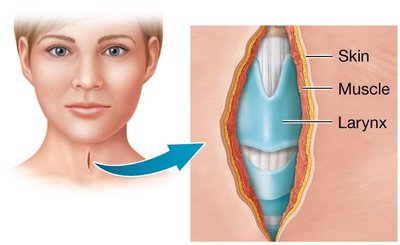
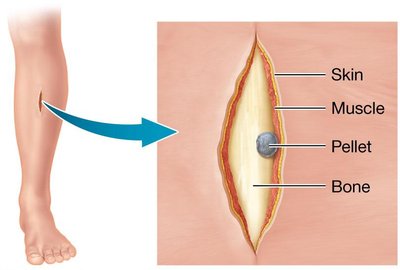
Combining regional, directional, and depth terms allows precise description of locations and procedures.
Example 1: Incision on anterior cervical region, lateral to midline, deep to skin and muscle, superficial to larynx.
Example 2: Wound on left anteromedial crural region, pellet lodged deep to skin and muscle, superficial to bone.
Planes of Section
Dividing the Body for Examination
Planes of section are used to divide the body or body parts for anatomical study.
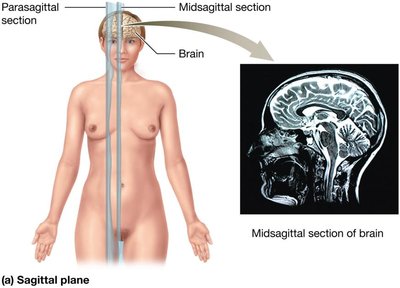
Sagittal Plane: Divides body into right and left sections; midsagittal (equal), parasagittal (unequal).
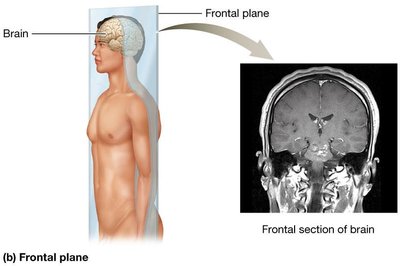
Frontal (Coronal) Plane: Divides body into anterior and posterior sections.
Transverse (Horizontal) Plane: Divides body into superior and inferior sections.
Oblique Plane: Divides body at an angle; less commonly used.
Body Cavities
Posterior Body Cavity
Body cavities protect internal organs and allow movement.
Cranial Cavity: Contains the brain.
Spinal Cavity: Contains the spinal cord.
Both filled with cerebrospinal fluid.
Anterior Body Cavity
The anterior body cavity is divided by the diaphragm into thoracic and abdominopelvic cavities.
Thoracic Cavity: Contains pleural cavities (lungs), mediastinum (heart, vessels, trachea, esophagus), and pericardial cavity (heart).
Abdominopelvic Cavity: Subdivided into abdominal and pelvic cavities; contains digestive, lymphatic, urinary, and reproductive organs.
Peritoneal Cavity: Abdominal subcavity within serous membranes.
Abdominopelvic Quadrants and Regions
Two systems divide the abdominopelvic cavity for diagnostic purposes.
Four Quadrants: RUQ, LUQ, RLQ, LLQ.
Nine Regions: Right/left hypochondriac, lumbar, iliac; epigastric, umbilical, hypogastric.
Serous Membranes
Structure and Function
Serous membranes are thin sheets that fold to form double layers filled with serous fluid, lubricating organs.
Visceral Layer: Contacts the organ.
Parietal Layer: Attaches to surrounding structures.
Types of Serous Membranes
Pleural Membranes: Surround lungs.
Pericardial Membranes: Surround heart.
Peritoneal Membranes: Surround abdominal organs; retroperitoneal organs are behind the parietal peritoneum.
Medical Imaging
Techniques for Internal Visualization
Medical imaging allows visualization of internal structures without surgery.
X-Ray: Uses ionizing radiation for imaging.
CT Scan: Uses ionizing radiation and computer-generated 3D images.
MRI: Uses magnetic fields for detailed 3D images.
Core Principles in Anatomy and Physiology
Homeostasis and Feedback Loops
Homeostasis is the maintenance of a stable internal environment. Feedback loops are mechanisms that regulate variables.
Regulated Variables: Variables maintained near a set point (e.g., temperature, blood sugar).
Controlled Variables: Variables manipulated to maintain regulated variables.
Negative Feedback Loops: Oppose initial change, promote stability.
Positive Feedback Loops: Reinforce initial change, amplify response.
Steps of a Negative Feedback Loop
Stimulus: Variable outside normal range.
Receptor: Detects stimulus.
Control Center: Processes information.
Effector: Responds to restore normal range.
Response: Returns variable to normal.
Common Misconceptions about Homeostasis
Negative feedback is not inherently bad; both feedback types promote homeostasis.
Homeostasis does not mean a static internal environment; changes are normal.
Regulatory mechanisms are not simply "on" or "off"; they are dynamic.
Only variables with detectable receptors can be controlled.
Principle of Complementarity of Structure and Function
Structure Suits Function
The form of a structure is optimized for its function at all levels of organization.
Gradients in Physiology
Role of Gradients
Gradients exist when more of something is present in one area than another, driving physiological processes.
Cell-Cell Communication
Coordination of Body Functions
Cells communicate via electrical signals and chemical messengers to maintain homeostasis.
Summary Table: Core Principles
Principle | Description |
|---|---|
Feedback Loops | Regulate variables to maintain homeostasis |
Structure-Function Relationship | Form follows function at all levels |
Gradients | Drive physiological processes |
Cell-Cell Communication | Coordinates body functions |
Additional info: Academic context was added to clarify the principles, expand on feedback loop steps, and provide examples for each organ system. Tables were recreated for regional terms and core principles. Images were included only when directly relevant to the explanation.
