 Indietro
Chapter 1 Review Guide – Introduction to Anatomy and Physiology: Step-by-Step Study Guidance
Guida di studio - Note intelligenti
 Appunti personalizzati basati sui tuoi materiali, ampliati con definizioni chiave, esempi e contesto.
Q1. What is anatomy and physiology? (Provide definitions.)
Background
Topic: Basic Definitions in Anatomy & Physiology
This question is testing your understanding of the foundational definitions of the two main branches of this field.
Key Terms:
Anatomy: The study of the structure of body parts and their relationships to one another.
Physiology: The study of the function of the body parts and how they work to carry out life-sustaining activities.
Step-by-Step Guidance
Start by considering what "structure" means in the context of the human body. Think about how the body is organized into parts.
Next, reflect on what "function" means—how those parts work and interact to keep the body alive and healthy.
Try to write a one-sentence definition for each term, focusing on the difference between structure (anatomy) and function (physiology).
Try solving on your own before revealing the answer!
Final Answer:
Anatomy is the study of the structure and shape of the body and its parts, as well as their relationships to one another.
Physiology is the study of how the body and its parts function and work together to sustain life.
These definitions highlight the difference between what things are (anatomy) and how they work (physiology).
Q2. What is homeostasis?
Background
Topic: Homeostasis
This question is about the body's ability to maintain a stable internal environment despite changes in the external environment.
Key Terms:
Homeostasis: The maintenance of a relatively constant internal environment in the body.
Step-by-Step Guidance
Think about what it means for the body to be "stable" or "balanced."
Consider examples of things the body keeps constant (like temperature, pH, or blood sugar).
Try to write a definition that includes the idea of maintaining internal conditions within certain limits.
Try solving on your own before revealing the answer!
Final Answer:
Homeostasis is the process by which the body maintains a stable internal environment, keeping conditions such as temperature, pH, and fluid balance within narrow limits despite external changes.
Q3. What are the levels of organization, from simplest to most complex?
Background
Topic: Levels of Structural Organization
This question tests your knowledge of how the human body is organized, from the smallest building blocks to the entire organism.
Key Terms:
Chemical level (atoms, molecules)
Cellular level (cells)
Tissue level (groups of similar cells)
Organ level (structures composed of at least two tissue types)
Organ system level (groups of organs working together)
Organismal level (the whole body)
Step-by-Step Guidance
Start by listing the smallest unit of matter in the body.
Think about how these units combine to form larger structures.
Continue building up, step by step, until you reach the entire organism.
Arrange these levels in order from simplest to most complex.
Try solving on your own before revealing the answer!
Final Answer:
The levels of organization, from simplest to most complex, are: chemical, cellular, tissue, organ, organ system, and organismal.
Q4. What is differentiation?
Background
Topic: Cellular Differentiation
This question is about how cells become specialized for specific functions in the body.
Key Terms:
Differentiation: The process by which unspecialized cells become specialized in structure and function.
Step-by-Step Guidance
Think about what happens to a stem cell as it develops.
Consider how different cell types (like muscle or nerve cells) arise from the same original cell.
Try to define differentiation in terms of changes in structure and function.
Try solving on your own before revealing the answer!
Final Answer:
Differentiation is the process by which unspecialized cells become specialized to perform specific functions in the body.
Q5. What is the relationship between metabolism and energy?
Background
Topic: Metabolism and Energy
This question explores how the body's chemical reactions are related to energy use and production.
Key Terms:
Metabolism: All the chemical reactions that occur in the body.
Catabolism: Breaking down molecules to release energy.
Anabolism: Building up molecules, which requires energy.
Step-by-Step Guidance
Recall that metabolism includes both breaking down and building up molecules.
Think about how energy is released or used during these processes.
Describe how metabolism is essential for providing the energy needed for life processes.
Try solving on your own before revealing the answer!
Final Answer:
Metabolism is the sum of all chemical reactions in the body, including those that break down molecules to release energy (catabolism) and those that build up molecules using energy (anabolism). Energy is required for all life processes and is produced or consumed during metabolic reactions.
Q6. What are the requirements for human life?
Background
Topic: Basic Requirements for Life
This question asks you to identify the essential factors needed for human survival.
Key Terms:
Water
Nutrients
Oxygen
Stable body temperature
Appropriate atmospheric pressure
Step-by-Step Guidance
List the basic needs of the human body for survival.
Think about why each requirement is important for maintaining life.
Try to explain the role of each requirement in supporting body functions.
Try solving on your own before revealing the answer!
Final Answer:
The requirements for human life include water, nutrients, oxygen, a stable body temperature, and appropriate atmospheric pressure. Each is essential for maintaining the body's internal environment and supporting metabolic processes.
Q7. What happened to Kati (the runner) and how was her condition diagnosed? What are vital signs?
Background
Topic: Case Study and Vital Signs
This question uses a real-life example to explore how medical professionals assess health and diagnose conditions.
Key Terms:
Vital signs: Measurements that indicate the state of a person's essential body functions (e.g., heart rate, blood pressure, respiratory rate, temperature).
Step-by-Step Guidance
Recall the story of Kati, the runner, and what happened to her during or after her run.
Think about the symptoms she exhibited and how medical staff assessed her condition.
List the vital signs that are commonly measured in a clinical setting.
Consider how these vital signs help diagnose medical conditions.
Try solving on your own before revealing the answer!
Final Answer:
Kati, the runner, suffered from hyponatremia (low blood sodium) after drinking excessive water during a marathon. Her condition was diagnosed by assessing her symptoms and measuring her vital signs, such as heart rate, blood pressure, and blood sodium levels. Vital signs are key indicators of essential body functions and help diagnose health conditions.
Q8. What is a negative feedback loop? Give an example. What is a set point? What are effectors? Explain the glucagon-insulin feedback loop.
Background
Topic: Homeostatic Mechanisms
This question explores how the body maintains stability through feedback systems, focusing on negative feedback and the regulation of blood glucose.
Key Terms and Concepts:
Negative feedback loop: A process that reverses a change to keep a variable within a set range.
Set point: The ideal value for a physiological parameter.
Effectors: Organs or cells that act to restore homeostasis.
Glucagon-insulin feedback loop: The system that regulates blood glucose levels.
Step-by-Step Guidance
Define what a negative feedback loop is and how it works to maintain homeostasis.
Provide a general example (such as body temperature regulation).
Explain what a set point is in the context of homeostasis.
Describe the role of effectors in feedback loops.
Outline the steps of the glucagon-insulin feedback loop, focusing on how insulin and glucagon regulate blood sugar.
Try solving on your own before revealing the answer!
Final Answer:
A negative feedback loop is a mechanism that reverses a deviation from the set point to maintain homeostasis. For example, when blood glucose rises, insulin is released to lower it; when it falls, glucagon is released to raise it. The set point is the target value (e.g., normal blood glucose level). Effectors are organs or cells that act to correct deviations (e.g., liver, muscle cells). The glucagon-insulin feedback loop keeps blood glucose within a narrow range.
Q9. What is a positive feedback loop? Give an example.
Background
Topic: Positive Feedback Mechanisms
This question asks you to describe a feedback system that amplifies changes rather than reversing them.
Key Terms:
Positive feedback loop: A process that increases the change from the set point.
Step-by-Step Guidance
Define what a positive feedback loop is and how it differs from negative feedback.
Think of a physiological example where a process is amplified (such as childbirth or blood clotting).
Describe the steps of the example you choose, showing how the response increases the original stimulus.
Try solving on your own before revealing the answer!
Final Answer:
A positive feedback loop amplifies a change away from the set point. An example is the release of oxytocin during childbirth, which intensifies contractions until delivery. Unlike negative feedback, positive feedback drives processes to completion.
Q10. Describe the body cavities, what organs are found in each, and be able to identify them on a diagram.
Background
Topic: Body Cavities and Organs
This question tests your knowledge of the major body cavities, their locations, and the organs they contain. You may also be asked to identify these on a diagram.
Key Terms:
Cranial cavity: Contains the brain.
Vertebral (spinal) cavity: Contains the spinal cord.
Thoracic cavity: Contains the heart and lungs.
Abdominal cavity: Contains digestive organs.
Pelvic cavity: Contains reproductive organs, bladder, and rectum.
Step-by-Step Guidance
List the major body cavities from superior (top) to inferior (bottom).
Identify the main organs found in each cavity.
Review diagrams of the human body and practice labeling each cavity and its contents.
Use the provided diagram to match numbers to the correct cavities and organs.
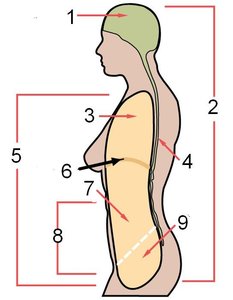
Try solving on your own before revealing the answer!
Final Answer:
The major body cavities are:
Cranial cavity (1) – contains the brain
Vertebral cavity (2) – contains the spinal cord
Thoracic cavity (3) – contains the heart and lungs
Abdominal cavity (8) – contains digestive organs
Pelvic cavity (9) – contains reproductive organs, bladder, and rectum
Refer to the diagram for visual identification of each cavity.
Q11. Identify body regions by description and by image (examples: cervical, orbital, pedal, etc.)
Background
Topic: Body Regions
This question tests your ability to recognize and name specific regions of the body, both by description and on diagrams.
Key Terms:
Cervical: Neck region
Orbital: Eye region
Pedal: Foot region
Other regions: thoracic (chest), abdominal, pelvic, etc.
Step-by-Step Guidance
Review the names and locations of major body regions.
Practice matching descriptions (e.g., "neck region") to the correct anatomical term (e.g., "cervical").
Use diagrams to visually identify and label these regions.
Try solving on your own before revealing the answer!
Final Answer:
Body regions include: cervical (neck), orbital (eye), pedal (foot), thoracic (chest), abdominal, pelvic, and others. These terms help describe locations on the body for medical and anatomical reference.
Q12. Know anatomical terminology (prone, supine, medial, lateral, proximal, distal, dorsal, ventral, anterior, posterior, superficial, deep).
Background
Topic: Anatomical Terminology
This question is about understanding and using the correct terms to describe body positions and directions.
Key Terms:
Prone: Lying face down
Supine: Lying face up
Medial: Toward the midline
Lateral: Away from the midline
Proximal: Closer to the point of attachment
Distal: Farther from the point of attachment
Dorsal: Back side
Ventral: Front side
Anterior: Front
Posterior: Back
Superficial: Toward the surface
Deep: Away from the surface
Step-by-Step Guidance
Review each term and its definition.
Practice using these terms to describe the position of body parts relative to each other.
Try drawing or labeling diagrams to reinforce your understanding.
Try solving on your own before revealing the answer!
Final Answer:
Anatomical terminology includes terms for body positions (prone, supine), directions (medial, lateral, proximal, distal), and surfaces (dorsal, ventral, anterior, posterior, superficial, deep). Mastery of these terms is essential for clear communication in anatomy and physiology.
Q13. Describe the membranes and their locations (parietal vs visceral).
Background
Topic: Body Membranes
This question is about the membranes that line body cavities and cover organs, and the difference between parietal and visceral layers.
Key Terms:
Parietal membrane: Lines the cavity wall
Visceral membrane: Covers the organ itself
Step-by-Step Guidance
Define what a membrane is in the context of anatomy.
Explain the difference between parietal and visceral membranes.
Give examples of where these membranes are found (e.g., pericardium, pleura, peritoneum).
Try solving on your own before revealing the answer!
Final Answer:
Parietal membranes line the walls of body cavities, while visceral membranes cover the organs within those cavities. For example, the parietal pericardium lines the pericardial cavity, and the visceral pericardium covers the heart.
Q15. Describe the organ systems, their functions, and organs found in each (See concept map).
Background
Topic: Organ Systems
This question asks you to identify the major organ systems, their primary functions, and the main organs in each system.
Key Terms:
Examples: Integumentary, skeletal, muscular, nervous, endocrine, cardiovascular, lymphatic, respiratory, digestive, urinary, reproductive
Step-by-Step Guidance
List each organ system by name.
For each system, identify its main function(s).
List the major organs found in each system.
Use a concept map or chart to organize this information for study.
Try solving on your own before revealing the answer!
Final Answer:
Each organ system has specific functions and organs. For example, the cardiovascular system (heart, blood vessels) transports blood; the respiratory system (lungs, trachea) exchanges gases; the digestive system (stomach, intestines) processes food. Refer to your concept map for a complete list.
Q16. Label body sections on a diagram (sagittal, transverse, coronal).
Background
Topic: Anatomical Planes and Sections
This question is about identifying and labeling the three main anatomical planes used to divide the body.
Key Terms:
Sagittal plane: Divides the body into left and right parts
Transverse plane: Divides the body into upper and lower parts
Coronal (frontal) plane: Divides the body into front and back parts
Step-by-Step Guidance
Review the definitions of each anatomical plane.
Practice drawing or labeling these planes on a diagram of the human body.
Be able to identify each plane by its orientation and the parts of the body it separates.
Try solving on your own before revealing the answer!
Final Answer:
The sagittal plane divides the body into left and right, the transverse plane divides it into upper and lower, and the coronal (frontal) plane divides it into front and back. These planes are used to describe locations and directions in anatomy.
