 Indietro
Chapter 1: The Human Body – An Orientation (Anatomy & Physiology Study Guide)
Guida di studio - Note intelligenti
 Appunti personalizzati basati sui tuoi materiali, ampliati con definizioni chiave, esempi e contesto.
The Human Body: An Orientation
Form Determines Function
The principle of complementarity states that the function of a body part depends on its structure. Anatomy and physiology are inseparable, as the structure of an organ determines its function and vice versa.
Anatomy: Study of the structure of body parts and their relationships.
Physiology: Study of the function of body parts and how they work to sustain life.
Principle of Complementarity: What a structure can do depends on its specific form.
Topics and Subdivisions of Anatomy
Anatomy is divided into several subdivisions based on the scale and focus of study.
Gross (Macroscopic) Anatomy: Study of large, visible structures.
Regional Anatomy: Examines all structures in a specific area.
System Anatomy: Focuses on one organ system (e.g., cardiovascular).
Surface Anatomy: Studies internal structures as they relate to the skin surface.
Microscopic Anatomy: Includes cytology (cells) and histology (tissues).
Developmental Anatomy: Studies anatomical changes throughout life, including embryology.
Topics and Subdivisions of Physiology
Physiology is typically studied by organ system and often focuses on cellular and molecular levels.
Renal Physiology: Kidney function.
Cardiovascular Physiology: Heart and blood vessels.
Requires understanding of physical and chemical principles.
Structural Organization of the Human Body
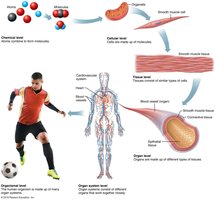
Levels of Structural Organization
The human body is organized hierarchically from the smallest chemical level to the whole organism.
Chemical Level: Atoms combine to form molecules.
Cellular Level: Organelles and cells.
Tissue Level: Groups of similar cells.
Organ Level: Two or more types of tissues.
Organ System Level: Organs working together.
Organismal Level: All organ systems combined.
Requirements for Life
Necessary Life Functions
To maintain life, the human body must perform several essential functions.
Maintaining Boundaries: Separation between internal and external environments (e.g., skin, plasma membranes).
Movement: Muscular system enables movement; skeletal system provides framework.
Responsiveness: Ability to sense and respond to stimuli (e.g., withdrawal reflex).
Digestion: Breakdown and absorption of food.
Metabolism: All chemical reactions in the body; includes catabolism and anabolism.
Excretion: Removal of wastes.
Reproduction: Cellular division and production of offspring.
Growth: Increase in size.
Survival Needs
Humans require several factors in appropriate amounts to survive.
Nutrients: Carbohydrates, proteins, fats, minerals, and vitamins.
Oxygen: Essential for cellular respiration.
Water: Most abundant chemical in the body; necessary for chemical reactions.
Normal Body Temperature: Required for proper metabolic function (37°C).
Appropriate Atmospheric Pressure: Needed for breathing and gas exchange.
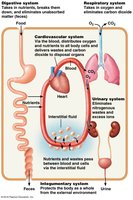
The Eleven Organ Systems
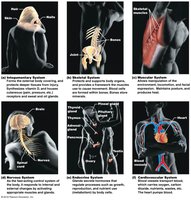
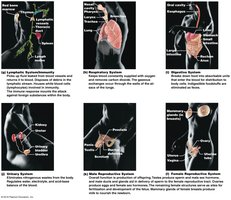
The human body contains eleven organ systems that work together to maintain life.
Integumentary
Skeletal
Muscular
Nervous
Endocrine
Cardiovascular
Lymphatic
Respiratory
Digestive
Urinary
Reproductive
Homeostasis
Definition and Importance
Homeostasis is the maintenance of stable internal conditions despite external changes. It is a dynamic equilibrium, requiring constant adjustment and communication between organ systems, primarily via the nervous and endocrine systems.
Variable: The factor or event being regulated (e.g., blood sugar, temperature).
Homeostatic Control Mechanisms
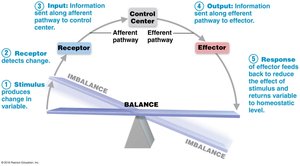
Homeostatic control involves three main components: receptor, control center, and effector.
Receptor: Detects changes (stimuli) and sends information to the control center via the afferent pathway.
Control Center: Determines the set point and response.
Effector: Receives output and responds, either reducing (negative feedback) or enhancing (positive feedback) the stimulus.
Negative Feedback
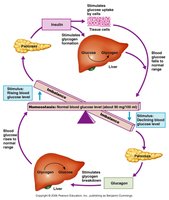
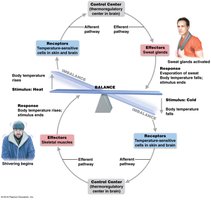
Negative feedback mechanisms reduce or shut off the original stimulus, maintaining homeostasis. Most body processes use negative feedback.
Example: Regulation of blood glucose by insulin.
Example: Regulation of body temperature.
Positive Feedback
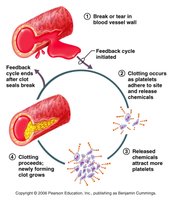
Positive feedback mechanisms enhance or exaggerate the original stimulus, usually controlling infrequent events.
Example: Enhancement of labor contractions by oxytocin.
Example: Platelet plug formation and blood clotting.
Homeostatic Imbalance
Disturbances in homeostasis can lead to disease, often due to aging or overwhelmed control systems.
Example: Heart failure.
Anatomical Terms
Standard Anatomical Position
The standard anatomical position is used as a reference for directional terms: body erect, feet slightly apart, palms forward, thumbs away from body.
Directional Terms
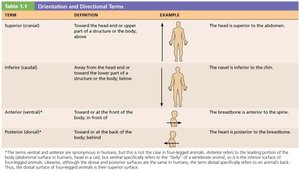
Directional terms describe the location of one body structure relative to another, always based on the standard anatomical position.
Term | Definition | Example |
|---|---|---|
Superior (cranial) | Toward the head or upper part of a structure | The head is superior to the abdomen. |
Inferior (caudal) | Away from the head or toward the lower part | The navel is inferior to the chin. |
Anterior (ventral) | Toward the front of the body | The breastbone is anterior to the spine. |
Posterior (dorsal) | Toward the back of the body | The heart is posterior to the breastbone. |
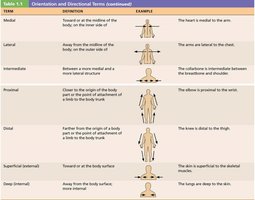
Term | Definition | Example |
|---|---|---|
Medial | Toward the midline of the body | The heart is medial to the arm. |
Lateral | Away from the midline | The arms are lateral to the chest. |
Intermediate | Between a more medial and a more lateral structure | The collarbone is intermediate between the breastbone and shoulder. |
Proximal | Closer to the origin of a body part | The elbow is proximal to the wrist. |
Distal | Farther from the origin | The knee is distal to the thigh. |
Superficial (external) | Toward or at the body surface | The skin is superficial to the skeletal muscles. |
Deep (internal) | Away from the body surface | The lungs are deep to the skin. |
Regional Terms
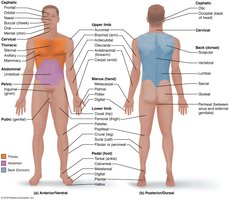
The body is divided into two major regions: axial (head, neck, trunk) and appendicular (limbs). Regional terms designate specific areas within these divisions.
Body Planes and Sections
Body Planes
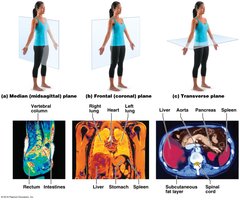
Body planes are imaginary lines used to divide the body for anatomical study.
Sagittal Plane: Divides body into right and left parts.
Midsagittal (Median) Plane: Divides body exactly on the midline.
Parasagittal Plane: Off-center division.
Frontal (Coronal) Plane: Divides body into anterior and posterior parts.
Transverse (Horizontal) Plane: Divides body into superior and inferior parts.
Oblique Section: Cuts at an angle other than 90°.
Body Cavities and Membranes
Major Body Cavities
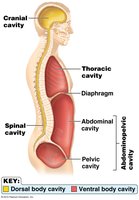
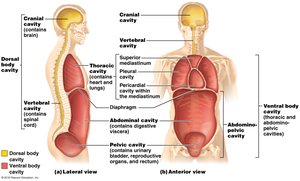
The body contains internal cavities that protect organs and provide space for their function. There are two main sets: dorsal and ventral body cavities.
Dorsal Body Cavity: Protects the nervous system; includes cranial and vertebral (spinal) cavities.
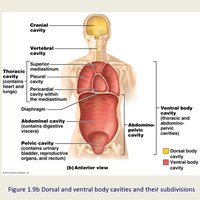
Ventral Body Cavity: Houses internal organs (viscera); includes thoracic and abdominopelvic cavities, separated by the diaphragm.
 P
Ventral Body Cavity Subdivisions
Thoracic Cavity: Contains pleural cavities (lungs), mediastinum (heart, trachea, esophagus), and pericardial cavity (heart).
Abdominopelvic Cavity: Contains abdominal cavity (digestive organs) and pelvic cavity (urinary bladder, reproductive organs, rectum).
Serous Membranes
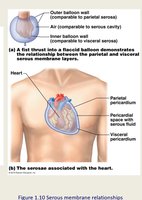
Serous membranes are thin, double-layered membranes covering surfaces in the ventral body cavity. They reduce friction between organs.
Parietal Serosa: Lines cavity walls.
Visceral Serosa: Covers organs.
Serous Fluid: Fills the cavity between layers.
Pericardium: Heart
Pleurae: Lungs
Peritoneum: Abdominopelvic cavity
Homeostatic Imbalances of Serous Membranes
Inflammation of serous membranes can cause pain and dysfunction (e.g., pleurisy, peritonitis).
Abdominopelvic Quadrants and Regions
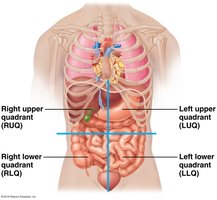
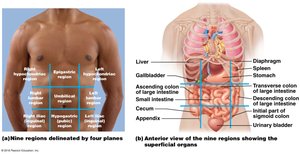
The abdominopelvic cavity is divided into quadrants and regions for medical and anatomical reference.
Quadrants: Right upper (RUQ), left upper (LUQ), right lower (RLQ), left lower (LLQ).
Regions: Right hypochondriac, epigastric, left hypochondriac, right lumbar, umbilical, left lumbar, right iliac, hypogastric, left iliac.
Other Body Cavities
Additional smaller cavities include oral, nasal, orbital, middle ear, and synovial (joint) cavities.
