 Indietro
Chapter 1: The Human Body – An Orientation (Essentials of Human Anatomy & Physiology)
Guida di studio - Note intelligenti
 Appunti personalizzati basati sui tuoi materiali, ampliati con definizioni chiave, esempi e contesto.
The Study of Anatomy and Physiology
Anatomy
Anatomy is the scientific study of the structure and shape of the body and its parts. It involves observation to understand the sizes and relationships of various body components.
Gross anatomy: Examines large structures that are easily observable without magnification.
Microscopic anatomy: Focuses on structures too small to be seen with the naked eye, such as cells and tissues, which require a microscope for examination.
Example: Digestive System (Gross Anatomy)
The digestive system includes organs such as the oral cavity, esophagus, stomach, small intestine, large intestine, and rectum.
These organs work together to break down food, absorb nutrients, and eliminate waste.

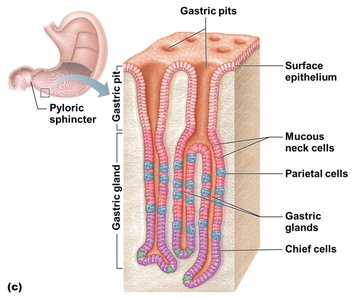
Example: Stomach (Microscopic Anatomy)
The stomach contains specialized cells and tissues, including surface epithelium, mucous neck cells, parietal cells, chief cells, and gastric glands.
These cells contribute to digestion by secreting enzymes and acids.

Physiology
Physiology is the study of how the body and its parts work or function. The structure of body parts determines their function. For example, the thin walls of lung air sacs enable efficient gas exchange.
Structure-function relationship: The anatomy of an organ directly influences its physiological role.
Levels of Structural Organization
The human body is organized into six hierarchical levels, each building upon the previous.
1. Chemical level: Atoms combine to form molecules.
2. Cellular level: Cells are made up of molecules.
3. Tissue level: Tissues consist of similar types of cells.
4. Organ level: Organs are made up of different types of tissues.
5. Organ system level: Organ systems consist of different organs that work together closely.
6. Organismal level: The human organism is made up of many organ systems.

Overview of Organ Systems
Integumentary System
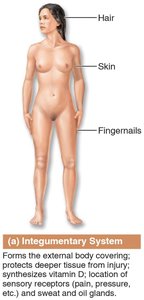
The integumentary system forms the external body covering and includes skin, hair, and fingernails.
Waterproofs the body
Cushions and protects deeper tissues
Produces vitamin D with sunlight
Excretes salts in perspiration
Regulates body temperature
Contains cutaneous nerve receptors
Skeletal System
The skeletal system consists of bones, cartilages, ligaments, and joints.
Provides muscle attachment for movement
Protects vital organs
Site of blood cell formation
Stores minerals

Muscular System
The muscular system is composed of skeletal muscles that contract to produce movement of bones.
Enables movement
Maintains posture
Produces heat

Nervous System
The nervous system is a fast-acting control system consisting of the brain, spinal cord, nerves, and sensory receptors.
Responds to internal and external stimuli
Sensory receptors detect changes
Central nervous system processes information and activates effectors

Endocrine System
The endocrine system secretes hormones into the blood to regulate body functions such as growth, reproduction, and nutrient use.
Includes glands: pituitary, thyroid, parathyroids, adrenal, thymus, pancreas, pineal, ovaries, and testes

Cardiovascular System
The cardiovascular system includes the heart and blood vessels.
Heart pumps blood
Blood vessels transport blood to tissues
Blood carries oxygen, carbon dioxide, nutrients, hormones
Contains white blood cells for protection

Lymphatic System
The lymphatic system includes lymphatic vessels, lymph nodes, and lymphoid organs.
Returns leaked fluids to the bloodstream
Cleanses the blood
Houses white blood cells for immunity

Respiratory System
The respiratory system includes the nasal passages, pharynx, larynx, trachea, bronchi, and lungs.
Exchanges gases with the blood through air sacs in the lungs
Supplies oxygen and removes carbon dioxide

Digestive System
The digestive system includes the oral cavity, esophagus, stomach, small and large intestines, rectum, and accessory organs.
Breaks down food
Absorbs nutrients into blood
Eliminates indigestible material as feces

Urinary System
The urinary system includes the kidneys, ureters, urinary bladder, and urethra.
Eliminates nitrogenous wastes
Maintains acid-base balance
Regulates water and electrolyte balance
Helps regulate blood pressure
Reproductive System
The reproductive system differs between males and females.
Males: Testes, scrotum, penis, accessory glands, duct system (produces and carries sperm)
Females: Ovaries, uterine tubes, uterus, vagina (produces eggs, site for fetal development)
Necessary Life Functions
To maintain life, the human body must perform several essential functions:
Maintaining boundaries: Separates internal from external environments
Movement: Locomotion and movement of substances
Responsiveness: Ability to sense and react to changes
Digestion: Breakdown and absorption of nutrients
Metabolism: Chemical reactions within the body, including catabolism and anabolism; produces energy (ATP); regulated by hormones
Excretion: Removal of waste products
Reproduction: Cellular and organismal reproduction
Growth: Increase in cell or body size
Survival Needs
The body requires certain conditions to survive:
Nutrients: Carbohydrates, proteins, lipids, vitamins, minerals
Oxygen: Essential for cellular respiration
Water: Most abundant chemical in the body; fluid base for secretions and excretions
Normal body temperature: 37°C (98.6°F); necessary for proper metabolic reactions
Atmospheric pressure: Required for gas exchange
The Language of Anatomy
Anatomical Position
The anatomical position is a standard reference used to avoid confusion. The body stands erect, feet parallel, arms at the sides with palms facing forward and thumbs pointing away from the body.
Directional Terms
Directional terms describe the location of one body structure relative to another.
Superior (cranial): Toward the head or upper part
Inferior (caudal): Away from the head or toward the lower part
Anterior (ventral): Toward the front
Posterior (dorsal): Toward the back
Medial: Toward the midline
Lateral: Away from the midline
Intermediate: Between medial and lateral
Proximal: Close to the origin or point of attachment
Distal: Farther from the origin or point of attachment
Superficial (external): Toward the body surface
Deep (internal): Away from the body surface
Body Planes and Sections
Body planes are imaginary lines used to divide the body:
Sagittal plane: Divides body into left and right parts
Median (midsagittal) plane: Divides body into equal left and right parts
Frontal (coronal) plane: Divides body into anterior and posterior parts
Transverse (cross) plane: Divides body into superior and inferior parts
Body Cavities
The body contains internal cavities that protect organs:
Dorsal cavity: Cranial (brain) and spinal (spinal cord)
Ventral cavity: Thoracic (heart, lungs) and abdominopelvic (digestive, reproductive organs)
Abdominopelvic cavity is subdivided into four quadrants and nine regions for clinical reference.
Homeostasis
Homeostasis is the maintenance of stable internal conditions. It is essential for normal body function and survival.
Controlled by: Nervous and endocrine systems
Imbalance: Leads to disease
Homeostatic Control Mechanisms
Receptor: Detects changes (stimuli) and sends information to the control center
Control center: Determines set point, analyzes information, and decides response
Effector: Provides means for response
Feedback Mechanisms
Negative feedback: Most common; shuts off or reduces the original stimulus (e.g., body temperature regulation)
Positive feedback: Rare; increases the original stimulus (e.g., blood clotting, childbirth)
Example: Negative Feedback
When body temperature rises, sweat glands are activated to cool the body.
When body temperature falls, shivering begins to generate heat.
Example: Positive Feedback
Blood clotting: Platelets adhere to a site of injury, release chemicals, and attract more platelets until a plug is formed.
Term | Definition |
|---|---|
Superior | Toward the head or upper part |
Inferior | Away from the head or lower part |
Anterior | Toward the front |
Posterior | Toward the back |
Medial | Toward the midline |
Lateral | Away from the midline |
Proximal | Closer to the origin |
Distal | Farther from the origin |
Superficial | Toward the surface |
Deep | More internal |
Additional info: These notes provide a comprehensive overview of Chapter 1, covering the orientation of the human body, levels of organization, organ systems, necessary life functions, survival needs, anatomical terminology, body planes, cavities, and homeostasis. The included images visually reinforce the structure and function of organ systems and anatomical concepts.
