 Indietro
Chapter 10: The Endocrine System – Anatomy & Physiology Study Guide
Guida di studio - Note intelligenti
 Appunti personalizzati basati sui tuoi materiali, ampliati con definizioni chiave, esempi e contesto.
The Endocrine System
Overview of the Endocrine System
The endocrine system is a major regulatory system in the body, responsible for maintaining homeostasis through the release of hormones. It works in concert with the nervous system, but differs in speed, specificity, and duration of effects.
Homeostasis: Maintained by chemical messengers (hormones).
Endocrine vs. Nervous System: Nervous system is faster and more specific; endocrine system is slower but has longer-lasting effects.
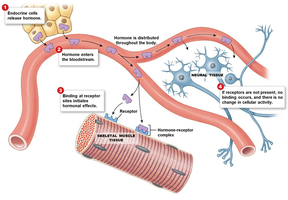
Hormones: Released into the bloodstream, affecting distant target cells.
Intercellular Communication
Communication between cells is essential for coordination of physiological processes. The endocrine system uses hormones to communicate with distant cells.
Target Cells: Must have specific receptors for a hormone to respond.
Multiple Effects: A single hormone can affect multiple tissues or organs.
Comparison: Nervous & Endocrine Systems
Both systems use chemical messengers and negative feedback to regulate body functions.
Shared Messengers: Epinephrine and norepinephrine act as both hormones and neurotransmitters.
Regulation: Both systems use negative feedback mechanisms.
Hormone Classification
Hormones are classified based on their chemical structure, which determines their solubility and mechanism of action.
Amino Acid Derivatives & Peptide Hormones: Structurally similar to amino acids; include epinephrine, norepinephrine, thyroid hormones, melatonin, ADH, oxytocin, and others.
Lipid Derivatives: Steroid and eicosanoid hormones; derived from cholesterol; include hormones from reproductive organs and adrenal glands.
Hormone Action & Receptors
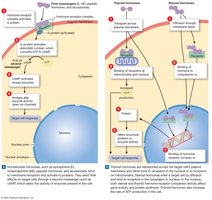
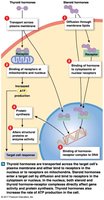
Hormones alter the activity of target cells by binding to specific receptors, which may be located on the plasma membrane or inside the cell.
Plasma Membrane Receptors: Used by hormones that are not lipid soluble (e.g., peptide hormones, catecholamines).
Intracellular Receptors: Used by lipid-soluble hormones (e.g., steroid and thyroid hormones).
Control of Endocrine Activity
Endocrine activity is regulated by negative feedback in response to various stimuli.
Humoral Stimuli: Changes in extracellular fluid composition (e.g., blood calcium levels).
Hormonal Stimuli: Changes in circulating hormone levels (e.g., TSH and T3/T4 interaction).
Neural Stimuli: Neural stimulation of endocrine glands (e.g., hypothalamus and pituitary gland).
Hypothalamus & Pituitary Gland
Hypothalamic Control
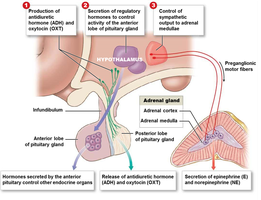
The hypothalamus is the highest level of endocrine control, regulating both nervous and endocrine systems.
Direct Secretion: ADH and oxytocin released into circulation.
Regulatory Hormones: Control anterior pituitary secretions.
ANS Centers: Control adrenal medullae via sympathetic innervation.
Pituitary Gland Structure & Function
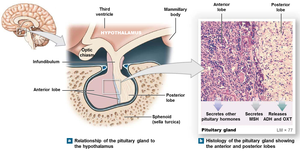
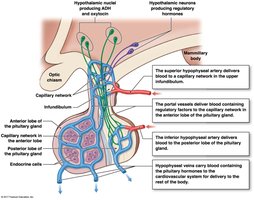
The pituitary gland is protected by the sella turcica and connected to the hypothalamus by the infundibulum. It consists of anterior and posterior lobes, each with distinct functions.
Anterior Lobe: Secretes 7 hormones, mostly tropic (target other endocrine glands).
Posterior Lobe: Releases ADH and oxytocin.
Anterior Pituitary Hormones
The anterior pituitary produces several hormones, many of which regulate other endocrine glands.
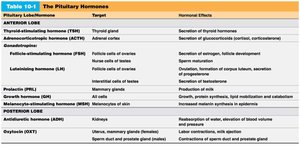
TSH: Stimulates thyroid hormone release.
ACTH: Stimulates glucocorticoid secretion from adrenal cortex.
FSH & LH: Regulate gonadal function.
PRL: Stimulates mammary gland development and milk production.
GH: Stimulates growth and metabolism.
MSH: Stimulates melanocytes.
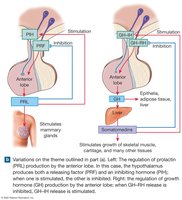
Posterior Pituitary Hormones
The posterior pituitary releases hormones produced by hypothalamic neurons.
ADH: Regulates water balance and blood pressure.
Oxytocin: Stimulates uterine contractions and milk ejection.
Thyroid & Parathyroid Glands
Thyroid Gland Anatomy & Function
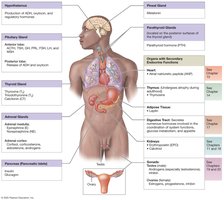
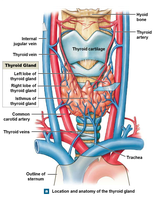
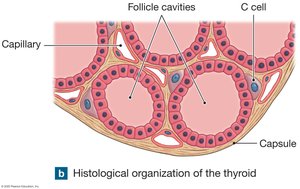
The thyroid gland is located anterior to the trachea and inferior to the larynx. It consists of two lobes connected by an isthmus and contains follicles filled with colloid.
Thyroid Hormones: T3 (triiodothyronine) and T4 (thyroxine) increase metabolic rate and are essential for development.
Calorigenic Effect: Increased ATP production and heat generation.
C Cells & Calcitonin
C cells (parafollicular cells) produce calcitonin, which lowers blood calcium levels by inhibiting osteoclasts and increasing calcium excretion by kidneys.
Parathyroid Glands & Calcium Regulation
Parathyroid glands are located on the posterior surface of the thyroid and produce parathyroid hormone (PTH), which increases blood calcium levels.
PTH: Activates osteoclasts, inhibits osteoblasts, increases calcium reabsorption in kidneys, and stimulates calcitriol production.
Calcium Homeostasis: Maintained by opposing actions of calcitonin and PTH.
Adrenal Glands
Adrenal Gland Structure
The adrenal glands sit atop the kidneys and consist of an outer cortex and inner medulla.
Adrenal Cortex: Produces corticosteroids (mineralocorticoids, glucocorticoids, androgens).
Adrenal Medulla: Produces epinephrine and norepinephrine.
Adrenal Cortex Hormones
Mineralocorticoids (Aldosterone): Regulate electrolyte balance.
Glucocorticoids (Cortisol): Regulate glucose metabolism and act as anti-inflammatory agents.
Androgens: Stimulate development of secondary sex characteristics.
Adrenal Medulla Hormones
Epinephrine & Norepinephrine: Increase cardiac activity, blood pressure, and energy availability.
Pancreas & Blood Glucose Regulation
Pancreatic Islets
The pancreas contains both exocrine and endocrine cells. Endocrine cells are found in the islets of Langerhans.
Alpha Cells: Secrete glucagon (raises blood glucose).
Beta Cells: Secrete insulin (lowers blood glucose).
Blood Glucose Regulation
Insulin: Promotes glucose uptake, protein synthesis, and fat storage.
Glucagon: Promotes glycogen breakdown and release of glucose.
Diabetes Mellitus
Diabetes mellitus is a disorder of glucose metabolism characterized by hyperglycemia.
Type 1: Inadequate insulin production.
Type 2: Insulin resistance.
Other Endocrine Organs
Pineal Gland
Melatonin: Regulates circadian rhythms.
Thymus
Thymosins: Aid in immune system development.
Kidneys
Calcitriol: Increases calcium absorption.
Erythropoietin (EPO): Stimulates RBC production.
Renin: Regulates blood pressure.
Heart
Atrial Natriuretic Peptide (ANP): Lowers blood pressure and volume.
Gonads
Testes: Produce testosterone and inhibin.
Ovaries: Produce estrogens, progesterone, and inhibin.
Hormones & Stress Response
General Adaptation Syndrome (GAS)
The body's response to stress involves three phases: alarm, resistance, and exhaustion.
Alarm Phase: Immediate response; dominated by epinephrine.
Resistance Phase: Long-term metabolic adjustments; dominated by glucocorticoids.
Exhaustion Phase: Failure of homeostasis; can be fatal if not corrected.
Summary Table: Pituitary Hormones
Pituitary Lobe/Hormone | Target | Hormonal Effects |
|---|---|---|
TSH (Anterior) | Thyroid gland | Secretion of thyroid hormones |
ACTH (Anterior) | Adrenal cortex | Secretion of glucocorticoids |
FSH (Anterior) | Ovaries/testes | Follicle development, sperm production |
LH (Anterior) | Ovaries/testes | Ovulation, androgen production |
PRL (Anterior) | Mammary glands | Production of milk |
GH (Anterior) | All cells | Growth, protein synthesis |
MSH (Anterior) | Melanocytes | Melanin production |
ADH (Posterior) | Kidneys | Reabsorption of water |
OXT (Posterior) | Uterus, mammary glands | Labor contractions, milk ejection |
Additional info: This study guide expands on brief points with academic context, definitions, and examples to ensure completeness and clarity for exam preparation.
