 Indietro
Chapter 10: The Muscular System – Structure, Function, and Levers
Guida di studio - Note intelligenti
 Appunti personalizzati basati sui tuoi materiali, ampliati con definizioni chiave, esempi e contesto.
Chapter 10: The Muscular System
Overview
The muscular system is essential for movement, posture, and force generation in the human body. This chapter focuses on skeletal muscle, examining how muscles interact to produce movement, the criteria for naming muscles, and the principles of leverage that govern muscle action.
Muscle Function in Movement
Functional Groups of Muscles
Muscles can only pull, never push, and act in groups to produce coordinated movements. For any movement, muscles are classified into three main functional groups:
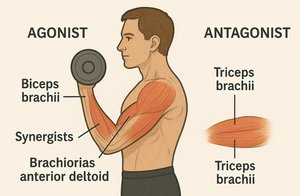
Prime mover (Agonist): The muscle primarily responsible for a specific movement. Example: Pectoralis major is a prime mover of arm flexion.
Antagonist: Opposes or reverses the action of the prime mover. Example: Latissimus dorsi antagonizes the pectoralis major during arm flexion.
Synergist: Assists the prime mover by adding force or reducing unwanted movements. Fixators are a type of synergist that stabilize the origin of the prime mover.
Example: During a biceps curl, the biceps brachii acts as the agonist, the triceps brachii as the antagonist, and muscles like the brachioradialis and anterior deltoid as synergists.
Criteria for Naming Skeletal Muscles
Muscle Naming Conventions
Skeletal muscles are named based on several criteria, often combining multiple features:
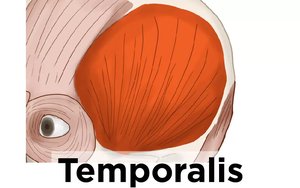
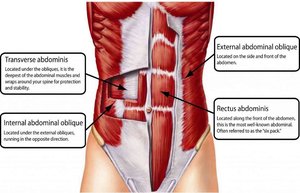
Location: Indicates the bone or region associated with the muscle. Example: Temporalis (over temporal bone).
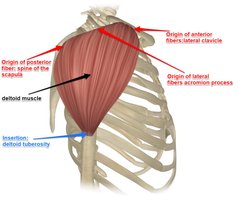
Shape: Describes the muscle's form. Example: Deltoid (triangle-shaped).
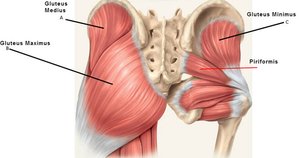
Size: Refers to relative size. Example: Maximus (largest), Minimus (smallest), Longus (long).
Direction of fibers: Orientation of muscle fibers. Example: Rectus (straight), Transversus (right angles), Oblique (angled).
Number of origins: Number of tendinous attachments. Example: Biceps (two origins), Triceps (three origins).
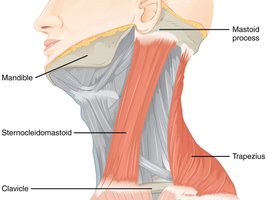
Location of attachments: Points of origin and insertion. Example: Sternocleidomastoid (originates at sternum and clavicle, inserts on mastoid process).
Action: The movement produced. Example: Flexor, Extensor, Abductor, Adductor.
Example: Extensor carpi radialis longus combines action (extends), joint (wrist), bone (radius), and size (long).
Fascicle Arrangement and Muscle Shape
Types of Fascicle Arrangements
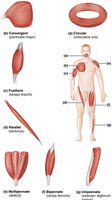
Fascicles are bundles of muscle fibers whose arrangement determines muscle shape and functional capabilities. The main patterns are:
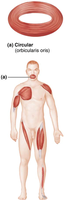
Circular: Fascicles arranged in concentric rings, forming sphincters. Example: Orbicularis oris.
Convergent: Broad origin, fascicles converge toward a single tendon. Example: Pectoralis major.
Parallel: Fascicles run parallel to the long axis of the muscle. Example: Sartorius.
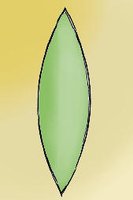
Fusiform: Spindle-shaped muscles with parallel fibers. Example: Biceps brachii.
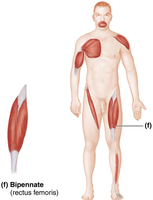
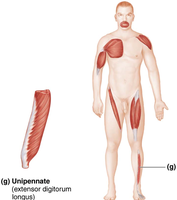
Pennate: Fascicles attach obliquely to a central tendon, resembling a feather. Includes unipennate, bipennate, and multipennate forms.
Fascicle Arrangement: Range of Motion and Power
Functional Implications
The arrangement of fascicles affects both the range of motion and the power of a muscle:
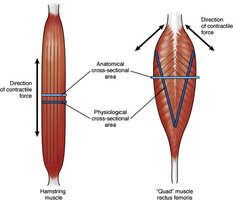
Range of motion: Muscles with long, parallel fibers shorten more and produce greater movement but are less powerful. Example: Sartorius.
Power: Muscles with more fibers (such as bipennate and multipennate) shorten less but generate greater force. Example: Rectus femoris.
Principles of Leverage in Skeletal Muscle Action
Lever Systems
Skeletal muscles move bones using lever systems, which consist of:
Lever: Rigid bar (usually a bone) that moves.
Fulcrum: Fixed point (usually a joint).
Effort: Force applied by muscle contraction.
Load: Weight or resistance moved, including bone, soft tissues, and external weight.
Example: In a biceps curl, the forearm acts as the lever, the elbow as the fulcrum, the biceps as the effort, and the forearm/hand as the load.
Power Levers vs Speed Levers
Mechanical Advantage and Disadvantage
Power levers: Effort is farther from the fulcrum than the load, increasing force but decreasing speed and range of motion. Example: Squat (knee joint as fulcrum).
Speed levers: Effort is closer to the fulcrum than the load, increasing speed and range of motion but requiring greater effort. Most skeletal muscles function this way. Example: Biceps curl.
Classes of Levers in the Human Body
Lever Classification
Levers are classified based on the relative positions of effort (E), fulcrum (F), and load (L):
First Class Lever (L-F-E): Fulcrum is between load and effort. Can function as either a power or speed lever. Example: Raising head from chest.
Second Class Lever (F-L-E): Load is between fulcrum and effort. Operates at a mechanical advantage (power lever). Example: Standing on tiptoes.
Third Class Lever (F-E-L): Effort is between fulcrum and load. Operates at a mechanical disadvantage (speed lever). Most common in the body. Example: Forearm flexion (biceps curl).
Lever Class | Arrangement | Example | Advantage |
|---|---|---|---|
First Class | L-F-E | Raising head from chest | Power or speed |
Second Class | F-L-E | Standing on tiptoes | Power |
Third Class | F-E-L | Biceps curl | Speed |
Summary of Lever Systems
Lever systems in the human body are designed to prioritize speed and range of motion, with most muscles functioning as speed levers. The arrangement of bones, joints, and muscles determines whether a movement is powerful or fast, and understanding these principles is essential for analyzing human movement.
Additional info:
These notes expand on brief points from the original materials, providing definitions, examples, and context for each topic. Images included are directly relevant to the explanations and reinforce key concepts in muscle function, naming, fascicle arrangement, and lever systems.
