 Indietro
Chapter 11: Fundamentals of the Nervous System and Nervous Tissue – Study Guide
Guida di studio - Note intelligenti
 Appunti personalizzati basati sui tuoi materiali, ampliati con definizioni chiave, esempi e contesto.
Functions of the Nervous System
Major Functions
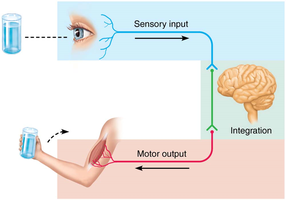
The nervous system is responsible for detecting stimuli, processing information, and initiating responses. It performs three essential functions:
Sensory Input: Gathering information from sensory receptors about internal and external environments.
Integration: Processing and interpreting sensory input to determine the appropriate response.
Motor Output: Activating effector organs (muscles and glands) to produce a response.
Example: When touching a hot stove, sensory receptors detect heat, the CNS interprets the stimulus, and muscles pull the hand away.
Organization of the Nervous System
Major Divisions
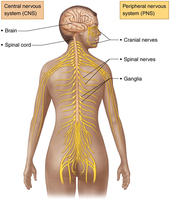
The nervous system is organized into two main divisions:
Central Nervous System (CNS): Consists of the brain and spinal cord. It serves as the integration and control center, interpreting sensory input and dictating motor output.
Peripheral Nervous System (PNS): Includes all nervous tissue outside the CNS, mainly nerves that extend from the brain and spinal cord. Spinal nerves carry impulses to and from the spinal cord, while cranial nerves carry impulses to and from the brain.
Functional Divisions of the PNS
Sensory and Motor Divisions
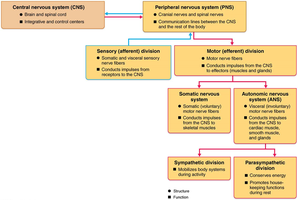
The PNS is further divided based on function:
Sensory (Afferent) Division: Carries information to the CNS. Includes somatic sensory fibers (from skin, muscles, joints) and visceral sensory fibers (from organs).
Motor (Efferent) Division: Carries commands away from the CNS to effector organs. Includes the somatic nervous system (voluntary control of skeletal muscles) and the autonomic nervous system (involuntary control of smooth muscle, cardiac muscle, and glands).
Somatic and Autonomic Nervous Systems
Somatic Nervous System
The somatic motor division conducts impulses from the CNS to skeletal muscle, allowing voluntary control and conscious movements such as walking, writing, and lifting weights.
Autonomic Nervous System
The autonomic nervous system consists of visceral motor nerve fibers and controls involuntary functions. It regulates smooth muscle, cardiac muscle, and glands. It has two opposing divisions:
Sympathetic Division: Mobilizes body systems during activity (fight or flight).
Parasympathetic Division: Conserves energy and promotes housekeeping functions during rest (rest and digest).
Nervous Tissue
Cell Types
Nervous tissue is composed of two major cell types:
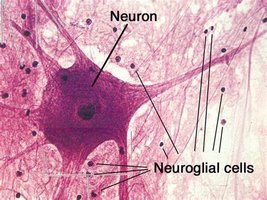
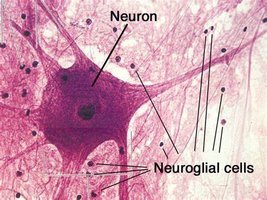
Neurons: Excitable cells that transmit electrical signals. Most are formed before birth and last a lifetime. Mature neurons rarely divide.
Neuroglia (Glial Cells): Small cells that surround and support neurons. They protect, insulate, and nourish neurons, and outnumber neurons in the nervous system.
Neuroglia Overview
Functions and Types
Neuroglia support CNS neurons by:
Supporting and bracing neurons
Protecting neurons
Insulating neurons
Nourishing neurons
Summary Table: Nervous System Organization
Division | Main Components | Function |
|---|---|---|
Central Nervous System (CNS) | Brain, Spinal Cord | Integration and control center |
Peripheral Nervous System (PNS) | Cranial nerves, Spinal nerves, Ganglia | Communication between CNS and body |
Somatic Nervous System | Somatic motor nerve fibers | Voluntary control of skeletal muscles |
Autonomic Nervous System | Visceral motor nerve fibers | Involuntary control of smooth muscle, cardiac muscle, glands |
Sympathetic Division | Part of ANS | Mobilizes body systems during activity |
Parasympathetic Division | Part of ANS | Conserves energy, promotes rest functions |
Key Terms and Definitions
Neuron: The structural and functional unit of the nervous system, specialized for transmitting electrical impulses.
Neuroglia: Supporting cells in the nervous system that provide structural and metabolic support to neurons.
CNS: Central Nervous System, consisting of the brain and spinal cord.
PNS: Peripheral Nervous System, consisting of nerves and ganglia outside the CNS.
Somatic Nervous System: Division of the PNS that controls voluntary movements.
Autonomic Nervous System: Division of the PNS that controls involuntary functions.
Sympathetic Division: Mobilizes the body for action.
Parasympathetic Division: Promotes rest and maintenance.
Additional info: The study notes above cover the introductory structure and function of the nervous system, including its major divisions, cell types, and functional organization. Further details on neuron structure, neuroglia types, and electrical signaling are found in subsequent sections of the chapter.
