Indietro
Chapter 16: The Endocrine System – Anatomy & Physiology Study Guide
Guida di studio - Note intelligenti
 Appunti personalizzati basati sui tuoi materiali, ampliati con definizioni chiave, esempi e contesto.
The Endocrine System
Overview of the Endocrine System
The endocrine system is one of the two major regulatory systems of the body, alongside the nervous system. It consists of organs that synthesize and secrete chemical messengers called hormones into the blood, which interact with specific cells known as target cells. Tissues containing these target cells are referred to as target tissues. Target cells possess receptors for hormones, enabling changes in cellular function.
Hormones: Chemical messengers secreted into the blood.
Target Cells: Cells with specific receptors for hormones.
Target Tissues: Tissues where target cells reside.
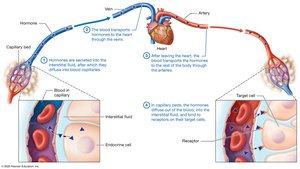
Comparison of the Endocrine and Nervous Systems
The endocrine system regulates body functions by releasing hormones into the bloodstream, which travel to distant target cells. In contrast, the nervous system uses direct synaptic connections for rapid communication.
Endocrine System: Hormones travel through blood; effects are slower but longer-lasting.
Nervous System: Neurotransmitters act locally and rapidly.
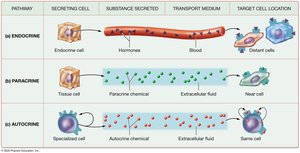
Paracrine and Autocrine Signals
Not all chemical signals act as classic hormones. Some act locally:
Paracrine Signals: Chemicals secreted into extracellular fluid (ECF) to influence nearby cells.
Autocrine Signals: Chemicals secreted by a cell into ECF to affect the same cell.
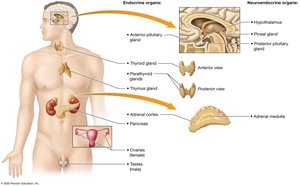
Overview of Endocrine Organs
Endocrine glands are ductless organs that secrete hormones into the interstitial fluid for transport by the bloodstream. Their effects are generally longer-lasting than those of the nervous system.
Primary Endocrine Organs: Anterior pituitary, thyroid, parathyroid, adrenal cortices, pancreas, thymus, ovaries/testes.
Secondary Endocrine Glands: Heart, kidneys, small intestine, adipose tissue.
Neuroendocrine Organs: Hypothalamus, pineal gland, adrenal medulla.
Classes of Hormones
Hormones are classified based on their structure and solubility:
Amino Acid-Based Hormones: Derived from amino acids; mostly hydrophilic.
Peptide/Protein Hormones: Chains of amino acids; generally hydrophilic.
Steroid Hormones: Derived from cholesterol; hydrophobic and lipid-soluble.
Hormone Transport in Blood
Free Hormones: Small, hydrophilic hormones travel freely in plasma.
Bound Hormones: Hydrophobic hormones form complexes with binding proteins, extending their lifespan in blood.
Target Cells and Receptors
Hormones bind to specific receptors on or within target cells. The number and type of receptors can vary, allowing for tight regulation.
Upregulation: Increase in receptor number when hormone levels decline.
Downregulation: Decrease in receptor number after prolonged exposure to high hormone levels.
Mechanisms of Hormone Action
Hormones act via different mechanisms depending on their solubility:
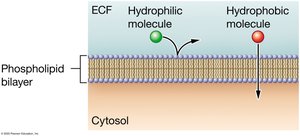
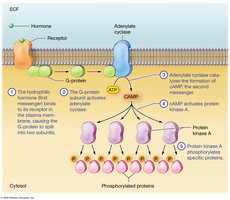
Hydrophilic Hormones: Bind to cell surface receptors and activate second-messenger systems (e.g., cAMP pathway).
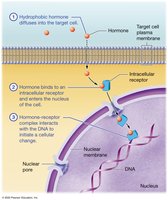
Hydrophobic Hormones: Diffuse into cells, bind to intracellular receptors, and directly influence gene expression.
Regulation of Hormone Secretion
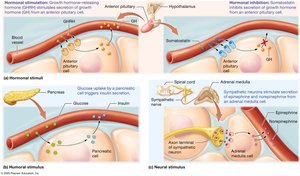
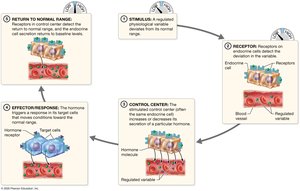
Hormone secretion is regulated by various stimuli and negative feedback loops:
Hormonal Stimuli: Response to other hormones.
Humoral Stimuli: Response to changes in blood composition.
Neural Stimuli: Response to nervous system signals.
Hypothalamus and Pituitary Gland
Structure and Functional Relationships
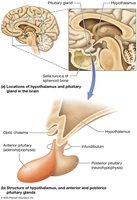
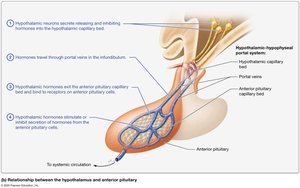
The hypothalamus connects to the pituitary gland via the infundibulum. The anterior pituitary is a true gland, while the posterior pituitary is nervous tissue that stores neurohormones.
Hormones of the Hypothalamus and Posterior Pituitary
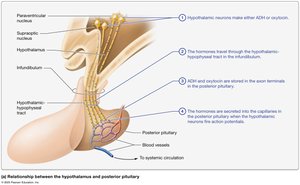
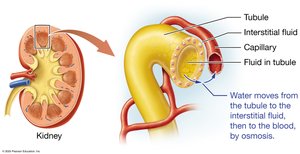
Antidiuretic Hormone (ADH): Promotes water retention by kidneys; released in response to high solute concentration.
Oxytocin: Stimulates uterine contractions and milk ejection; operates via positive feedback.
Functional Relationship of the Hypothalamus and Anterior Pituitary
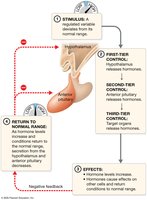
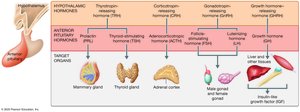
The hypothalamus produces releasing and inhibiting hormones that control the anterior pituitary. Tropic hormones from the anterior pituitary regulate other glands.
Anterior Pituitary Hormones
Thyroid-Stimulating Hormone (TSH): Stimulates thyroid gland.
Adrenocorticotropic Hormone (ACTH): Stimulates adrenal cortex.
Prolactin: Stimulates milk production.
Luteinizing Hormone (LH): Stimulates sex hormone production.
Follicle-Stimulating Hormone (FSH): Stimulates gamete production.
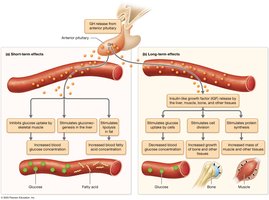
Growth Hormone (GH): Promotes growth and metabolism.
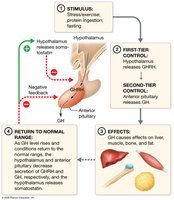
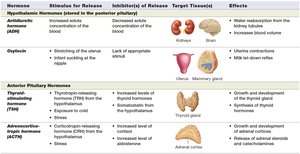
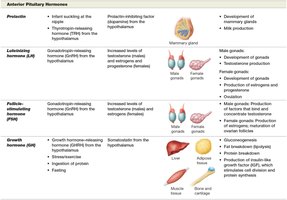
Hormones of the Hypothalamus and Pituitary Gland (Table)
Hormone | Stimulus for Release | Inhibitor(s) of Release | Target Tissue(s) | Effects |
|---|---|---|---|---|
ADH | Increased solute concentration | Decreased solute concentration | Kidneys, brain | Water reabsorption |
Oxytocin | Stretching of uterus, infant suckling | Lack of appropriate stimulus | Uterus, mammary gland | Uterine contractions, milk let-down |
TSH | TRH from hypothalamus | Somatostatin | Thyroid gland | Growth and development, secretion of thyroid hormones |
ACTH | CRH from hypothalamus | Increased level of cortisol | Adrenal cortex | Growth and development, secretion of steroid hormones |
Prolactin | Infant suckling, TRH from hypothalamus | Prolactin-inhibiting factor | Mammary gland | Development, milk production |
LH | GnRH from hypothalamus | Increased levels of sex hormones | Male/female gonads | Development, production of hormones |
FSH | GnRH from hypothalamus | Increased levels of sex hormones | Male/female gonads | Production of gametes |
GH | GHRH from hypothalamus, protein ingestion, fasting | Somatostatin | Liver, adipose, bone, muscle | Growth, protein synthesis |
Thyroid and Parathyroid Glands
Structure of the Thyroid and Parathyroid Glands
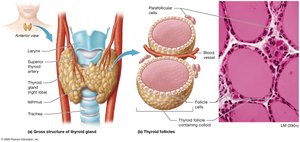
The thyroid gland is located in the anterior neck and consists of two lobes connected by the isthmus. It contains thyroid follicles filled with colloid, and parafollicular cells that produce calcitonin. The parathyroid glands are usually four small glands on the posterior thyroid, with chief cells producing parathyroid hormone (PTH).
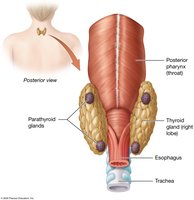
Thyroid Hormones: Metabolic Regulators
Triiodothyronine (T3): Contains three iodine atoms; more physiologically active.
Thyroxine (T4): Contains four iodine atoms; converted to T3 in target cells.
Regulate basal metabolic rate, thermoregulation, growth, and development.
Synergize with the sympathetic nervous system.
Thyroid Hormone Production
Iodide ions and thyroglobulin are secreted into colloid.
Iodide is converted to iodine, which attaches to thyroglobulin.
Iodinated thyroglobulin is endocytosed and cleaved to release T3 and T4.
Most T4 is bound to plasma proteins; only free T3 and T4 are biologically active.
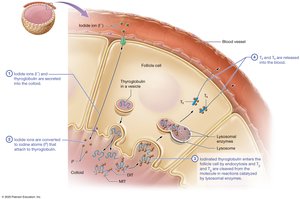
Regulation of Thyroid Hormone Production
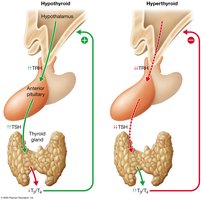
Regulated by a negative feedback loop involving TRH (hypothalamus), TSH (anterior pituitary), and thyroid hormones.
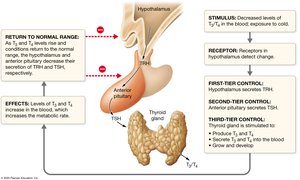
Thyroid Disorders
Hyperthyroidism: Overproduction of thyroid hormones; causes weight loss, heat intolerance, and cardiovascular effects.
Hypothyroidism: Underproduction; causes weight gain, cold intolerance, and low blood pressure.
Graves Disease: Autoimmune hyperthyroidism; may cause goiter and exophthalmos.
Goiter: Enlargement of the thyroid gland.

Negative Feedback Loops and Thyroid Function
TSH secretion increases with hypothyroidism and decreases with hyperthyroidism. In hypothyroidism, the thyroid cannot produce more T3/T4, so TRH and TSH remain elevated. In hyperthyroidism, T3/T4 are elevated, suppressing TRH and TSH.
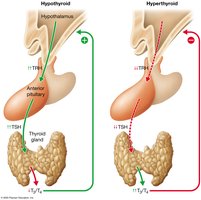
Parathyroid Hormone and Calcitonin: Bone Homeostasis
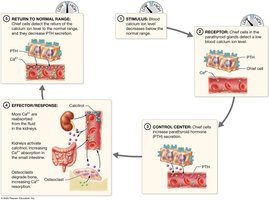
Parathyroid Hormone (PTH): Increases blood calcium by stimulating osteoclasts, increasing intestinal absorption, and kidney reabsorption.
Calcitonin: Produced by thyroid parafollicular cells; inhibits osteoclasts, lowering blood calcium.
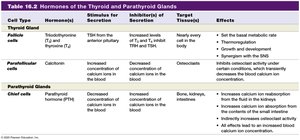
Hormones of the Thyroid and Parathyroid Glands (Table)
Cell Type | Hormone(s) | Stimulus for Secretion | Inhibitor(s) of Secretion | Target Tissue(s) | Effects |
|---|---|---|---|---|---|
Follicle cells | T3, T4 | TSH | Increased T3/T4 | Nearly every cell | Basal metabolic rate, thermoregulation, growth, development, SNS synergy |
Parafollicular cells | Calcitonin | Increased blood calcium | Decreased blood calcium | Osteoclasts | Inhibits osteoclasts, lowers blood calcium |
Chief cells | PTH | Decreased blood calcium | Increased blood calcium | Bone, kidneys, intestine | Increases blood calcium via bone, kidney, intestine |