 Indietro
Chapter 19C: The Cardiovascular System – Blood Vessels and Capillary Exchange
Guida di studio - Note intelligenti
 Appunti personalizzati basati sui tuoi materiali, ampliati con definizioni chiave, esempi e contesto.
The Cardiovascular System: Blood Vessels
Control of Blood Flow
Blood flow through body tissues, known as tissue perfusion, is essential for delivering oxygen and nutrients, removing wastes, facilitating gas exchange, absorbing nutrients, and forming urine. The rate of blood flow is regulated to meet the functional needs of each tissue or organ.
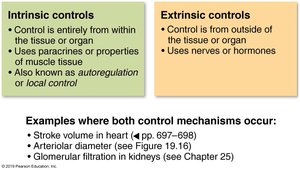
Extrinsic Control: Managed by the sympathetic nervous system and hormones, which act on arteriolar smooth muscle to prioritize blood flow to regions most in need.
Intrinsic Control: Also called autoregulation, this local control adjusts blood flow to meet specific tissue requirements by modifying arteriole diameter.
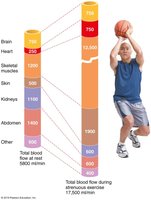
Example: During exercise, skeletal muscle blood flow increases dramatically (from ~20% at rest to over 70%), while extrinsic controls reduce flow to organs like kidneys and digestive tract. Mean arterial pressure (MAP) is maintained despite these changes.
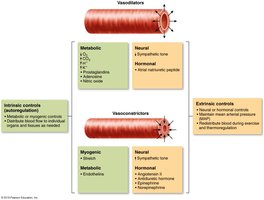
Intrinsic vs Extrinsic Control Mechanisms
Intrinsic and extrinsic mechanisms regulate arteriolar smooth muscle in the systemic circulation, balancing vasodilation and vasoconstriction to optimize tissue perfusion.
Intrinsic (Local) Controls: Metabolic and myogenic factors adjust blood flow within tissues.
Extrinsic Controls: Neural and hormonal signals adjust blood flow systemically.
Autoregulation: Intrinsic Regulation of Blood Flow
Autoregulation refers to local mechanisms that regulate blood flow to specific areas. Reactive hyperemia is increased blood flow due to intrinsic factors. Two main types of intrinsic mechanisms are:
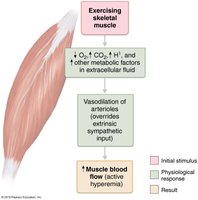
Metabolic Controls: Increased tissue activity lowers O2 and raises metabolic products (H+, K+, adenosine, prostaglandins), causing vasodilation via direct relaxation of arterioles and release of nitric oxide (NO).
Myogenic Controls: Vascular smooth muscle responds to changes in MAP. Increased stretch causes constriction (reducing flow), while reduced stretch causes dilation (increasing flow).
Long-term autoregulation involves angiogenesis (growth of new vessels) and enlargement of existing vessels, especially in response to chronic needs or high-altitude adaptation.
Blood Flow in Special Areas: Skeletal Muscle
Blood flow in skeletal muscle varies with fiber type and activity. At rest, myogenic and neural mechanisms maintain flow (~1L/min). During activity, active hyperemia increases blood flow in direct proportion to metabolic activity, overriding sympathetic vasoconstriction.
Capillary Exchange
Velocity of Blood Flow
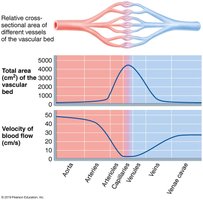
Blood flow velocity changes throughout the systemic circulation. It is fastest in the aorta, slowest in capillaries, and increases again in veins. The speed is inversely related to the total cross-sectional area, with capillaries having the largest area and slowest flow, allowing time for exchange.
Vasomotion
Vasomotion is the intermittent flow of blood through capillaries, caused by the on/off opening and closing of precapillary sphincters.
Capillary Exchange of Respiratory Gases and Nutrients
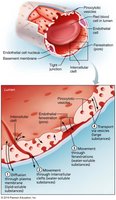
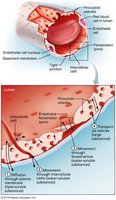
Molecules move between blood and interstitial fluid by diffusion, following concentration gradients. There are four main routes for capillary exchange:
Direct diffusion through endothelial membranes (e.g., lipid-soluble gases)
Passage through intercellular clefts (e.g., water-soluble solutes)
Passage through fenestrations (e.g., water-soluble solutes)
Active transport via pinocytotic vesicles or caveolae (e.g., proteins)
Fluid Movements: Bulk Flow
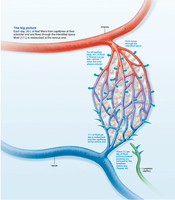
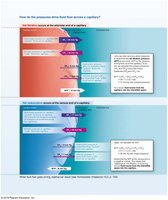
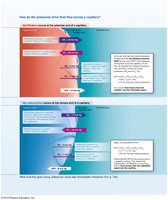
Bulk flow across capillary walls is crucial for maintaining fluid balance between plasma and interstitial fluid. Fluid is forced out at the arterial end and returns at the venous end, driven by hydrostatic and colloid osmotic pressures.
Hydrostatic Pressure (HP): Force exerted by fluid against vessel walls. Capillary HP (HPc) is higher at the arterial end (35 mm Hg) than at the venule end (17 mm Hg). Interstitial HP (HPif) is usually zero.
Colloid Osmotic Pressure (OP): Created by plasma proteins pulling water into capillaries. Capillary OP (OPc) is ~26 mm Hg; interstitial OP (OPif) is ~1 mm Hg.
The net filtration pressure (NFP) determines the direction and amount of fluid movement:
Filtration occurs at the arterial end, reabsorption at the venous end. Excess interstitial fluid is returned to the blood via the lymphatic system.
Circulatory Pathways: Blood Vessels of the Body
Pulmonary and Systemic Circulation
The vascular system consists of two main circulations:
Pulmonary Circulation: Short loop from heart to lungs and back.
Systemic Circulation: Long loop to all body parts and back to heart. Blood is pumped out via the aorta and returns via the superior and inferior vena cava and coronary sinus.
Type of Circulation | Main Function | Major Vessels |
|---|---|---|
Pulmonary | Gas exchange in lungs | Pulmonary arteries and veins |
Systemic | Delivery of nutrients and removal of wastes | Aorta, vena cava, coronary sinus |
Additional info: Angiogenesis is especially important in chronic tissue demand, such as in heart disease or adaptation to high altitude.
