 Indietro
Chapter 21: The Immune System—Innate and Adaptive Body Defenses
Guida di studio - Note intelligenti
 Appunti personalizzati basati sui tuoi materiali, ampliati con definizioni chiave, esempi e contesto.
The Immune System: Overview
Introduction to Immune Defenses
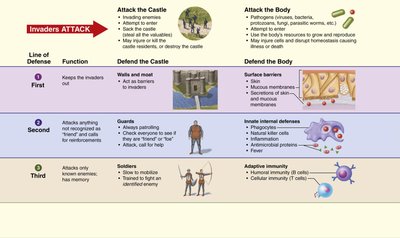
The immune system is a functional system that provides resistance to disease-causing microorganisms such as bacteria, fungi, and viruses. It operates through a network of molecules and immune cells, especially lymphocytes, which reside in lymphoid tissues and circulate in body fluids. The immune system is often compared to a medieval castle, with multiple lines of defense acting both independently and cooperatively to resist invasion.
Three Lines of Defense:
Surface Barriers: Intact skin and mucosae act as the first line of defense, preventing entry of pathogens.
Innate Internal Defenses: The second line of defense includes inflammation, antimicrobial proteins, and phagocytes, which inhibit the spread of invaders.
Adaptive (Specific) Defense System: The third line of defense targets identified enemies with specialized responses, taking longer to mount but providing specificity and memory.

Innate Defenses
Surface Barriers: First Line of Defense
Surface barriers include the skin and mucous membranes, along with their secretions. These barriers are highly effective for most microbes due to their structural and chemical properties.
Keratin: Resistant to acids, bases, bacterial enzymes, and toxins.
Acid Mantle: Acidity of skin, vaginal, and stomach secretions inhibits bacterial growth.
Enzymes: Lysozyme in saliva, mucus, and tears kills microbes; protein-digesting enzymes in the stomach destroy pathogens.
Mucin: Sticky mucus traps microbes in the digestive and respiratory tracts.
Defensins: Antimicrobial peptides secreted in response to barrier breach and inflammation.
Other Chemicals: Lipids in sebum and dermcidin in sweat are toxic to bacteria.
Innate Internal Defenses: Second Line of Defense
If microbes breach surface barriers, innate internal defenses are activated. These include phagocytes, natural killer cells, antimicrobial proteins, inflammation, and fever. Pattern recognition receptors, such as Toll-like receptors (TLRs), play a central role in identifying pathogens.
Phagocytes
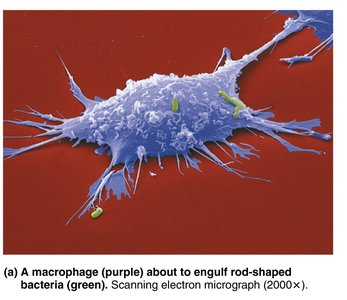
Phagocytes are white blood cells that ingest and digest foreign invaders and cellular debris. The main types are neutrophils and macrophages.
Neutrophils: Most abundant phagocytes; rapidly respond to infection.
Macrophages: Voracious phagocytes; can be free (wandering) or fixed (resident in organs).
Phagocytosis Process
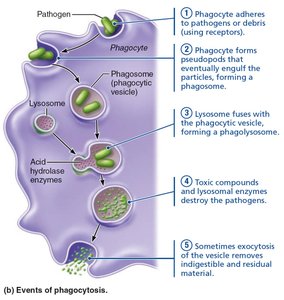
Phagocyte adheres to pathogen or debris.
Phagocyte forms pseudopods to engulf particles, forming a phagosome.
Phagosome fuses with lysosome, forming a phagolysosome.
Lysosomal enzymes and toxic compounds destroy the pathogen.
Residual material may be exocytosed.
Phagocyte Mobilization During Inflammation
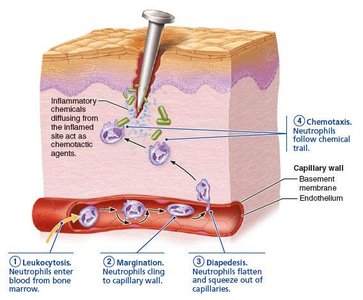
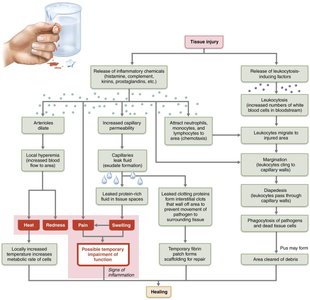
Inflammation triggers the mobilization of phagocytes to the site of injury through a series of steps: leukocytosis, margination, diapedesis, and chemotaxis.
Leukocytosis: Increased production of neutrophils.
Margination: Neutrophils cling to capillary walls.
Diapedesis: Neutrophils squeeze out of capillaries.
Chemotaxis: Neutrophils follow chemical signals to the site of injury.
Antimicrobial Proteins
Antimicrobial proteins enhance innate defenses by attacking microbes directly or hindering their ability to reproduce. The most important are interferons and complement proteins.
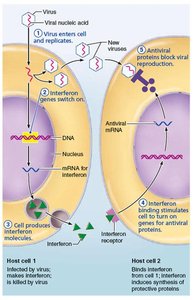
Interferons (IFNs): Produced by virus-infected cells; block viral replication in neighboring cells and activate NK cells and macrophages.
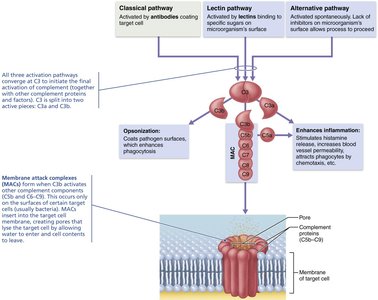
Complement: A group of plasma proteins that, when activated, amplify inflammation, enhance phagocytosis, and cause cell lysis.
Adaptive Defenses
Key Features of Adaptive Immunity
The adaptive immune system is a specific defensive system that targets and eliminates almost any pathogen that invades the body. It consists of two overlapping arms:
Humoral Immunity: Antibody-mediated, provided by B lymphocytes and antibodies in body fluids.
Cellular Immunity: Cell-mediated, provided by T lymphocytes targeting infected or abnormal cells.
Antigens and Antigenic Determinants
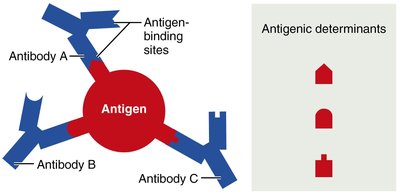
Antigens are substances that provoke an immune response. Most are large, complex molecules foreign to the body. Antigenic determinants are specific parts of an antigen that antibodies or lymphocyte receptors bind to, allowing one antigen to stimulate multiple immune responses.
Lymphocyte Development, Maturation, and Activation
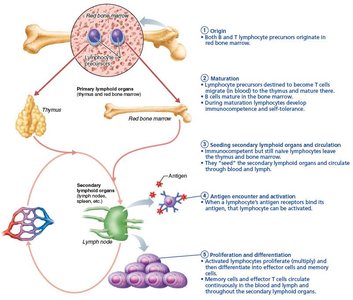
Lymphocytes (B and T cells) undergo a five-step process:
Origin: Hematopoietic stem cells in red bone marrow.
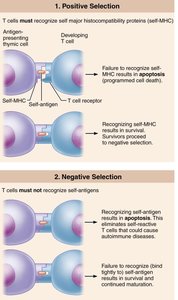
Maturation: B cells mature in bone marrow; T cells in thymus. Education ensures immunocompetence and self-tolerance.
Seeding: Naive cells colonize secondary lymphoid organs.
Antigen Encounter and Activation: Clonal selection upon antigen encounter.
Proliferation and Differentiation: Formation of effector and memory cells.
Humoral Immunity
Primary and Secondary Immune Responses
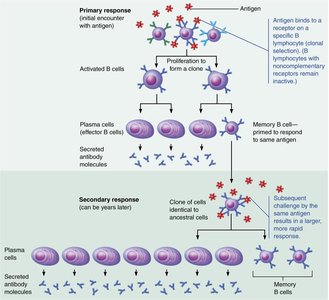
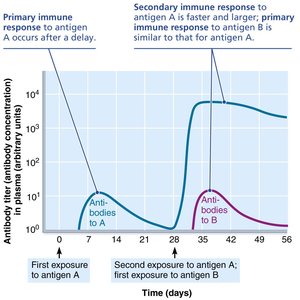
When B cells encounter their antigen, they proliferate and differentiate into plasma cells (which secrete antibodies) and memory cells. The primary response is slower, while the secondary response is faster and more robust due to memory cells.
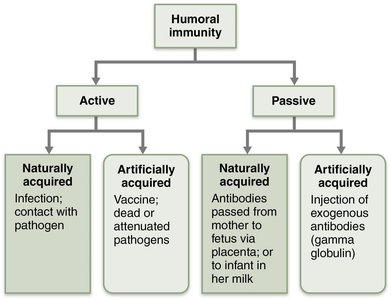
Active and Passive Humoral Immunity
Active Immunity: B cells produce antibodies after exposure to antigens (natural infection or vaccination).
Passive Immunity: Antibodies are introduced from outside (mother to fetus, injection of antibodies); no memory cells are produced.
Antibody Structure and Classes
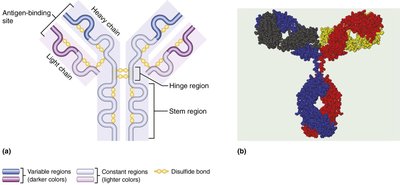
Antibodies (immunoglobulins) are Y-shaped proteins composed of two heavy and two light chains. The variable regions form antigen-binding sites, while the constant regions determine the antibody class and function.
IgG: Most abundant; crosses placenta.
IgA: Found in secretions.
IgM: First antibody released; potent agglutinating agent.
IgE: Involved in allergic responses.
IgD: Functions as B cell receptor.
Cellular Immunity
T Lymphocytes and Their Functions
T cells provoke cellular immune responses when presented with antigens. Major types include:
Helper T Cells (TH): Activate B cells, other T cells, and macrophages; direct adaptive responses.
Cytotoxic T Cells (TC): Destroy infected, cancerous, or foreign cells.
Regulatory T Cells (TReg): Moderate immune responses and prevent autoimmunity.
Primary and Secondary Responses in Cellular Immunity
Activated T cells proliferate and differentiate into effector and memory cells. Helper T cells are essential for both humoral and cellular immunity, while cytotoxic T cells directly kill target cells.
Immunological Disorders
Immunodeficiencies
Immunodeficiencies are conditions that impair immune function, such as severe combined immunodeficiency (SCID), Hodgkin's lymphoma, and AIDS.
Autoimmune Diseases
Autoimmune diseases occur when the immune system attacks self-antigens, leading to conditions like rheumatoid arthritis, type 1 diabetes, and lupus.
Hypersensitivities
Hypersensitivities are exaggerated immune responses to harmless antigens, including allergies (immediate hypersensitivity), subacute, and delayed hypersensitivity reactions.
Developmental Aspects of the Immune System
Immune system development begins in fetal liver and spleen, then shifts to bone marrow. Efficiency declines with age, increasing susceptibility to infections and autoimmune diseases.
Additional info: This summary covers the main concepts and mechanisms of innate and adaptive immunity, including cellular and humoral responses, antibody structure and function, and immunological disorders. It is suitable for exam preparation and self-study for Anatomy & Physiology students.
