 Indietro
Chapter 24: Nutrition, Metabolism, and Energy Balance – Study Notes
Guida di studio - Note intelligenti
 Appunti personalizzati basati sui tuoi materiali, ampliati con definizioni chiave, esempi e contesto.
Nutrition, Metabolism, and Energy Balance
Introduction to Nutrition and Metabolism
Nutrition and metabolism are fundamental concepts in human physiology, describing how the body acquires, processes, and utilizes nutrients for growth, maintenance, and energy. Understanding these processes is essential for comprehending how the human body maintains homeostasis and supports life.
Nutrient: A substance in food needed for growth, maintenance, and repair.
Macronutrients: Nutrients required in large amounts: carbohydrates, lipids, and proteins.
Micronutrients: Nutrients required in small amounts: vitamins and minerals.
Essential nutrients: Nutrients that must be obtained from the diet because the body cannot synthesize them.
RDA (Recommended Dietary Allowance): The daily intake level of a nutrient considered sufficient to meet the requirements of most healthy individuals.
Caloric balance: The relationship between caloric intake and energy expenditure.
Nitrogen balance: The state where the rate of protein synthesis equals the rate of protein breakdown and loss.
BMI (Body Mass Index): A formula used to determine obesity based on weight relative to height.
BMR (Basal Metabolic Rate): The energy required to perform essential activities at rest.
Calorie: The amount of heat needed to raise the temperature of 1 kg of water by 1°C; one dietary "Calorie" equals 1 kcal.
Metabolism: The sum of all biochemical reactions inside a cell involving nutrients, including anabolism (building up) and catabolism (breaking down).
Three Stages of Metabolism of Energy-Containing Nutrients
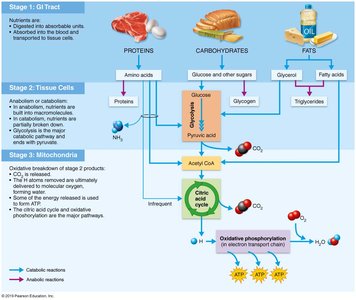
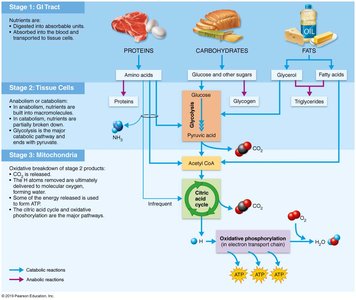
The metabolism of nutrients occurs in three main stages: digestion, cellular processing, and mitochondrial energy production.
Stage 1: GI Tract – Nutrients are digested into absorbable units and transported to tissue cells.
Stage 2: Tissue Cells – Nutrients undergo anabolic or catabolic reactions to form intermediates such as pyruvic acid and acetyl CoA.
Stage 3: Mitochondria – Oxidative breakdown of stage 2 products occurs, producing ATP via the citric acid cycle and oxidative phosphorylation.
Nutrients: Types and Energy Values
Nutrients are classified based on their function and required amounts. Their energy values are measured in kilocalories (kcal).
Carbohydrates: 4 Calories/gram
Lipids: Approximately 9 Calories/gram
Proteins: 4 Calories/gram
Summary Table: Carbohydrate, Lipid, and Protein Nutrients
The following table summarizes the food sources, recommended daily allowance, and problems associated with excesses and deficits of carbohydrates, lipids, and proteins.
Food Sources | Recommended Daily Allowance (RDA) for Adults | Excesses | Deficits |
|---|---|---|---|
Carbohydrates | 130 g; 45-65% of total caloric intake | Obesity, diabetes mellitus, nutritional deficits, dental caries, gastrointestinal irritation, elevated triglycerides in plasma | Tissue wasting, metabolic acidosis, accelerated fat use for energy |
Lipids | 65 g; 20-35% of total caloric intake | Obesity, increased risk of cardiovascular disease | Weight loss, skin lesions, poor growth |
Proteins | 0.8 g/kg body weight; 12-20% of total caloric intake | Obesity, high cholesterol, kidney stones | Profound weight loss, tissue wasting, edema |
Carbohydrate Metabolism
Uses of Carbohydrates in the Body
Carbohydrates are the primary fuel for most cells, especially neurons and red blood cells, which rely entirely on glucose. Excess glucose is stored as glycogen or converted to fat.
Glucose: Main fuel for ATP production.
Fructose and Galactose: Converted to glucose by the liver.
Disaccharides: Sucrose, lactose, and maltose are part of the diet.
Key Carbohydrate Reactions
The body processes carbohydrates through several key reactions:
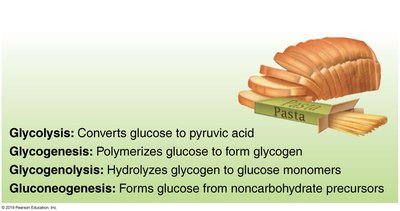
Glycolysis: Converts glucose to pyruvic acid.
Glycogenesis: Polymerizes glucose to form glycogen.
Glycogenolysis: Hydrolyzes glycogen to glucose monomers.
Gluconeogenesis: Forms glucose from noncarbohydrate precursors.
Glycogenesis and Glycogenolysis
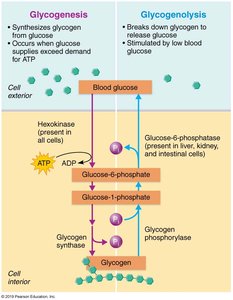
Glycogenesis and glycogenolysis are processes that regulate blood glucose levels by storing or releasing glucose as needed.
Glycogenesis: Synthesizes glycogen from glucose when energy demand is low.
Glycogenolysis: Breaks down glycogen to release glucose when blood glucose is low.
Energy Yield During Cellular Respiration
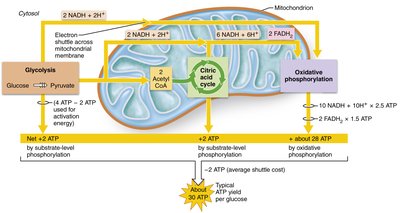
Cellular respiration is the process by which cells extract energy from glucose, producing ATP.
Glycolysis: Occurs in the cytosol, produces 2 ATP.
Citric Acid Cycle: Occurs in mitochondria, produces 2 ATP.
Oxidative Phosphorylation: Produces about 28 ATP.
Total ATP Yield: About 30 ATP per glucose molecule.
Lipid Metabolism
Uses of Lipids in the Body
Lipids serve multiple functions, including energy storage, membrane structure, and hormone synthesis.
Adipose tissue: Provides protection, insulation, and fuel storage.
Phospholipids: Essential for cell membranes and myelin sheaths.
Cholesterol: Stabilizes membranes and is a precursor for bile salts and steroid hormones.
Prostaglandins: Involved in smooth muscle contraction, blood pressure control, and inflammation.
Major fuel: For hepatocytes and skeletal muscle.
Fat-soluble vitamins: Lipids help absorb vitamins A, D, E, and K.
Composition and Function of Lipoproteins
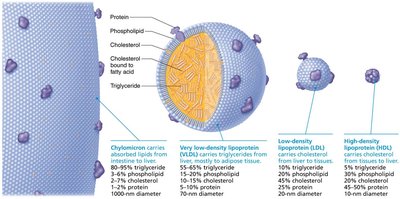
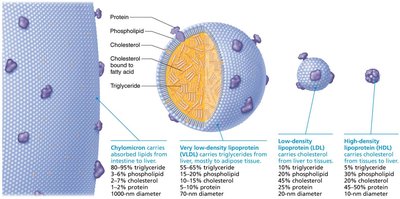
Lipoproteins are complexes that transport lipids in the blood. They vary in density and function.
Chylomicrons: Carry absorbed lipids from the intestine to the liver.
VLDL (Very Low-Density Lipoprotein): Carries triglycerides to adipose tissue.
LDL (Low-Density Lipoprotein): Carries cholesterol to tissues.
HDL (High-Density Lipoprotein): Carries cholesterol from tissues to the liver for excretion.
Key Lipid Reactions
Lipid metabolism involves several important reactions:
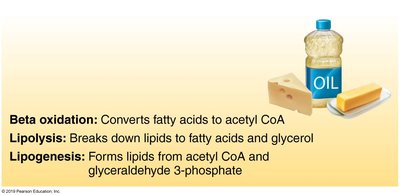
Beta oxidation: Converts fatty acids to acetyl CoA.
Lipolysis: Breaks down lipids to fatty acids and glycerol.
Lipogenesis: Forms lipids from acetyl CoA and glyceraldehyde 3-phosphate.
Protein Metabolism
Uses of Proteins in the Body
Proteins are essential for structural and functional roles in the body.
Amino acids: Used to build proteins; all must be present for synthesis (all-or-none rule).
Structural materials: Keratin (skin), collagen and elastin (connective tissue), muscle proteins.
Functional molecules: Enzymes and some hormones.
Essential Amino Acids
Essential amino acids cannot be synthesized by the body and must be obtained from the diet.
Examples: Tryptophan, methionine, valine, threonine, phenylalanine, isoleucine, leucine, lysine, histidine, arginine (infants).
Complementary proteins: Combining foods (e.g., corn and beans) can provide all essential amino acids.
Key Protein Reactions
Protein catabolism involves the removal and transfer of amine groups.
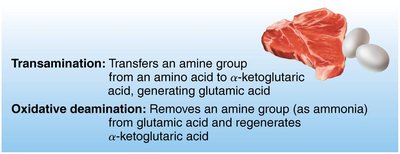
Transamination: Transfers an amine group from an amino acid to α-ketoglutaric acid, generating glutamic acid.
Oxidative deamination: Removes an amine group (as ammonia) from glutamic acid and regenerates α-ketoglutaric acid.
Nitrogen Balance
Definition and Types
Nitrogen balance is a homeostatic state where the rate of protein synthesis equals the rate of breakdown and loss.
Positive nitrogen balance: Synthesis exceeds breakdown (normal in children, pregnant women, tissue repair).
Negative nitrogen balance: Breakdown exceeds synthesis (stress, burns, infection, injury, poor dietary proteins, starvation).
Interconversion of Nutrients
Metabolic Flexibility
The body can interconvert carbohydrates, fats, and proteins to meet energy and metabolic needs.
Carbohydrates: Can be converted to fat or used for energy.
Proteins: Can be converted to glucose or fat if needed.
Fats: Can be used for energy or stored.
Absorptive and Postabsorptive States
Absorptive (Fed) State
The absorptive state occurs during and shortly after eating, when nutrients are being absorbed and used for energy or storage.
Major events: Glucose is used for ATP production, excess is stored as glycogen or fat; amino acids are used for protein synthesis.
Hormones: Insulin is the major hormone regulating this state.
Postabsorptive (Fasted) State
The postabsorptive state occurs when the GI tract is empty and the body must rely on stored nutrients.
Major events: Glycogenolysis, lipolysis, and gluconeogenesis provide glucose and energy.
Hormones: Glucagon and other hormones regulate this state.
Hormonal Regulation of Metabolism
Summary Table: Hormonal Influences
Hormones play a critical role in regulating metabolism, including insulin, glucagon, thyroxine, and others.
Hormone | Effect |
|---|---|
Insulin | Promotes glucose uptake and storage |
Glucagon | Promotes glycogenolysis and gluconeogenesis |
Thyroxine | Increases BMR and cellular respiration |
Basal Metabolic Rate (BMR) and Energy Balance
BMR
Basal metabolic rate reflects the energy needed for essential activities at rest.
Influenced by: Age, gender, body temperature, stress, and thyroxine levels.
Example: 70 kg adult BMR = 66 kcal/h.
Energy Balance and BMI
Energy balance is achieved when caloric intake equals energy expenditure.
Positive energy balance: Weight gain.
Negative energy balance: Weight loss.
BMI formula:
Classification: Overweight (BMI 25–30), obese (BMI > 30).
Regulation of Appetite
Neural and Hormonal Control
Appetite and food intake are regulated by neural and hormonal factors, primarily through hypothalamic control.
Model: Hypothalamic command integrates signals to regulate hunger and satiety.
Dietary Principles
USDA MyPlate Guidelines
The USDA's MyPlate provides guidelines for healthy eating, emphasizing balanced portions and nutrient-rich foods.
Eat only what you need (eat less overall).
Eat plenty of fruits, vegetables, and whole grains.
Avoid junk food.
Conclusion
Understanding nutrition, metabolism, and energy balance is essential for maintaining health and preventing disease. These concepts integrate biochemistry, physiology, and dietary science to explain how the human body processes nutrients and regulates energy.
