 Indietro
Chapter 4: Tissues – The Living Fabric (Anatomy & Physiology Study Notes)
Guida di studio - Note intelligenti
 Appunti personalizzati basati sui tuoi materiali, ampliati con definizioni chiave, esempi e contesto.
Tissues: The Fabric of Life
Levels of Structural Organization
The human body is organized into hierarchical levels, each building upon the previous. Understanding these levels is essential for grasping how tissues fit into the overall structure and function of the body.
Chemical Level: Atoms combine to form molecules.
Cellular Level: Cells are made up of molecules and organelles.
Tissue Level: Tissues consist of groups of similar cells performing a common function.
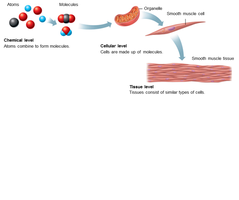
Additional info: Higher levels include organs, organ systems, and the organism itself.
Tissue: The Living Fabric
Definition and Importance
Tissues are groups of cells similar in structure that perform common or related functions. The study of tissues is called histology. Each tissue type is specialized to maintain homeostasis in the body.
Four basic tissue types: Epithelial, connective, muscle, and nervous tissue.
Key function: Each tissue type contributes uniquely to the body's structure and function.
Epithelial Tissue
General Characteristics
Epithelial tissue (epithelium) is a sheet of cells that covers body surfaces or lines cavities. It is highly specialized for protection, absorption, filtration, excretion, secretion, and sensory reception.
Covering and lining epithelia: Found on external and internal surfaces (e.g., skin).
Glandular epithelia: Forms secretory tissue in glands (e.g., salivary glands).
Glandular Epithelia
A gland is one or more cells that makes and secretes an aqueous fluid called a secretion. Glands are classified by their site of product release and the number of cells forming the gland.
Endocrine glands: Internally secreting (e.g., hormones).
Exocrine glands: Externally secreting (e.g., sweat).
Unicellular: Single cells (e.g., goblet cells).
Multicellular: Multiple cells (e.g., salivary glands).
Formation of Multicellular Exocrine and Endocrine Glands
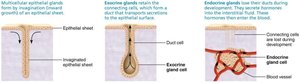
Multicellular glands develop from epithelial sheets. Exocrine glands retain their connecting cells, forming ducts, while endocrine glands lose their ducts and release hormones into the blood.
Modes of Secretion in Exocrine Glands
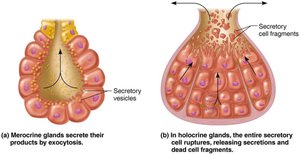
Multicellular exocrine glands can secrete their products in different ways:
Merocrine: Secrete products by exocytosis as they are produced (e.g., sweat, pancreas).
Holocrine: Accumulate products within, then rupture to release secretions (e.g., sebaceous oil glands).
Connective Tissue
General Characteristics
Connective tissue is the most abundant and widely distributed tissue in the body. It serves to bind, support, protect, insulate, store reserve fuel, and transport substances.
Four main classes: Connective tissue proper, cartilage, bone, blood.
Major functions: Structural support, protection, energy storage, and transport.
Structural Elements of Connective Tissue
Connective tissue is composed of cells, fibers, and ground substance. The cells can be immature "blast" cells (actively secreting matrix) or mature "cyte" cells (maintaining matrix health).
Fibroblasts: Found in connective tissue proper.
Chondroblasts: Found in cartilage.
Osteoblasts: Found in bone.
Hematopoietic stem cells: Found in bone marrow.
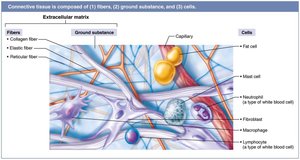
Additional info: The extracellular matrix consists of fibers (collagen, elastic, reticular), ground substance, and various cell types.
Muscle Tissue
General Characteristics
Muscle tissue is responsible for most types of movement in the body. Muscle cells contain myofilaments made of actin and myosin, which enable contraction.
Skeletal muscle: Voluntary movement.
Cardiac muscle: Heart contraction.
Smooth muscle: Involuntary movement in organs.
Additional info: Muscle tissue will be discussed in greater detail in later chapters.
Nervous Tissue
General Characteristics
Nervous tissue forms the main component of the nervous system (brain, spinal cord, nerves). It regulates and controls body functions through specialized cells.
Neurons: Specialized cells that generate and conduct nerve impulses.
Supporting cells: Support, insulate, and protect neurons.
Additional info: Nervous tissue will be discussed in greater detail in later chapters.
Tissue Repair
Overview of Tissue Repair
When the body's barriers are compromised, tissue repair is initiated through inflammatory and immune responses. Repair can occur by regeneration (restoring original function) or fibrosis (forming scar tissue).
Regeneration: Same kind of tissue replaces destroyed tissue.
Fibrosis: Connective tissue replaces destroyed tissue, resulting in loss of original function.
Steps in Tissue Repair
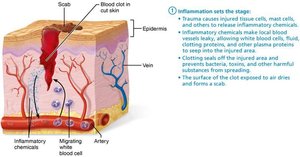
Step 1: Inflammation Sets the Stage
Inflammatory chemicals are released, causing dilation and increased permeability of blood vessels. Clotting occurs to prevent further injury and infection.
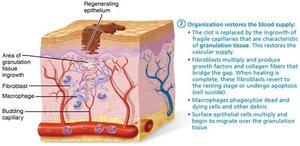
Step 2: Organization Restores Blood Supply
The blood clot is replaced by granulation tissue, restoring vascular supply. Fibroblasts produce collagen fibers to bridge the gap, and debris is removed by phagocytosis.
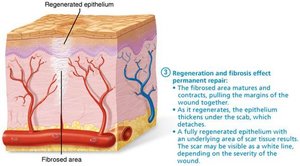
Step 3: Regeneration and Fibrosis Effect Permanent Repair
The scab detaches, fibrous tissue matures, and epithelium thickens to resemble adjacent tissue. The result is a fully regenerated epithelium with underlying scar tissue.
Summary Table: Modes of Secretion in Exocrine Glands
Mode of Secretion | Description | Example |
|---|---|---|
Merocrine | Secrete products by exocytosis as produced | Sweat glands, pancreas |
Holocrine | Accumulate products, then rupture to release | Sebaceous oil glands |
Summary Table: Types of Tissue
Tissue Type | Main Function | Example |
|---|---|---|
Epithelial | Protection, absorption, secretion | Skin, lining of GI tract |
Connective | Support, binding, transport | Bone, blood, cartilage |
Muscle | Movement | Skeletal muscle, heart |
Nervous | Control, communication | Brain, nerves |
