 Indietro
Chapter 8: Joints – Structure, Classification, and Movements
Guida di studio - Note intelligenti
 Appunti personalizzati basati sui tuoi materiali, ampliati con definizioni chiave, esempi e contesto.
Joints: An Overview
Introduction to Joints
Joints, or articulations, are the sites where two or more bones meet. They play a crucial role in providing the skeleton with mobility and holding the bones together for stability. Joints are essential for movement, stability, and, in some cases, the growth of long bones.
Functions of Joints
Movement: Joints allow for a wide range of body movements by serving as pivot points for bones.
Stability: Some joints provide stability to the skeleton, especially those with limited movement.
Growth: Certain joints, such as those in long bones, permit lengthwise growth during development.
Classification of Joints
Functional Classification
Joints can be classified by the amount of movement they allow:
Synarthrosis: Immovable joints (e.g., sutures of the skull).
Amphiarthrosis: Slightly movable joints (e.g., intervertebral discs).
Diarthrosis: Freely movable joints (e.g., most limb joints).
Structural Classification
Joints are also classified by their structural features:
Fibrous Joints: Bones joined by dense regular connective tissue; mostly immovable.
Cartilaginous Joints: Bones joined by hyaline cartilage or fibrocartilage; allow limited movement.
Synovial Joints: Bones separated by a fluid-filled cavity; all are diarthroses (freely movable).
Synovial Joints
Overview of Synovial Joints
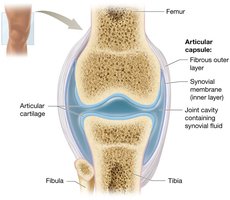
Synovial joints are the most common and movable type of joint in the body. They are characterized by a joint cavity filled with synovial fluid, which reduces friction and nourishes the articular cartilage. These joints are found in nearly all limb articulations and are associated with high mobility but lower stability.
Key Features of Synovial Joints
Articular cartilage: Covers the ends of bones, reducing friction and absorbing shock.
Joint (synovial) cavity: Space filled with synovial fluid.
Articular capsule: Double-layered structure enclosing the joint cavity.
Synovial fluid: Lubricates and nourishes the joint.
Ligaments: Reinforce and stabilize the joint.
Types of Synovial Joints
Classification by Shape and Movement
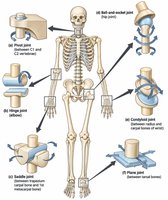
Synovial joints are classified based on the shape of their articulating surfaces and the type of movement they allow:
Type | Articular Surface | Movement | Example |
|---|---|---|---|
Plane | Flat | Gliding | Intercarpal joints |
Hinge | Cylinder and trough | Flexion/Extension | Elbow, knee, ankle |
Pivot | Rounded and ring | Rotation | Proximal radioulnar joint |
Condylar | Oval convex and concave | Flexion/Extension, Abduction/Adduction, Circumduction | Wrist, metacarpophalangeal joints |
Saddle | Concave and convex | Flexion/Extension, Abduction/Adduction, Circumduction | Thumb (carpometacarpal joint) |
Ball-and-socket | Spherical and cup | All movements | Shoulder, hip |
Hinge Joint
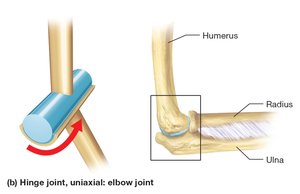
Hinge joints involve the articulation between a convex surface and a concave depression, allowing movement primarily in one plane (uniaxial).
Movements: Flexion and extension
Examples: Elbow, knee, ankle
Condylar Joint
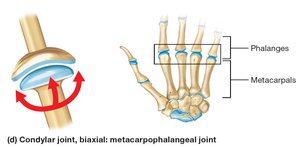
Condylar joints feature an oval, convex surface articulating with a shallow, concave surface, permitting movement in two planes (biaxial).
Movements: Flexion, extension, abduction, adduction, circumduction
Examples: Wrist, metacarpophalangeal joints
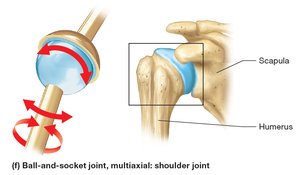
Ball-and-Socket Joint
Ball-and-socket joints have a spherical articulating surface fitting into a cup-shaped depression, allowing the greatest range of motion (multiaxial).
Movements: Flexion, extension, abduction, adduction, circumduction, medial and lateral rotation
Examples: Shoulder (glenohumeral joint), hip (coxal joint)
Movements at Synovial Joints
General Types of Movements
Movements at synovial joints are described relative to the anatomical position and include gliding, angular, rotational, and special movements.
Angular Movements
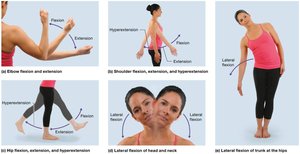
Angular movements change the angle between bones. These include:
Flexion: Decreases the angle between bones
Extension: Increases the angle between bones
Hyperextension: Extension beyond the anatomical position
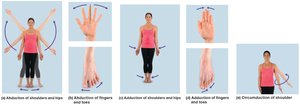
Abduction: Movement away from the midline
Adduction: Movement toward the midline
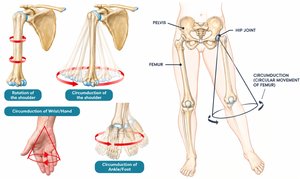
Circumduction: Cone-shaped movement combining flexion, extension, abduction, and adduction
Rotational Movements
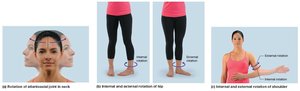
Rotation involves turning a bone around its own longitudinal axis.
Medial rotation: Rotation toward the midline
Lateral rotation: Rotation away from the midline
Special Movements
Special movements do not fit into the previous categories and are unique to specific joints:
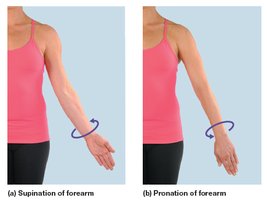
Pronation: Medial rotation of the forearm (palm down)
Supination: Lateral rotation of the forearm (palm up)
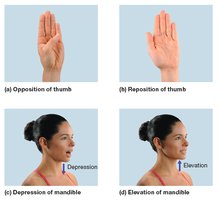
Opposition: Thumb moves toward the index finger
Reposition: Thumb returns to anatomical position
Depression: Body part moves inferiorly
Elevation: Body part moves superiorly
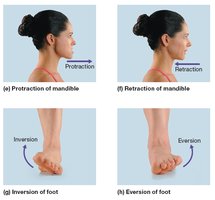
Protraction: Body part moves anteriorly
Retraction: Body part moves posteriorly
Inversion: Sole of foot turns medially
Eversion: Sole of foot turns laterally
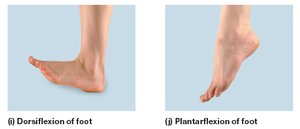
Dorsiflexion: Superior surface of foot moves toward the shin
Plantarflexion: Superior surface of foot moves away from the shin (toes pointed)
Summary Table: Types of Synovial Joints and Movements
Joint Type | Movement(s) | Example |
|---|---|---|
Plane | Gliding | Intercarpal joints |
Hinge | Flexion/Extension | Elbow, knee |
Pivot | Rotation | Proximal radioulnar joint |
Condylar | Flexion/Extension, Abduction/Adduction, Circumduction | Wrist |
Saddle | Flexion/Extension, Abduction/Adduction, Circumduction | Thumb |
Ball-and-socket | All movements | Shoulder, hip |
Key Terms
Articulation: The site where two or more bones meet.
Synovial fluid: Lubricating fluid within synovial joints.
Ligament: Connective tissue that connects bone to bone.
Flexion/Extension: Decreasing/increasing the angle between bones.
Abduction/Adduction: Movement away from/toward the midline.
Circumduction: Circular movement combining several motions.
Rotation: Movement around a longitudinal axis.
