 Indietro
Chemical Level of Organization: Atoms, Molecules, and Physiology
Guida di studio - Note intelligenti
 Appunti personalizzati basati sui tuoi materiali, ampliati con definizioni chiave, esempi e contesto.
Chemical Level of Organization
Atoms and Atomic Structure
The chemical level of organization forms the foundation for understanding anatomy and physiology. Atoms are the smallest units of matter, and their structure determines how they interact to form molecules and compounds essential for life.
Atom: The basic unit of matter, composed of a nucleus (containing protons and neutrons) and an electron cloud.
Subatomic particles: Protons (positive charge), Neutrons (neutral), and Electrons (negative charge).
Electron cloud: Electrons occupy energy levels (shells) around the nucleus; the outermost shell (valence shell) determines chemical bonding.
Atomic number: Number of protons in the nucleus; defines the element.
Mass number: Sum of protons and neutrons.
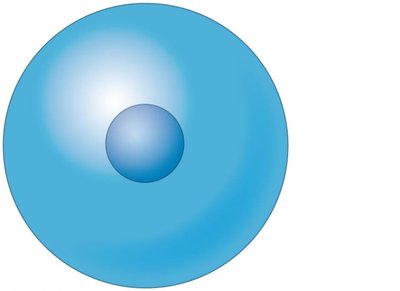
Energy levels: Lower shells fill first; the valence shell is key for reactivity.
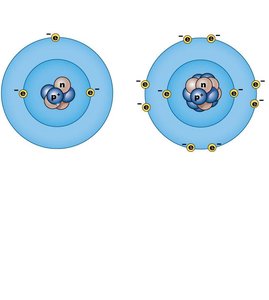
Example: Lithium (Li) has 3 electrons; the first shell holds 2, the third occupies the second shell. Neon (Ne) has 10 electrons, filling both the first and second shells.
Principal Elements in the Human Body
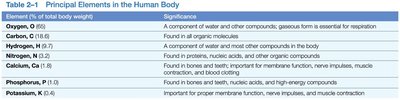
Elements are the building blocks of all matter. The human body is composed of several principal elements, each with specific physiological roles.
Element (% of total body weight) | Significance |
|---|---|
Oxygen (O, 65) | Component of water and other compounds; essential for respiration |
Carbon (C, 18.6) | Found in all organic molecules |
Hydrogen (H, 9.7) | Component of water and most other compounds |
Nitrogen (N, 3.2) | Found in proteins, nucleic acids, and other organic compounds |
Calcium (Ca, 1.8) | Found in bones and teeth; important for membrane function, nerve impulses, muscle contraction, and blood clotting |
Phosphorus (P, 1.0) | Found in bones and teeth, nucleic acids, and high-energy compounds |
Potassium (K, 0.4) | Important for membrane function, nerve impulses, and muscle contraction |
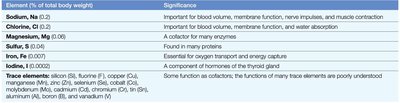
Element (% of total body weight) | Significance |
|---|---|
Sodium (Na, 0.2) | Important for blood volume, membrane function, nerve impulses, and muscle contraction |
Chlorine (Cl, 0.2) | Important for blood volume, membrane function, and water absorption |
Magnesium (Mg, 0.06) | Cofactor for many enzymes |
Sulfur (S, 0.05) | Found in many proteins |
Iron (Fe, 0.01) | Essential for oxygen transport and energy capture |
Iodine (I, 0.01) | Component of hormones of the thyroid gland |
Trace elements | Some function as cofactors; many functions are poorly understood |
Molecules and Compounds
Atoms combine to form molecules and compounds through chemical bonds. The type of bond determines the properties and functions of the resulting substance.
Molecule: Two or more atoms joined by strong bonds.
Compound: Two or more atoms of different elements joined by strong or weak bonds.
Chemical bonds: Involve sharing, gaining, or losing electrons.
Three major types: Ionic bonds, Covalent bonds, Hydrogen bonds.
Ionic Bonds
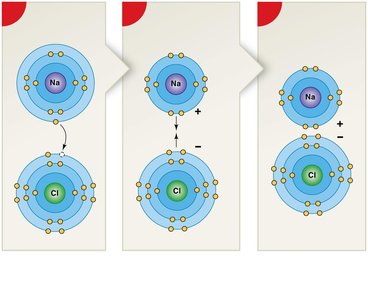
Ionic bonds form when one atom donates electrons to another, resulting in charged ions that attract each other.
Cation: Positively charged ion (electron donor).
Anion: Negatively charged ion (electron acceptor).
Example: Sodium (Na) donates an electron to chlorine (Cl), forming Na+ and Cl-, which combine to make sodium chloride (NaCl).
Covalent Bonds
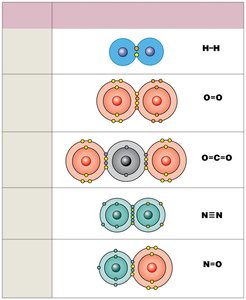
Covalent bonds involve the sharing of electrons between atoms, resulting in strong bonds. The number of shared pairs determines whether the bond is single, double, or triple.
Single covalent bond: One pair of electrons shared.
Double covalent bond: Two pairs shared.
Triple covalent bond: Three pairs shared.
Examples: H2 (hydrogen), O2 (oxygen), CO2 (carbon dioxide), N2 (nitrogen), NO (nitric oxide).
Hydrogen Bonds
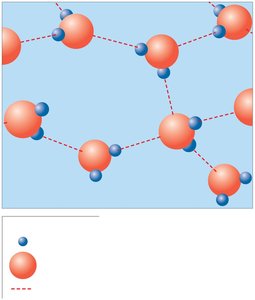
Hydrogen bonds are weak attractions between polar molecules, often involving hydrogen. They are crucial for the properties of water and biological molecules.
Form between a slight positive charge (hydrogen) and a slight negative charge (usually oxygen or nitrogen).
Responsible for surface tension in water.
Chemical Reactions
Chemical reactions involve the formation or breaking of bonds between atoms. These reactions are fundamental to metabolism and physiological processes.
Reactants: Materials entering a reaction.
Products: Materials produced by a reaction.
Metabolism: All chemical reactions occurring in the body.
Decomposition (catabolism): Breaking bonds (e.g., hydrolysis).
Synthesis (anabolism): Forming bonds (e.g., dehydration synthesis).
Example equations:
Decomposition:
Hydrolysis:
Synthesis:
Dehydration synthesis:
Inorganic and Organic Compounds
Compounds in the body are classified as inorganic or organic based on their composition and function.
Inorganic compounds: Do not contain both carbon and hydrogen (e.g., water, oxygen, carbon dioxide, acids, bases, salts).
Organic compounds: Contain carbon and hydrogen (e.g., carbohydrates, proteins, lipids, nucleic acids).
Nutrients: Essential molecules obtained from food.
Metabolites: Molecules made or broken down in the body.
Properties of Water
Water is vital for life due to its unique chemical properties. It makes up a significant portion of body weight and is involved in numerous physiological processes.
Universal solvent: Many molecules dissolve in water.
Reactivity: Water participates in chemical reactions.
High heat capacity: Water absorbs and retains heat efficiently.
Lubrication: Reduces friction in body tissues.
Hydrophilic: Water-loving; includes ions and polar molecules.
Hydrophobic: Water-fearing; includes nonpolar molecules, fats, and oils.
pH and Homeostasis
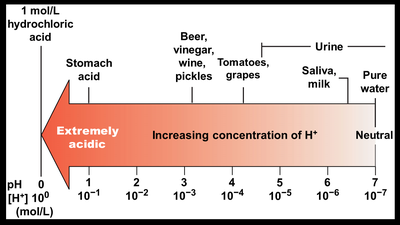
The pH scale measures the concentration of hydrogen ions (H+) in a solution, which is crucial for maintaining homeostasis in the body.
pH: Negative logarithm of the hydrogen ion concentration ().
Neutral pH: pH 7.0; equal concentrations of H+ and OH-.
Acidic pH: Less than 7.0; higher H+ concentration.
Basic (alkaline) pH: Greater than 7.0; lower H+ concentration.
Human blood pH: 7.35–7.45.
Inverse relationship: More H+ means lower pH.
High-Energy Compounds
High-energy compounds, such as ATP, are essential for storing and transferring energy in cells. They are derived from nucleotides and are involved in phosphorylation reactions.
Phosphorylation: Addition of a phosphate group to a molecule, creating a high-energy bond.
AMP (Adenosine monophosphate): Contains one phosphate group.
ADP (Adenosine diphosphate): Contains two phosphate groups.
ATP (Adenosine triphosphate): Contains three phosphate groups; main energy carrier in cells.
ATPase: Enzyme that catalyzes the conversion of ATP to ADP, releasing energy.
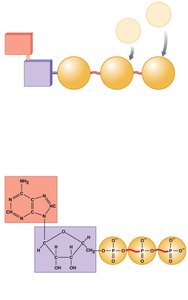
Example equation:
Additional info: These notes expand on the provided lecture content with definitions, examples, and equations to ensure completeness and academic quality for Anatomy & Physiology students.
