 Indietro
Connective Tissue: Structure, Types, and Functions
Guida di studio - Note intelligenti
 Appunti personalizzati basati sui tuoi materiali, ampliati con definizioni chiave, esempi e contesto.
Tissue: The Living Fabric
Introduction to Connective Tissue
Connective tissue is the most abundant and widely distributed of the primary tissues in the human body. It plays essential roles in structural support, protection, insulation, storage, and transport. The diversity of connective tissue types allows for a wide range of functions and properties.
Four Main Classes: Connective tissue proper, cartilage, bone, and blood.
Major Functions: Binding and support, protection, insulation, storing reserve fuel, and transporting substances.
Characteristics of Connective Tissue
Connective tissues differ from other primary tissues due to three key characteristics:
Common Origin: All connective tissues arise from mesenchyme, an embryonic tissue.
Vascularity: Varying degrees of blood supply, from highly vascular (bone) to avascular (cartilage).
Extracellular Matrix: Composed mainly of nonliving material, allowing tissues to bear weight and withstand tension.
Structural Elements of Connective Tissue
Connective tissue consists of three main structural elements:
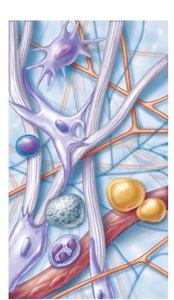
Ground Substance: Unstructured material filling spaces between cells, composed of interstitial fluid, cell adhesion proteins, and proteoglycans.
Fibers: Collagen (strongest), elastic (stretch and recoil), and reticular (network for support).
Cells: "Blast" cells (immature, matrix-secreting), "Cyte" cells (mature, matrix-maintaining), and other specialized cells (fat cells, white blood cells, mast cells, macrophages).
Types of Connective Tissue
Connective Tissue Proper
Connective tissue proper includes all connective tissues except bone, cartilage, and blood. It is divided into loose and dense subclasses.
Loose Connective Tissue: Areolar, adipose, and reticular.
Dense Connective Tissue: Dense regular, dense irregular, and elastic.
Areolar Connective Tissue
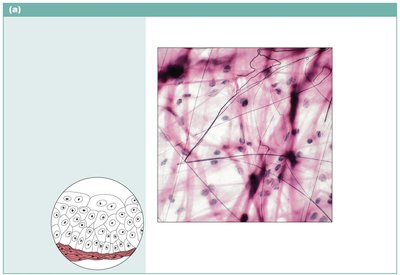
Areolar tissue is the most widely distributed connective tissue, serving as a universal packing material. It supports and binds other tissues, provides a reservoir of water and salts, defends against infection, and stores nutrients as fat.
Cells: Fibroblasts, macrophages, mast cells, and some white blood cells.
Function: Wraps and cushions organs, plays a role in inflammation, holds and conveys tissue fluid.
Location: Under epithelia, lamina propria of mucous membranes, packages organs, surrounds capillaries.
Adipose Tissue
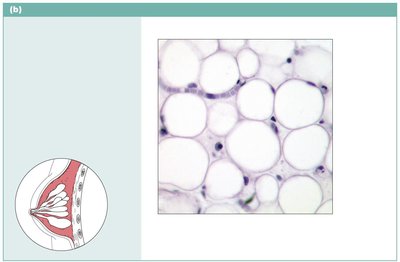
Adipose tissue is specialized for nutrient storage, shock absorption, insulation, and energy storage. It is richly vascularized and consists mainly of adipocytes.
Function: Provides reserve food fuel, insulates against heat loss, supports and protects organs.
Location: Under skin, around kidneys and eyeballs, within abdomen, in breasts.
Reticular Connective Tissue
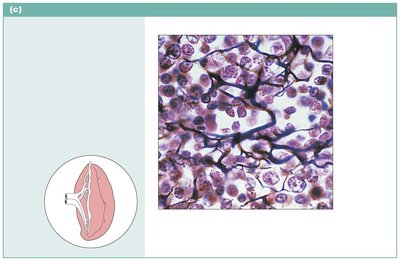
Reticular tissue resembles areolar but contains only reticular fibers. It supports free blood cells in lymphoid organs.
Function: Forms a soft internal skeleton (stroma) supporting other cell types.
Location: Lymph nodes, bone marrow, spleen.
Dense Regular Connective Tissue
Dense regular tissue consists of closely packed bundles of collagen fibers running parallel to the direction of pull, providing great resistance to tension.
Function: Attaches muscles to bones or muscles, attaches bones to bones, withstands tensile stress.
Location: Tendons, ligaments, aponeuroses.
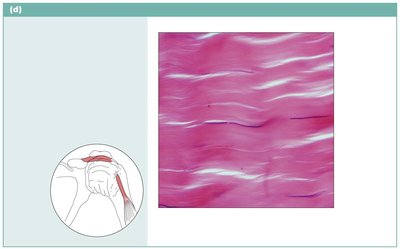
Dense Irregular Connective Tissue
Dense irregular tissue has thicker, irregularly arranged collagen bundles, allowing it to resist tension from multiple directions.
Function: Withstands tension exerted in many directions, provides structural strength.
Location: Fibrous capsules of organs and joints, dermis of skin, submucosa of digestive tract.
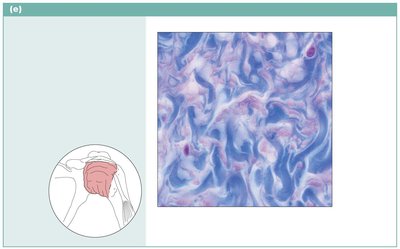
Elastic Connective Tissue
Elastic connective tissue contains a high proportion of elastic fibers, allowing tissues to recoil after stretching. It is found in certain ligaments and the walls of large arteries.
Function: Maintains pulsatile flow of blood through arteries, aids passive recoil of lungs.
Location: Walls of large arteries, ligaments associated with vertebral column, walls of bronchial tubes.
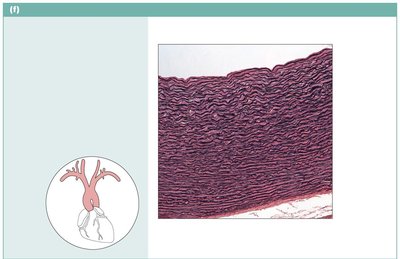
Cartilage
Structure and Types
Cartilage is a tough yet flexible tissue, lacking nerve fibers and being avascular. It is composed of chondroblasts and chondrocytes, and receives nutrients from the perichondrium. There are three types of cartilage: hyaline, elastic, and fibrocartilage.
Hyaline Cartilage: Supports and reinforces, serves as a cushion, resists compressive stress. Found in embryonic skeleton, ends of long bones, costal cartilages, nose, trachea, larynx.
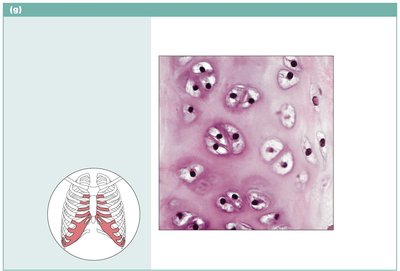
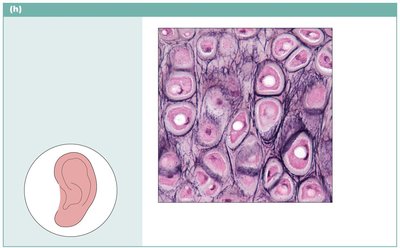
Elastic Cartilage: Maintains shape while allowing flexibility. Found in external ear and epiglottis.
Fibrocartilage: Provides tensile strength and absorbs compressive shock. Found in intervertebral discs, pubic symphysis, discs of knee joint.
Bone (Osseous Tissue)
Structure and Function
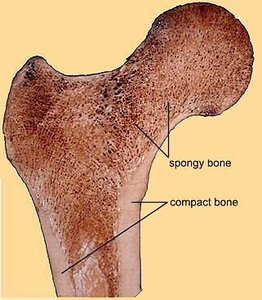
Bone tissue supports and protects body structures, stores fat, and synthesizes blood cells. It contains more collagen than cartilage and has inorganic calcium salts. Osteoblasts produce the matrix, osteocytes maintain it, and osteons are the structural units. Bone is richly vascularized.
Function: Supports and protects, provides levers for muscles, stores minerals and fat, site for blood cell formation.
Structure: Compact bone and spongy bone.
Blood
Structure and Function
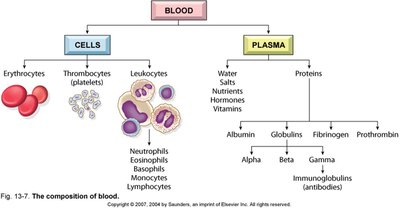
Blood is a fluid connective tissue composed of red blood cells, white blood cells, and platelets suspended in plasma. It functions in the transport of respiratory gases, nutrients, wastes, and other substances.
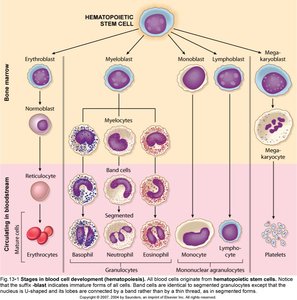
Cells: Erythrocytes (RBCs), leukocytes (WBCs), platelets.
Matrix: Plasma (fluid, no fibers).
Function: Transport of gases, nutrients, wastes, hormones.
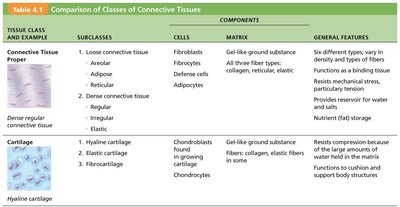
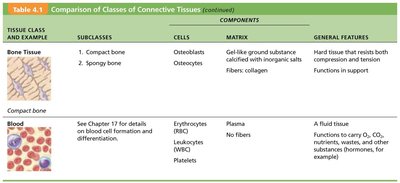
Summary Table: Comparison of Classes of Connective Tissues
Tissue Class and Example | Subclasses | Cells | Matrix | General Features |
|---|---|---|---|---|
Connective Tissue Proper | Loose (Areolar, Adipose, Reticular); Dense (Regular, Irregular, Elastic) | Fibroblasts, Fibrocytes, Defense cells, Adipocytes | Gel-like ground substance; All three fiber types: collagen, reticular, elastic | Six different types; density and types of fibers vary; functions as binding tissue; resists mechanical stress; reservoir for water and salts; nutrient storage |
Cartilage | Hyaline, Elastic, Fibrocartilage | Chondroblasts (in growing cartilage), Chondrocytes | Gel-like ground substance; fibers: collagen, elastic fibers in some | Resists compression due to large amounts of water in matrix; functions to cushion and support body structures |
Bone Tissue | Compact bone, Spongy bone | Osteoblasts, Osteocytes | Gel-like ground substance calcified with inorganic salts; fibers: collagen | Hard tissue that resists both compression and tension; functions in support |
Blood | --- | Erythrocytes, Leukocytes, Platelets | Plasma (fluid); no fibers | Fluid tissue; functions to carry O2, CO2, nutrients, wastes, and other substances |
Key Formulas and Concepts
Proteoglycan Structure: Protein core + large polysaccharides (chondroitin sulfate, hyaluronic acid)
Blood Cell Development: Hematopoietic stem cells differentiate into various blood cell types
Example: The matrix composition in cartilage allows it to resist compressive forces, making it ideal for cushioning joints.
Additional info: Connective tissue is essential for maintaining the integrity and function of organs and systems throughout the body. Its regenerative capacity varies, with some tissues healing rapidly and others (like cartilage and nervous tissue) healing slowly or not at all.
