 Indietro
Connective Tissue: Structure, Types, and Functions
Guida di studio - Note intelligenti
 Appunti personalizzati basati sui tuoi materiali, ampliati con definizioni chiave, esempi e contesto.
Connective Tissue: Structure, Types, and Functions
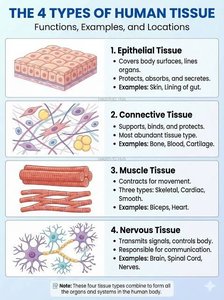
Overview of Human Tissue Types
The human body is composed of four primary tissue types: epithelial, connective, muscle, and nervous tissue. Each plays a distinct role in maintaining the structure and function of organs and systems.
Epithelial Tissue: Covers body surfaces, lines organs, and forms glands. Functions include protection, absorption, and secretion.
Connective Tissue: Supports, binds, and protects other tissues. It is the most abundant tissue type and includes bone, blood, and cartilage.
Muscle Tissue: Responsible for movement. Types include skeletal, cardiac, and smooth muscle.
Nervous Tissue: Transmits signals and coordinates body functions. Found in the brain, spinal cord, and nerves.
Connective Tissue: Definition and Major Functions
Connective tissue is the most abundant and widely distributed of the primary tissues. Its major functions include binding and support, protection, insulation, storing reserve fuel, and transporting substances (such as blood).
Binding and Support: Connective tissue forms the framework for organs and tissues.
Protection: Provides mechanical protection and immune defense.
Insulation: Adipose tissue insulates and stores energy.
Transport: Blood transports nutrients, gases, and wastes.
Classes of Connective Tissue
Connective tissue is classified into four main types:
Connective Tissue Proper: Includes loose (areolar, adipose, reticular) and dense (regular, irregular, elastic) connective tissues.
Cartilage: Includes hyaline, elastic, and fibrocartilage.
Bone: Compact and spongy bone.
Blood: Fluid connective tissue.
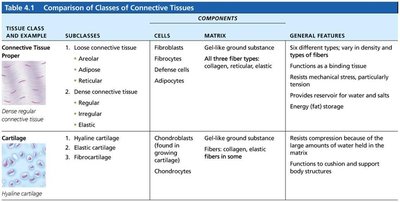
Comparison of Classes of Connective Tissues
The following tables summarize the subclasses, cellular components, matrix composition, and general features of connective tissue types.
Tissue Class and Example | Subclasses | Cells | Matrix | General Features |
|---|---|---|---|---|
Connective Tissue Proper | Loose: Areolar, Adipose, Reticular Dense: Regular, Irregular, Elastic | Fibroblasts, Fibrocytes, Adipocytes | Gel-like ground substance; all three fiber types: collagen, reticular, elastic | Six different types; vary in density and types of fibers. Functions as a binding tissue, resists mechanical stress, reservoir for water and salts, energy (fat) storage. |
Cartilage | Hyaline, Elastic, Fibrocartilage | Chondroblasts (in growing cartilage), Chondrocytes | Gel-like ground substance; fibers: collagen, elastic fibers in some | Resists compression due to water held in the matrix; functions to cushion and support body structures. |
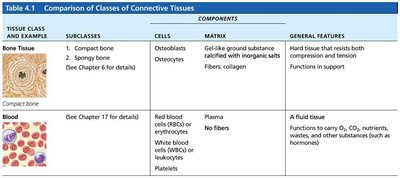
Tissue Class and Example | Subclasses | Cells | Matrix | General Features |
|---|---|---|---|---|
Bone Tissue | Compact bone, Spongy bone | Osteoblasts, Osteocytes | Gel-like ground substance calcified with inorganic salts; fibers: collagen | Hard tissue that resists both compression and tension; functions in support. |
Blood | See Chapter 17 for details | Red blood cells (RBCs), White blood cells (WBCs), Platelets | Plasma; no fibers | A fluid tissue; functions to carry O2, CO2, nutrients, wastes, and other substances (such as hormones). |
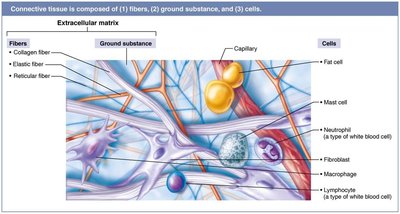
Structural Elements of Connective Tissue
Connective tissue is composed of three main elements: fibers, ground substance, and cells. The composition and arrangement of these elements vary among different types of connective tissues.
Fibers: Collagen (strongest), elastic (stretch and recoil), and reticular (branching networks).
Ground Substance: Gel-like material that fills space between cells; contains interstitial fluid, cell adhesion proteins, proteoglycans, and water.
Cells: Includes fibroblasts, chondroblasts, osteoblasts, adipocytes, and various immune cells.

Connective Tissue Proper: Loose Connective Tissues
Loose connective tissues are characterized by a loose arrangement of fibers and abundant ground substance. They include areolar, adipose, and reticular tissues.
Areolar Connective Tissue
Description: Gel-like matrix with all three fiber types; contains fibroblasts, macrophages, mast cells, and some white blood cells.
Function: Wraps and cushions organs; plays a role in inflammation.
Location: Widely distributed under epithelia of the body; forms lamina propria of mucous membranes.
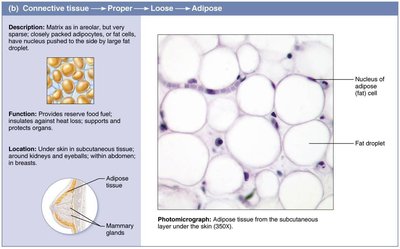
Adipose Tissue
Description: Matrix as in areolar, but very sparse; closely packed adipocytes.
Function: Provides reserve food fuel; insulates against heat loss; supports and protects organs.
Location: Under skin in subcutaneous tissue; around kidneys and eyeballs; within abdomen; in breasts.
Reticular Connective Tissue
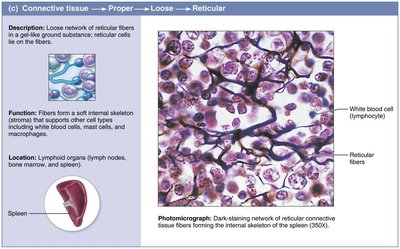
Description: Loose network of reticular fibers in a gel-like ground substance; reticular cells lie on the fibers.
Function: Fibers form a soft internal skeleton (stroma) that supports other cell types.
Location: Lymphoid organs (lymph nodes, bone marrow, spleen).
Connective Tissue Proper: Dense Connective Tissues
Dense connective tissues are characterized by closely packed fibers and less ground substance. They include dense regular, dense irregular, and elastic tissues.
Dense Regular Connective Tissue
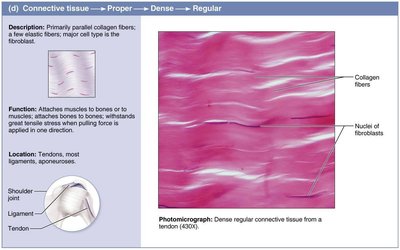
Description: Primarily parallel collagen fibers; few elastic fibers; major cell type is the fibroblast.
Function: Attaches muscles to bones or to muscles; withstands great tensile stress when pulling force is applied.
Location: Tendons, most ligaments, aponeuroses.
Dense Irregular Connective Tissue
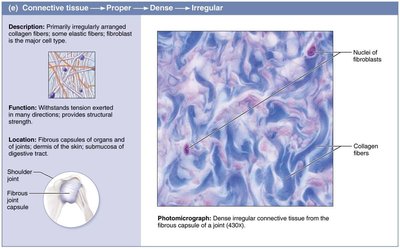
Description: Primarily irregularly arranged collagen fibers; some elastic fibers; fibroblast is the major cell type.
Function: Withstands tension exerted in many directions; provides structural strength.
Location: Fibrous capsules of organs and joints; dermis of the skin; submucosa of digestive tract.
Summary Table: Connective Tissue Types and Functions
The following table summarizes the main connective tissue types, their cellular components, matrix, and general features.
Type | Cells | Matrix | Function |
|---|---|---|---|
Areolar | Fibroblasts, macrophages, mast cells, WBCs | Gel-like, all fiber types | Wraps, cushions, inflammation |
Adipose | Adipocytes | Sparse, mostly fat | Energy storage, insulation, protection |
Reticular | Reticular cells | Reticular fibers | Internal skeleton for lymphoid organs |
Dense Regular | Fibroblasts | Collagen fibers | Attachment, tensile strength |
Dense Irregular | Fibroblasts | Irregular collagen fibers | Structural strength |
