Indietro
Digestive System: Structure, Function, and Physiology of Digestion & Absorption
Guida di studio - Note intelligenti
 Appunti personalizzati basati sui tuoi materiali, ampliati con definizioni chiave, esempi e contesto.
Digestive System Overview
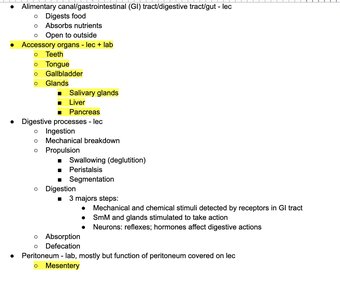
Alimentary Canal and Digestive Tract
The alimentary canal, also known as the gastrointestinal (GI) tract, is responsible for digesting food, absorbing nutrients, and serving as an open system to the external environment. It consists of several organs and accessory structures that facilitate the breakdown and absorption of nutrients.
Digestive functions: Digestion, absorption, and excretion
Open to outside: Mouth and anus
Accessory Organs
Accessory organs assist in digestion by producing enzymes, bile, and other substances. These include:
Teeth: Mechanical breakdown of food
Tongue: Assists in mixing and swallowing
Gallbladder: Stores and concentrates bile
Glands: Salivary glands, liver, pancreas
Digestive Processes
Ingestion, Mechanical Breakdown, and Propulsion
Food undergoes several processes in the digestive tract:
Ingestion: Intake of food
Mechanical breakdown: Chewing and mixing
Propulsion: Movement of food via swallowing (deglutition), peristalsis, and segmentation
Digestion and Absorption
Digestion involves chemical and mechanical stimuli detected by GI tract receptors, leading to the breakdown of food into absorbable units. Absorption is the process by which nutrients enter the blood or lymph.
Three major steps:
Mechanical and chemical stimuli
Neural and hormonal controls
Absorption of nutrients
Peritoneum and Mesentery
Peritoneal Structures
The peritoneum is a serous membrane lining the abdominal cavity. The mesentery is a fold of the peritoneum that attaches the intestines to the posterior abdominal wall, providing support and containing blood vessels, nerves, and lymphatics.
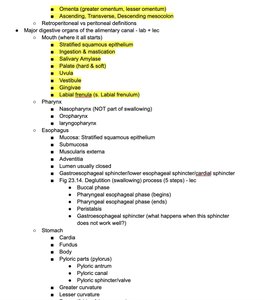
Omenta: Greater and lesser omentum
Mesocolon: Ascending, transverse, descending
Mesentery: Supports intestines
Major Digestive Organs
Mouth
The mouth is the entry point for food and is lined with stratified squamous epithelium. It contains structures for ingestion, mastication, and mixing food with saliva.
Structures: Teeth, palate (hard & soft), uvula, vestibule, gingiva, labial frenula
Salivary glands: Parotid, submandibular, sublingual
Pharynx and Esophagus
The pharynx and esophagus transport food from the mouth to the stomach. The esophagus is lined with stratified squamous epithelium and contains sphincters to regulate passage.
Pharynx: Nasopharynx, oropharynx, laryngopharynx
Esophagus: Upper and lower esophageal sphincters
Stomach
The stomach is a muscular organ that produces chyme and contains specialized cells for digestion.
Regions: Cardia, fundus, body, pyloric antrum, pyloric canal, pylorus
Histology: Gastric pits, glands, parietal cells (HCl, intrinsic factor), chief cells (pepsinogen), enteroendocrine cells (gastrin, histamine)
Mechanical processes: Rugae, muscularis externa (oblique layer)
Small Intestine
Structure and Function
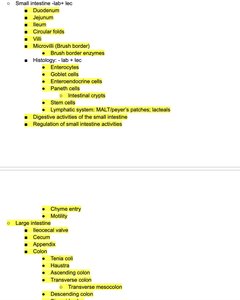
The small intestine is the primary site for digestion and absorption. It consists of the duodenum, jejunum, and ileum, and features villi and microvilli to increase surface area.
Histology: Enterocytes, goblet cells, enteroendocrine cells, Paneth cells, stem cells
Lymphatic system: MALT, Peyer's patches, lacteals
Digestive activities: Brush border enzymes, regulation of activities
Large Intestine
Structure and Function
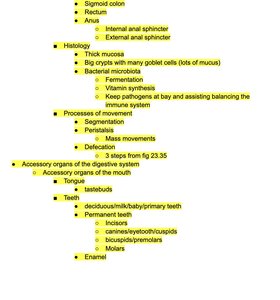
The large intestine absorbs water and forms feces. It includes the cecum, appendix, colon (ascending, transverse, descending, sigmoid), rectum, and anus.
Histology: Thick mucosa, goblet cells, crypts
Bacterial microbiota: Fermentation, vitamin synthesis, immune support
Processes: Segmentation, peristalsis, mass movements, defecation
Accessory Organs of the Mouth
Teeth and Tongue
Teeth are classified as deciduous (baby) or permanent, with various types (incisors, canines, bicuspids, molars). The tongue contains taste buds and assists in mechanical digestion.
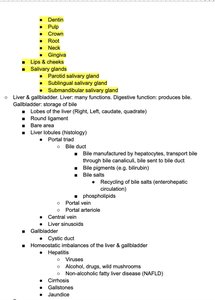
Tooth structure: Enamel, dentin, pulp, crown, root, neck, gingiva
Salivary Glands
Types and Functions
Salivary glands produce saliva, which contains enzymes for carbohydrate digestion and lubricates food.
Major glands: Parotid, submandibular, sublingual
Liver and Gallbladder
Structure and Function
The liver produces bile, which is stored and concentrated in the gallbladder. Bile aids in the digestion and absorption of lipids.
Liver lobes: Right, left, caudate, quadrate
Liver lobules: Portal vein, portal triad, central vein
Bile duct: Transports bile to duodenum
Bile salts: Recycled via enterohepatic circulation
Pancreas
Structure and Function
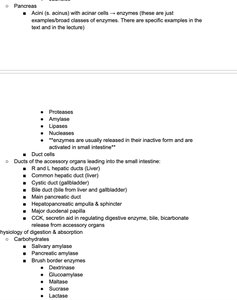
The pancreas contains acinar cells that produce digestive enzymes (proteases, amylase, lipase, nucleases). Enzymes are released in inactive forms and activated in the small intestine.
Duct cells: Secrete bicarbonate
Accessory ducts: Transport enzymes and bile to the duodenum
Physiology of Digestion and Absorption
Carbohydrate Digestion
Carbohydrates are broken down by salivary and pancreatic amylase, as well as brush border enzymes. Monosaccharides are absorbed into enterocytes and transported into the blood.
Enzymes: Amylase, maltase, sucrase, lactase
Transport: Diffusion, cotransport
Protein Digestion
Proteins are digested by pepsin in the stomach and pancreatic proteases in the small intestine. Amino acids are absorbed into enterocytes and transported into the blood.
Enzymes: Pepsin, trypsin, chymotrypsin, carboxypeptidase, brush border enzymes
Lipid Digestion
Lipids are digested by lipases and emulsified by bile salts. Absorption occurs via micelle formation and transport into enterocytes.
Enzymes: Pancreatic lipase
Micelle formation: Facilitates absorption
Absorption of Other Nutrients
Other nutrients, such as ions and water, are absorbed in the intestine.
Ions: Na+, Cl-, HCO3-, Ca2+
Water: Absorbed via osmosis
Relevant Images
The following images are directly relevant to the explanation of the digestive system and its components: