 Indietro
Digestive System: Structure, Function, and Processes
Guida di studio - Note intelligenti
 Appunti personalizzati basati sui tuoi materiali, ampliati con definizioni chiave, esempi e contesto.
The Digestive System
Overview of the Digestive System
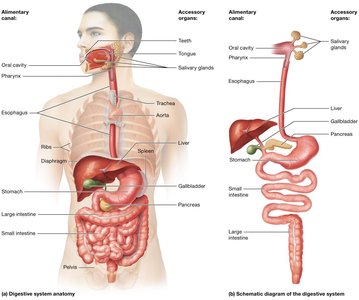
The digestive system is responsible for breaking down food into nutrients that can be absorbed and utilized by the body. It consists of the alimentary canal and accessory organs.
Alimentary Canal: Includes the oral cavity, pharynx, esophagus, stomach, small intestine, and large intestine.
Accessory Organs: Teeth, tongue, salivary glands, liver, gallbladder, and pancreas.
Basic Digestive Functions and Processes
The digestive system performs several key functions:
Ingestion: Intake of food and water into the mouth.
Secretion: Release of substances such as mucus, enzymes, acids, and hormones by glands.
Propulsion: Movement of food through the alimentary canal via peristalsis.
Digestion:
Mechanical Digestion: Physical breakdown of food (e.g., chewing, churning).
Chemical Digestion: Enzymatic breakdown of food molecules.
Absorption: Transfer of nutrients, water, electrolytes, and vitamins into blood or lymph.
Defecation: Elimination of indigestible materials as feces.
Regulation of Motility by the Nervous and Endocrine Systems
Motility is regulated by both nervous and endocrine systems.
Skeletal Muscle: Found in oral cavity, pharynx, upper esophagus, and last portion of large intestine.
Smooth Muscle: Present in the rest of the alimentary canal.
Nervous System:
Autonomic Nervous System (ANS): Sympathetic inhibits, parasympathetic stimulates digestive processes (long reflexes).
Enteric Nervous System (ENS): Local control (short reflexes).
Endocrine System: Hormones produced in digestive organs regulate motility.
The Oral Cavity, Pharynx, and Esophagus
Structure and Function of the Oral Cavity
The oral cavity is the entry point for digestion, where ingestion, secretion, mechanical and chemical digestion, and propulsion occur.
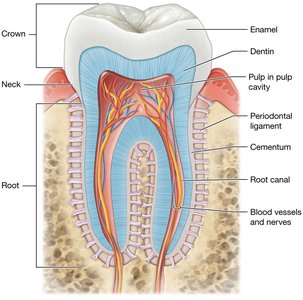
Teeth: Located in alveoli of mandible and maxilla, held by periodontal ligaments. Responsible for mastication (chewing).
Tongue: Assists in mixing food and forming the bolus.
Salivary Glands: Secrete saliva containing enzymes and mucus.
Swallowing (Deglutition)
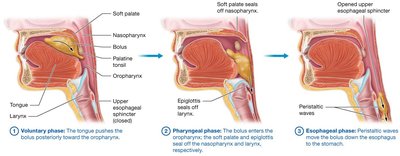
Swallowing is a specialized propulsion process with three phases:
Voluntary Phase: Tongue pushes bolus toward oropharynx (conscious control).
Pharyngeal Phase: Bolus enters oropharynx; soft palate and epiglottis seal off nasopharynx and larynx (swallowing reflex).
Esophageal Phase: Peristaltic waves move bolus down esophagus to stomach; regulated by ENS and medulla oblongata.
Histology and Functions of the Stomach
Structure of the Stomach
The stomach has specialized layers and cells for digestion.
Muscularis Externa: Includes an inner oblique layer for churning food into chyme.
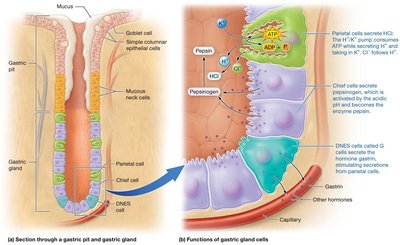
Mucosa: Contains gastric pits and glands with various cell types.
Gastric Gland Cells and Their Functions
Mucous Neck Cells: Secrete acidic mucus.
Parietal Cells: Secrete hydrochloric acid (HCl) and intrinsic factor.
Chief Cells: Secrete pepsinogen (precursor to pepsin).
DNES Cells: Secrete hormones (e.g., gastrin).
Acid Secretion Phases
Gastric acid secretion occurs in three phases:
Cephalic Phase: Triggered by sight, smell, taste, or thought of food; CNS and vagus nerve stimulate acid release.
Gastric Phase: Food in stomach stimulates ENS and vagus nerve; positive feedback increases acid secretion.
Intestinal Phase: Chyme in duodenum triggers hormones that reduce acid secretion.
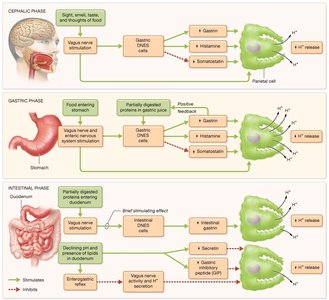
Motility of the Stomach
The stomach exhibits receptive relaxation, churning, and emptying functions.
Receptive Relaxation: Stomach expands to accommodate food.
Churning: Peristaltic waves mix chyme; controlled by gastric pacemaker cells.
Emptying: Chyme passes through pyloric sphincter; regulated by duodenal feedback.
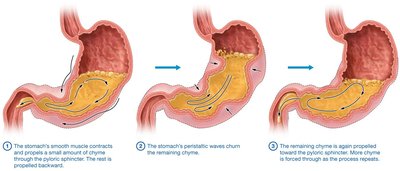
The Small Intestine
Structure and Functions
The small intestine is the primary site for digestion and absorption.
Divisions: Duodenum, jejunum, ileum.
Folds: Circular folds, villi, and microvilli increase surface area for absorption.
Enterocytes: Epithelial cells producing enzymes, hormones, and mucus.
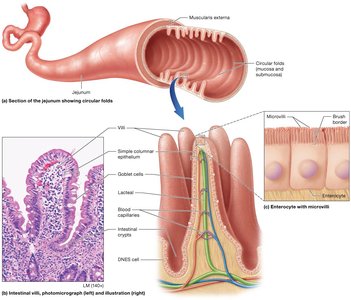
Motility of the Small Intestine
Migrating Motor Complex: Clears leftover material during fasting.
Peristalsis: Propels chyme during feeding.
Segmentation: Mixes chyme for digestion and absorption.
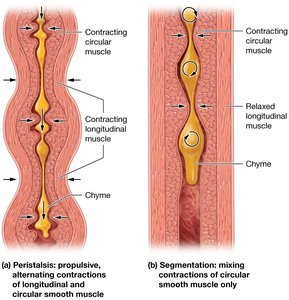
The Large Intestine
Structure and Functions
The large intestine absorbs water, electrolytes, and houses beneficial bacteria.
Normal Flora: Bacteria produce vitamins, metabolize undigested materials, and deter harmful bacteria.
Motility: Segmentation (churning) and mass movements propel contents.
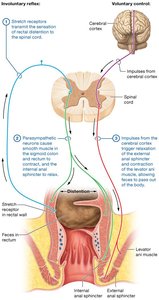
Defecation Reflex: Controlled by stretch receptors, parasympathetic neurons, and voluntary impulses.
Accessory Digestive Organs
The Pancreas
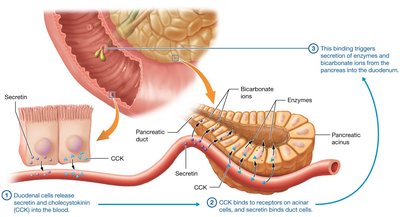
Pancreatic Juice: Contains digestive enzymes and bicarbonate ions; neutralizes acidic chyme.
Hormonal Regulation: CCK and secretin stimulate enzyme and bicarbonate secretion.
The Liver and Gallbladder
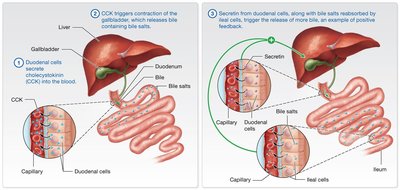
Liver: Produces bile, metabolizes nutrients, detoxifies substances, and excretes waste.
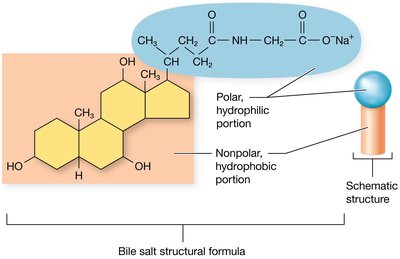
Bile Salts: Amphipathic molecules that emulsify lipids for digestion.
Gallbladder: Stores and releases bile upon stimulation by CCK.
Summary Table: Accessory Digestive Organs
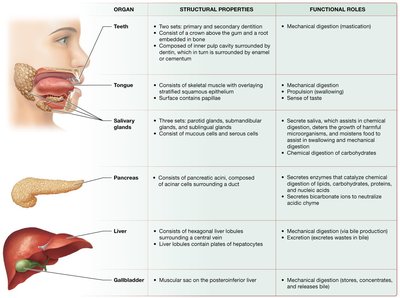
Organ | Structural Properties | Functional Roles |
|---|---|---|
Teeth | Primary and secondary dentition; crown, neck, root; enamel, dentin, pulp | Mechanical digestion (mastication) |
Tongue | Skeletal muscle with papillae | Mechanical digestion, propulsion, taste |
Salivary glands | Parotid, submandibular, sublingual glands | Secrete saliva (enzymes, mucus, IgA, lysozyme) |
Pancreas | Acinar and duct cells | Secrete enzymes and bicarbonate ions |
Liver | Hexagonal lobules, hepatocytes | Bile production, nutrient metabolism, detoxification |
Gallbladder | Muscular sac | Stores and releases bile |
Digestion and Absorption of Nutrients
Carbohydrates
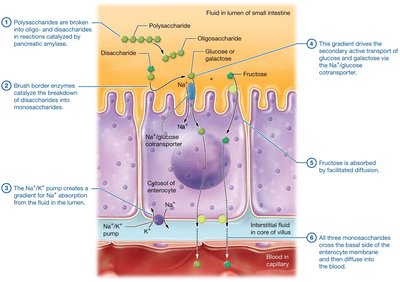
Digestion: Begins with salivary amylase in mouth, continues with pancreatic amylase and brush border enzymes in small intestine.
Absorption: Glucose and galactose via Na+/glucose cotransporter; fructose by facilitated diffusion.
Proteins
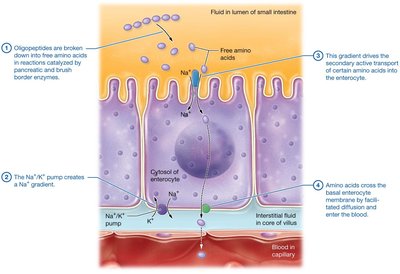
Digestion: Begins with pepsin in stomach, continues with pancreatic enzymes and brush border enzymes in small intestine.
Absorption: Amino acids and oligopeptides via Na+-driven cotransport; facilitated diffusion into blood.
Lipids
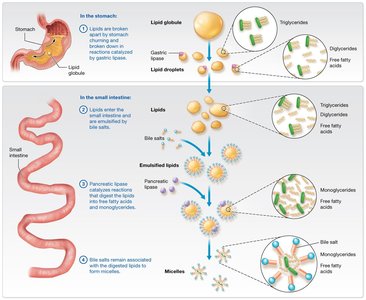
Digestion: Begins with gastric lipase in stomach, continues with pancreatic lipase in small intestine; bile salts emulsify lipids.
Absorption: Micelles escort lipids to enterocytes; lipids are reassembled into triglycerides and packaged into chylomicrons, which enter lymphatic vessels.
Nucleic Acids
Digestion: Pancreatic nucleases break nucleic acids into nucleotides; brush border enzymes further digest them.
Absorption: Phosphate, ribose/deoxyribose, and nitrogenous bases absorbed into blood.
Absorption of Water, Electrolytes, and Vitamins
Water: Absorbed by osmosis; most in small intestine, remainder in large intestine.
Electrolytes: Sodium, calcium, iron, magnesium absorbed by active transport or cotransport mechanisms.
Vitamins: Water-soluble vitamins absorbed by diffusion; vitamin B12 requires intrinsic factor. Fat-soluble vitamins absorbed with lipids in micelles.
Summary Table: Digestive Enzymes
Enzyme(s) | Source | Reaction Catalyzed |
|---|---|---|
Salivary amylase | Salivary glands | Polysaccharides to oligosaccharides |
Pancreatic amylase | Pancreatic juice | Polysaccharides to oligosaccharides |
Maltase, sucrase, lactase | Intestinal brush border | Oligosaccharides to monosaccharides |
Pepsin | Chief cells (gastric glands) | Proteins to polypeptides/oligopeptides |
Trypsin, chymotrypsin, carboxypeptidase | Pancreatic juice | Oligopeptides to small peptides |
Dipeptidase, tripeptidase | Intestinal brush border | Dipeptides/tripeptides to amino acids |
Gastric lipase | Gastric glands | Triglycerides to free fatty acids/diglycerides |
Pancreatic lipase | Pancreatic juice | Triglycerides to free fatty acids/monoglycerides |
Nucleases | Pancreatic juice | Nucleic acids to nitrogenous bases/simple sugars |
Putting It All Together: The Big Picture of Digestion
The digestive system integrates mechanical and chemical processes to break down food, absorb nutrients, and eliminate waste. Each organ and accessory structure plays a specialized role, coordinated by neural and hormonal signals. Understanding these processes is essential for comprehending human physiology and maintaining health.
