 Indietro
Fluid and Electrolyte Balance: Integrative Physiology Study Notes
Guida di studio - Note intelligenti
 Appunti personalizzati basati sui tuoi materiali, ampliati con definizioni chiave, esempi e contesto.
Fluid and Electrolyte Balance
Overview of Fluid and Electrolyte Homeostasis
Fluid and electrolyte balance is essential for maintaining homeostasis in the human body. The kidneys, lungs, and cardiovascular system work together to regulate the volume, osmolarity, and composition of body fluids. Disruptions in this balance can affect cell function, blood pressure, and overall health.
Key Routes of Excretion: Kidneys (primary), feces, sweat, lungs (water and bicarbonate loss).
Behavioral Mechanisms: Thirst and salt appetite help maintain balance.
Integration: Respiratory and cardiovascular systems provide rapid neural responses; kidneys provide slower endocrine/neuroendocrine responses.
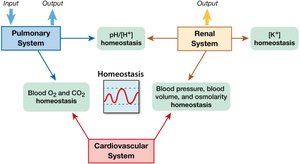
Core Concepts in Fluid and Electrolyte Physiology
Several foundational principles guide the understanding of fluid and electrolyte physiology:
Homeostasis: The body maintains internal stability through feedback mechanisms.
Communication: Cells and organs communicate via chemical and electrical signals.
Mass Balance: Input and output of substances must be balanced.
Structure-Function: The structure of organs and cells determines their function.
Compartmentation: Body fluids are separated into compartments (intracellular, extracellular).
Molecular Interactions: Interactions between molecules affect physiological processes.

Water Balance
Daily Water Intake and Excretion
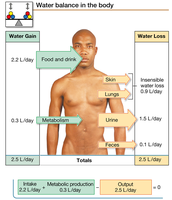
Water balance is achieved when daily intake equals daily loss. The body gains water through ingestion and metabolism, and loses water via urine, feces, skin, and lungs.
Intake: Food and drink (2.2 L/day), metabolism (0.3 L/day).
Loss: Skin and lungs (0.9 L/day), urine (1.5 L/day), feces (0.1 L/day).
Pathological Loss: Diarrhea, vomiting, excessive sweating.
Kidneys: Conserve water by adjusting urine concentration.
Kidneys Conserve Volume
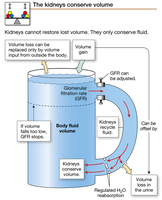
The kidneys play a crucial role in conserving body fluid volume. They cannot restore lost volume but can minimize further loss by regulating urine output.
Glomerular Filtration Rate (GFR): Adjusted to conserve fluid.
Volume Loss: If fluid falls too low, GFR stops.
Regulated Reabsorption: Kidneys recycle fluid and regulate water reabsorption.
Osmolarity Changes Through the Nephron
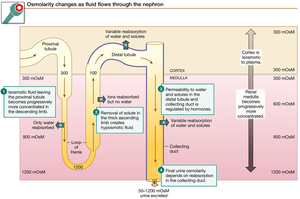
Osmolarity of urine reflects the amount of water excreted. The nephron creates concentrated or dilute urine by varying water and solute reabsorption.
Descending Loop of Henle: Loses water by osmosis.
Ascending Limb: Impermeable to water; actively transports solutes.
Distal Nephron: Water permeability controlled by hormones.
Collecting Duct: Can reabsorb additional solute, making urine more dilute.
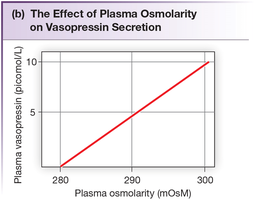
Vasopressin and Water Reabsorption
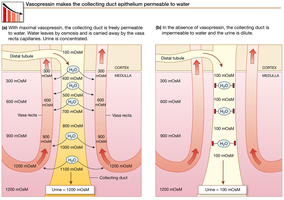
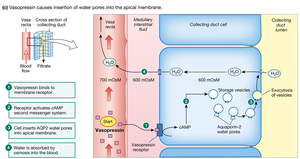
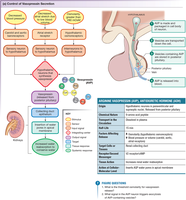
Vasopressin (antidiuretic hormone, ADH) regulates water reabsorption in the collecting ducts. It increases the permeability of the duct to water, allowing more water to be reabsorbed and urine to become concentrated.
Mechanism: Vasopressin stimulates insertion of aquaporins into the apical membrane.
Graded Effect: Matches urine concentration to body needs.
Circadian Pattern: Less urine produced at night.
Countercurrent Mechanisms in the Kidney
Loop of Henle as a Countercurrent Multiplier
The loop of Henle and vasa recta form a countercurrent multiplier system, which creates a concentration gradient in the renal medulla. This gradient allows the kidney to produce concentrated urine.
Active Transport: Ascending limb transfers solutes into the medulla.
Water Removal: Vasa recta removes water, maintaining osmolarity.
Urea: Increases interstitial osmolarity.
*Additional info: Countercurrent exchange systems are essential for efficient reabsorption and concentration of urine.*
Sodium Balance and ECF Volume
Regulation of Sodium and Extracellular Fluid (ECF) Volume
Sodium balance is tightly regulated to maintain ECF volume and osmolarity. Aldosterone, a steroid hormone, controls sodium reabsorption in the distal tubules and collecting ducts.
Extra NaCl: Raises osmolarity, triggers vasopressin release and thirst.
Aldosterone: Increases sodium reabsorption, targets principal cells.
Low Blood Pressure: Stimulates aldosterone secretion.
*Additional info: Sodium balance is critical for blood pressure regulation and cellular function.*
Renin-Angiotensin Pathway
The renin-angiotensin system (RAS) is activated when blood pressure decreases. Renin, secreted by juxtaglomerular cells, initiates a cascade that produces angiotensin II, which stimulates aldosterone release and increases blood pressure.
Renin: Converts angiotensinogen to angiotensin I.
ACE: Converts angiotensin I to angiotensin II.
Angiotensin II: Potent vasoconstrictor, stimulates thirst, increases vasopressin secretion.
*Additional info: Drugs such as ACE inhibitors and ARBs target this pathway to treat hypertension.*
Natriuretic Peptides
Natriuretic peptides promote sodium and water excretion, decreasing blood volume and pressure. Atrial natriuretic peptide (ANP) and brain natriuretic peptide (BNP) are key hormones in this process.
ANP: Produced in atrial myocardial cells.
BNP: Produced in ventricular myocardial cells and certain brain neurons.
Effects: Dilate afferent arterioles, increase GFR, decrease sodium reabsorption, suppress RAS.
*Additional info: Natriuretic peptides are important in heart failure management.*
Potassium Balance
Regulation of Plasma Potassium
Potassium levels are maintained within a narrow range by regulatory mechanisms, primarily involving aldosterone. Imbalances can lead to serious health issues.
Hypokalemia: Causes muscle weakness and failure of respiratory muscles and heart.
Hyperkalemia: Can lead to cardiac arrhythmias.
Disturbances: May result from kidney disease, diarrhea, or diuretics.
*Additional info: Potassium balance is essential for nerve and muscle function.*
Behavioral Mechanisms in Salt and Water Balance
Behavioral Responses
Behavioral mechanisms such as drinking and salt appetite help maintain fluid and electrolyte balance. Avoidance behaviors prevent dehydration.
Thirst: Replaces fluid loss.
Salt Appetite: Craving for salty foods when plasma sodium levels drop.
Avoidance: Behaviors such as avoiding heat help conserve water.
*Additional info: These mechanisms are especially important in extreme environments.*
Integrated Control of Volume, Osmolarity, and Blood Pressure
Homeostatic Responses to Dehydration
Dehydration triggers a series of homeostatic responses involving cardiovascular, renal, and behavioral mechanisms. Compensation includes increased vasopressin, thirst, and cardiovascular adjustments.
Decreased Blood Volume/Pressure: Triggers vasopressin release, thirst, and cardiovascular responses.
Increased Osmolarity: Activates osmoreceptors, increases vasopressin secretion.
Endocrine Disorders: Diabetes insipidus (low vasopressin), SIADH (high vasopressin).
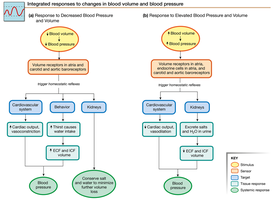 *Additional info: Osmolarity and volume can change independently, requiring integrated control.*
Acid–Base Balance
Regulation of Plasma pH
Normal plasma pH is tightly regulated between 7.38 and 7.42. Changes in pH can denature proteins and affect nervous system function.
Acidosis: Neurons become less excitable; CNS depression.
Alkalosis: Neurons become hyperexcitable; severe cases can lead to muscle tetanus.
Sources of Acids: Organic acids from diet and metabolism, ketoacids in diabetes.
Sources of Bases: Few dietary or metabolic sources.
*Additional info: Acid-base disturbances are associated with respiratory and metabolic disorders.*
Buffer Systems, Lungs, and Kidneys
pH homeostasis depends on buffer systems, respiratory compensation, and renal compensation.
Buffers: Proteins, phosphate ions, bicarbonate.
Henderson-Hasselbalch Equation: Describes pH as a function of bicarbonate and CO2 concentration.
Ventilation: Corrects 75% of pH disturbances; hypoventilation and hyperventilation affect pH.
Kidneys: Use ammonia and phosphate buffers to remove acids and add base.
Henderson-Hasselbalch Equation:
*Additional info: The kidneys and lungs work together to maintain acid-base balance.*
Acid-Base Disturbances
Acid-base disturbances may be respiratory or metabolic in origin.
Respiratory Acidosis: Hypoventilation increases CO2, decreases pH.
Metabolic Acidosis: Excess acid input or decreased excretion lowers pH.
Respiratory Alkalosis: Hyperventilation decreases CO2, increases pH.
Metabolic Alkalosis: Loss of acid or excessive base intake increases pH.
*Additional info: Compensation may be incomplete, leading to clinical symptoms.*
Summary Table: Responses to Changes in Volume, Blood Pressure, and Osmolarity
The following table summarizes the homeostatic responses triggered by changes in blood pressure, volume, and osmolarity:
Condition | Stimulus | Response | Effect |
|---|---|---|---|
Decreased Blood Pressure/Volume | Low blood pressure/volume | Vasopressin release, thirst, cardiovascular adjustments | Conserve water, increase blood pressure |
Increased Blood Pressure | High blood pressure/volume | Natriuretic peptide release, decreased vasopressin | Excrete water and sodium, decrease blood pressure |
Increased Osmolarity | High plasma osmolarity | Vasopressin release, thirst | Conserve water, dilute plasma |
Decreased Osmolarity | Low plasma osmolarity | Decrease vasopressin, increase water excretion | Concentrate plasma |
*Additional info: Table entries inferred from context and academic knowledge.*
