 Indietro
Fluid, Electrolyte, and Acid-Base Balance: Study Notes for Anatomy & Physiology
Guida di studio - Note intelligenti
 Appunti personalizzati basati sui tuoi materiali, ampliati con definizioni chiave, esempi e contesto.
Fluid Compartments of the Body
Main Fluid Compartments
The human body contains several distinct fluid compartments, each with specific volumes and functions. Understanding these compartments is essential for grasping fluid and electrolyte balance.
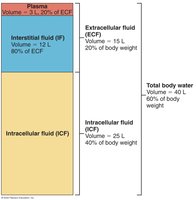
Intracellular Fluid (ICF): Fluid within cells; makes up about 40% of body weight (25 L).
Extracellular Fluid (ECF): Fluid outside cells; includes interstitial fluid and plasma. Comprises about 20% of body weight (15 L).
Interstitial Fluid (IF): Fluid between cells; constitutes 80% of ECF (12 L).
Plasma: The liquid component of blood; makes up 20% of ECF (3 L).
Total Body Water: Approximately 40 L, or 60% of body weight.
Electrolyte Composition of Body Fluids
Major Electrolytes in Plasma, Interstitial Fluid, and Intracellular Fluid
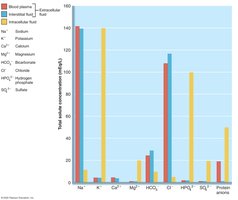
Electrolytes are ions that help regulate fluid balance, nerve function, and muscle contraction. Their concentrations differ between compartments.
Sodium (Na+): Highest in ECF (plasma and interstitial fluid).
Potassium (K+): Highest in ICF.
Chloride (Cl-): Predominant anion in ECF.
Bicarbonate (HCO3-): Important buffer, mainly in ECF.
Proteins: More abundant in plasma and ICF than in interstitial fluid.
Fluid Movement Among Compartments
Mechanisms of Exchange
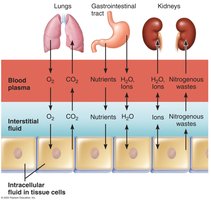
Fluid movement between compartments is regulated by osmotic and hydrostatic pressures, ensuring continuous exchange and mixing.
Plasma ↔ Interstitial Fluid: Occurs across capillary walls; fluid leaves at arteriolar end, reabsorbed at venule end. Lymphatics return remaining fluid to blood.
Interstitial Fluid ↔ Intracellular Fluid: Occurs across cell membranes; water moves two ways by osmosis, ions move selectively, nutrients/wastes/gases flow unidirectionally.
Water Balance and ECF Osmolality
Regulation of Osmolality
Osmolality refers to the concentration of solutes in body fluids. It is tightly regulated to maintain homeostasis.
Normal ECF Osmolality: 280–300 mOsm.
Rise in Osmolality: Stimulates thirst and ADH (antidiuretic hormone) release.
Decrease in Osmolality: Inhibits ADH release.
Disturbances in Water Balance
Dehydration and Hypotonic Hydration
Imbalances in water intake or loss can lead to dehydration or hypotonic hydration, affecting cell volume and function.
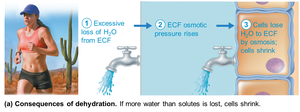
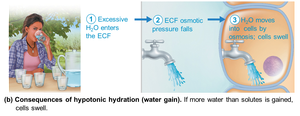
Dehydration: Excessive water loss from ECF increases osmotic pressure, causing cells to lose water and shrink.
Hypotonic Hydration: Excessive water gain lowers ECF osmotic pressure, causing water to move into cells and swell.
Central Role of Sodium in Fluid and Electrolyte Balance
Sodium's Functions and Effects
Sodium is the most abundant cation in ECF and is crucial for controlling ECF volume, water distribution, and blood pressure.
Contribution: Sodium accounts for 280 mOsm of the total 300 mOsm ECF solute concentration.
Regulation: Changes in Na+ levels affect plasma volume, blood pressure, and ECF/IF volumes.
Acid-Base Balance
Importance of pH Regulation
Body fluid pH affects all functional proteins and biochemical reactions. Maintaining normal pH is essential for physiological function.
Normal pH Values: Arterial blood: 7.4; Venous blood and interstitial fluid: 7.35.
Alkalosis: Arterial pH > 7.45.
Acidosis: Arterial pH < 7.35.
Sources of Acids
Lactic Acid: Produced during anaerobic respiration of glucose.
Fatty Acids and Ketone Bodies: From fat metabolism.
Hydrogen Ions (H+): Generated when CO2 is converted to HCO3- in blood.
Mechanisms of Acid-Base Balance
Buffer Systems, Respiratory, and Renal Regulation
The body uses three main mechanisms to regulate acid-base balance:
Chemical Buffer Systems: Rapid, first line of defense against pH changes.
Brain Stem Respiratory Centers: Act within 1–3 minutes to adjust CO2 elimination.
Renal Mechanisms: Most potent, but require hours to days to effect pH changes.
Respiratory Regulation of H+
Role of the Respiratory System
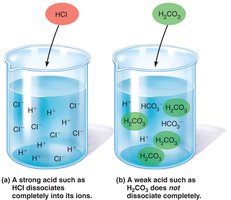
The respiratory system eliminates CO2, an acid, and helps regulate blood pH.
CO2 Unloading: Reaction shifts left, H+ incorporated into H2O.
CO2 Loading: Reaction shifts right, H+ buffered.
High PCO2: Activates medullary chemoreceptors, increases respiratory rate and depth.
Rising Plasma H+ (Acidosis): Activates peripheral chemoreceptors, increases respiratory rate and depth.
Alkalosis: Depresses respiratory center, decreases respiratory rate and depth, H+ concentration increases.
Impairment: Hypoventilation causes respiratory acidosis; hyperventilation causes respiratory alkalosis.
Renal Regulation of Acid-Base Balance
Kidney Functions
The kidneys regulate acid-base balance by adjusting the amount of bicarbonate (HCO3-) in the blood.
Conserving/Generating HCO3-: Raises blood pH.
Excreting HCO3-: Lowers blood pH.
Excreting one HCO3- is equivalent to gaining one H+.
To reabsorb bicarbonate, kidney must secrete H+.
To excrete excess bicarbonate, kidney must retain (not secrete) H+.
Summary Table: Causes and Consequences of Electrolyte Imbalances
Classification and Effects
Electrolyte imbalances can have significant physiological consequences. The following table summarizes major types, causes, and effects.
Electrolyte | Imbalance | Primary Cause | Consequences |
|---|---|---|---|
Sodium | Hypernatremia / Hyponatremia | Dehydration / Excess water intake | Neurological symptoms, confusion, muscle twitching |
Potassium | Hyperkalemia / Hypokalemia | Renal failure / Vomiting, diarrhea | Cardiac arrhythmias, muscle weakness |
Calcium | Hypercalcemia / Hypocalcemia | Hyperparathyroidism / Vitamin D deficiency | Bone fragility, neuromuscular dysfunction |
Phosphate | Hyperphosphatemia / Hypophosphatemia | Renal failure / Malnutrition | Muscle weakness, bone loss |
Chloride | Hyperchloremia / Hypochloremia | Dehydration / Vomiting | Acid-base disturbances |
Additional info: Table entries inferred from typical clinical presentations and textbook content.
