 Indietro
Forensic Investigation of Skeletal Remains: Anatomical and Physiological Principles
Guida di studio - Note intelligenti
 Appunti personalizzati basati sui tuoi materiali, ampliati con definizioni chiave, esempi e contesto.
Forensic Investigation of Skeletal Remains
Introduction to Forensic Osteology
Forensic osteology involves the identification of skeletal remains using anatomical and physiological principles. Key characteristics assessed include sex, race, and height. Accurate identification is enhanced by the presence of a complete skeleton, but forensic scientists often work with partial remains. Both metric (measurable) and non-metric (qualitative) data are used, with metric data generally providing more objective results.
Sex determination relies heavily on pelvic and cranial features.
Race determination is primarily based on cranial morphology and, to a lesser extent, femoral characteristics.
Height estimation uses the lengths of long bones, adjusted for sex and race.
Note: Age estimation is less reliable in adults and is not covered in this guide.
Key Directional Terms in Anatomy
Anterior (ventral): Front of the body
Posterior (dorsal): Back of the body
Superior: Toward the head
Inferior: Away from the head
Medial: Toward the midline
Lateral: Away from the midline
Proximal: Closer to a reference point
Distal: Farther from a reference point
Sex Determination
Pelvic Indicators
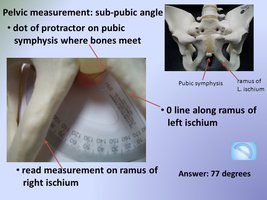
The pelvis is the most reliable bone for sex determination due to pronounced sexual dimorphism. Key features include the sub-pubic angle, pubis body width, pelvic cavity shape, and the greater sciatic notch.
Sub-pubic angle: Wider (>90°) and U-shaped in females; narrower (<90°) and V-shaped in males.
Pubis body width: ~40 mm in females; 25–30 mm in males.
Pelvic cavity shape: Circular and wide in females; heart-shaped in males.
Greater sciatic notch: Broad and shallow in females; deep and narrow in males.
Skull Indicators
Sexual dimorphism in the skull is less pronounced but still useful. Features assessed include the eye orbit, zygomatic arch, occipital protuberance, nuchal line, frontal bone, and mandible shape.
Eye orbit: Rounded and sharp in females; square and blunt in males.
Zygomatic arch: Less pronounced in females; more pronounced in males.
External occipital protuberance: Generally absent or slender in females; prominent in males.
Mandible: V-shaped and rounded in females; U-shaped and square in males.
Long Bones
Long bones such as the femur, humerus, and tibia can provide supporting evidence for sex determination, though they are less reliable than the pelvis or skull.
Race Determination
Race determination is based on cranial features and, to a lesser extent, femoral curvature. The three-race model commonly used is Caucasoid (European), Mongoloid (Asian/Amerindian), and Negroid (African).
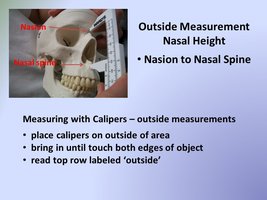
Nasal index: Calculated as nasal width divided by nasal height. Lower values (<0.48) suggest Caucasoid, intermediate (0.48–0.53) suggest Mongoloid, and higher (>0.53) suggest Negroid ancestry.
Nasal spine: Prominent in Caucasoids, somewhat prominent in Mongoloids, small in Negroids.
Nasal silling/guttering: Sharp ridge (silling) in Caucasoids, rounded in Mongoloids, guttering (no ridge) in Negroids.
Prognathism: Straight in Caucasoids, variable in Mongoloids, prognathic in Negroids.
Shape of orbital openings: Rounded/square in Caucasoids, rounded/circular in Mongoloids, rectangular/squared in Negroids.
Height Determination
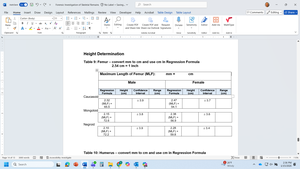
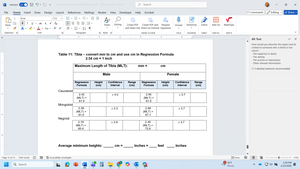
Height is estimated using the maximum length of long bones (femur, humerus, tibia) and regression formulas that account for sex and race. The accuracy increases when multiple bones are used.
Convert bone length from millimeters to centimeters before using the formula.
Apply the appropriate regression formula based on sex and race (see tables below).
Include a confidence interval to express the range of possible heights.
Femur Regression Formulas
Race | Sex | Regression Formula | Confidence Interval |
|---|---|---|---|
Caucasoid | Male | ±3.94 | |
Caucasoid | Female | ±3.72 | |
Mongoloid | Male | ±3.80 | |
Mongoloid | Female | ±3.91 | |
Negroid | Male | ±3.91 | |
Negroid | Female | ±3.82 |
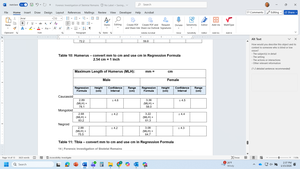
Humerus Regression Formulas
Race | Sex | Regression Formula | Confidence Interval |
|---|---|---|---|
Caucasoid | Male | ±4.57 | |
Caucasoid | Female | ±4.45 | |
Mongoloid | Male | ±4.41 | |
Mongoloid | Female | ±4.38 | |
Negroid | Male | ±4.38 | |
Negroid | Female | ±4.45 |
Tibia Regression Formulas
Race | Sex | Regression Formula | Confidence Interval |
|---|---|---|---|
Caucasoid | Male | ±3.90 | |
Caucasoid | Female | ±3.85 | |
Mongoloid | Male | ±3.92 | |
Mongoloid | Female | ±3.85 | |
Negroid | Male | ±3.90 | |
Negroid | Female | ±3.85 |
Using the Vernier Caliper
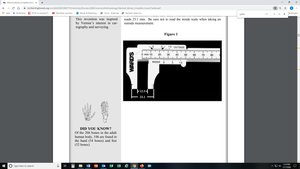
The Vernier caliper is an essential tool for taking precise measurements of bones. It can be used for both outside and inside measurements. For outside measurements, the caliper is placed around the object, and the reading is taken from the 'outside' scale.
Lightly squeeze the bone for outside measurements.
Open the caliper between the parts for inside measurements.
Read the whole number at the '0' of the appropriate scale; the decimal is where the scale lines up with a millimeter mark.
Summary Table: Passenger List for Identification
Forensic identification often involves matching skeletal findings to known profiles. The provided passenger list includes sex, race, age, and height, which are compared to skeletal determinations for final identification.
Conclusion
Forensic investigation of skeletal remains integrates anatomical and physiological knowledge to determine sex, race, and height. Accurate measurement techniques and understanding of skeletal variation are essential for reliable identification in forensic contexts.
