 Indietro
Forensic Investigation of Skeletal Remains: Sex, Race, and Height Determination
Guida di studio - Note intelligenti
 Appunti personalizzati basati sui tuoi materiali, ampliati con definizioni chiave, esempi e contesto.
Forensic Investigation of Skeletal Remains
Introduction to Forensic Skeletal Analysis
Forensic scientists utilize both metric (measurable) and non-metric (qualitative) data to identify skeletal remains. Key characteristics assessed include sex, race, and height. Accurate identification is facilitated by the presence of a complete skeleton, but partial remains require careful analysis using multiple anatomical indicators. Non-metric data, while subjective, can provide valuable supplementary information.
Key Directional Terms in Anatomy
Anterior (ventral): Front of the body
Posterior (dorsal): Back of the body
Superior: Toward the head
Inferior: Away from the head
Medial: Toward the midline
Lateral: Away from the midline
Proximal: Closer to a point of reference
Distal: Farther from a point of reference
Sex Determination from Skeletal Remains
Pelvis
The pelvis is the most reliable bone for sex determination due to pronounced sexual dimorphism. Several features are assessed:
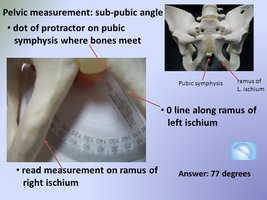
Sub-pubic angle: Wider (>90°) and U-shaped in females; narrower (<90°) and V-shaped in males.
Pubis body width: Broader in females (~40 mm) than in males (25–30 mm).
Pelvic cavity shape: Circular and wide in females; heart-shaped in males.
Greater sciatic notch: Broad and shallow in females; deep and narrow in males.
Sacrum: Short and wide in females; long and narrow in males.
Ilium shape: Wide and slanted in females; high and vertical in males.
Obturator foramen: Triangular in females; ovoid in males.
Skull
Sex determination from the skull involves assessing several morphological traits:
Upper edge of eye orbit: Slender and sharp in females; prominent and blunt in males.
Shape of eye orbit: Round in females; square in males.
Zygomatic arch: Not expressed below external auditory meatus in females; expressed in males.
External occipital protuberance: Generally absent or slender in females; prominent in males.
Superior nuchal line: Smooth in females; rough and bumpy in males.
Frontal bone: Round and globular in females; low and slanting in males.
Mandible shape: Round, V-shaped in females; square, U-shaped in males.
Angle of the mandible: Wide and rounded in females; squared (~90°) in males.
Glabella: Flat in females; bony in males.
Mastoid process: Small in females; large in males.
Long Bones (Femur, Humerus, Tibia)
Long bones can provide supplementary information for sex determination, though they are less reliable than the pelvis or skull. Key measurements include:
Femoral head diameter
Bicondylar width
Maximum bone length
Humeral head diameter
Epicondylar width
Tibial epiphyseal breadth
Race Determination from Skeletal Remains
Race determination is complex and based primarily on skull morphology. Forensic anthropologists often use a three-race model: Caucasoid (European), Mongoloid (Asian/Amerindian), and Negroid (African). Key features include:
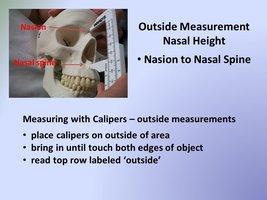
Nasal index: Calculated as nasal width divided by nasal height.
Nasal spine: Prominent in Caucasoids, somewhat prominent in Mongoloids, very small in Negroids.
Nasal silling/guttering: Sharp ridge (silling) in Caucasoids, rounded in Mongoloids, no ridge (guttering) in Negroids.
Prognathism: Straight in Caucasoids, variable in Mongoloids, prognathic in Negroids.
Shape of orbital openings: Rounded/square in Caucasoids, rounded/circular in Mongoloids, rectangular/squared in Negroids.
Height Determination from Long Bones
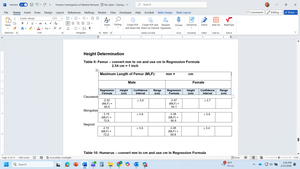
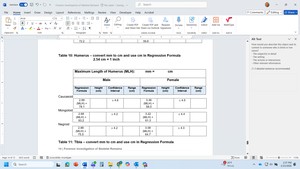
Height estimation is most accurate when multiple long bones are available. The relationship between bone length and height is dependent on both sex and race. The femur, humerus, and tibia are commonly used, and specific regression formulas are applied based on the individual's sex and race.
Convert bone length from millimeters to centimeters before using the formula.
Apply the appropriate regression equation for each bone and demographic group.
Calculate a confidence interval to provide a range for estimated height.
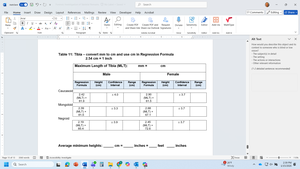
Sample Regression Formula (Femur Example)
For a Caucasoid male, the regression formula for height estimation from femur length (in cm) may be:
Always refer to the provided tables for the correct formula based on sex and race.
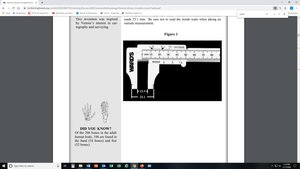
Using the Vernier Caliper
The Vernier caliper is an essential tool for taking precise skeletal measurements. It can be used for both outside and inside measurements. For outside measurements, the caliper is placed around the object, and the reading is taken from the 'outside' scale. For inside measurements, the tips are placed inside the object, and the reading is taken from the 'inside' scale.
Summary Table: Key Skeletal Traits for Sex and Race Determination
Trait | Female | Male | Caucasoid | Mongoloid | Negroid |
|---|---|---|---|---|---|
Sub-pubic angle | >90°, U-shaped | <90°, V-shaped | N/A | ||
Nasal index | N/A | <0.48 | 0.48–0.53 | >0.53 | |
Pelvic cavity shape | Circular, wide | Heart-shaped | N/A | ||
Mandible shape | V-shaped | U-shaped | N/A | ||
Prognathism | N/A | Straight | Variable | Prognathic | |
Application: Identification Process
To identify skeletal remains, forensic scientists:
Assess sex using pelvic and cranial features.
Determine race using cranial measurements and indices.
Estimate height using regression formulas based on long bone measurements.
Compare findings with known data (e.g., missing persons lists) to make a final identification.
Additional info: Forensic anthropology integrates anatomical knowledge with statistical methods to provide biological profiles from skeletal remains, which are crucial in both legal and archaeological contexts.
