 Indietro
Fundamentals of the Nervous System and Nervous Tissue: Study Notes
Guida di studio - Note intelligenti
 Appunti personalizzati basati sui tuoi materiali, ampliati con definizioni chiave, esempi e contesto.
Fundamentals of the Nervous System and Nervous Tissue
Overview of the Nervous System
The nervous system is the master control and communication system of the body, responsible for regulating thought, action, and emotion. It achieves this by transmitting electrical signals throughout the body, allowing for rapid and precise communication between different body regions.
Master Control: Coordinates voluntary and involuntary actions.
Communication: Relies on electrical impulses for fast signaling.
Integration: Processes and interprets sensory input to determine appropriate responses.
Main Functions of the Nervous System
The nervous system performs three essential functions:
Sensory Input: Detects changes (stimuli) inside and outside the body and sends this information to the brain and spinal cord.
Integration: Processes and interprets sensory input, deciding what should be done at each moment. This primarily occurs in the central nervous system (CNS).
Motor Output: Activates effector organs (muscles and glands) to cause a response.
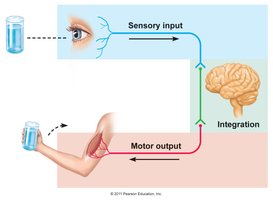
Organization of the Nervous System
Divisions of the Nervous System
The nervous system is divided into two main anatomical subdivisions:
Central Nervous System (CNS): Consists of the brain and spinal cord. It is the integrating and command center of the nervous system.
Peripheral Nervous System (PNS): Includes all nervous tissue outside the CNS, such as cranial and spinal nerves and their branches. It serves as the communication lines between the CNS and the rest of the body.
Divisions of the Peripheral Nervous System (PNS)
Sensory (Afferent) Division: Transmits impulses from sensory receptors to the CNS. It includes:
Somatic sensory fibers: Convey impulses from the skin, skeletal muscles, and joints (external environment).
Visceral sensory fibers: Transmit impulses from the visceral organs (internal environment).
Motor (Efferent) Division: Transmits impulses from the CNS to effector organs (muscles and glands).
Motor Division Subdivisions
Somatic Nervous System: Conducts impulses from the CNS to skeletal muscles. It is under voluntary control.
Autonomic Nervous System (ANS): Regulates smooth muscle, cardiac muscle, and glands. It is involuntary and has two subdivisions:
Sympathetic Division: Mobilizes body systems during emergency situations ("fight or flight").
Parasympathetic Division: Conserves energy and promotes housekeeping functions during rest ("rest and digest").
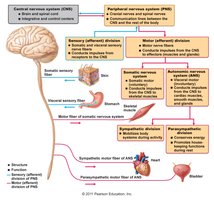
Histology of Nervous Tissue
Cellular Composition
Nervous tissue is densely packed, with less than 20% of the CNS being extracellular space. It contains two main types of cells:
Neurons: The functional units of the nervous system, specialized for transmitting electrical signals.
Neuroglia (Glial Cells): Supporting cells that provide structural and metabolic support to neurons.
Supporting Cells of the CNS
Astrocytes: Support and brace neurons, supply nutrients, and regulate the chemical environment.
Microglia: Monitor neuron health and act as macrophages to remove debris.
Ependymal Cells: Line the central cavities of the brain and spinal cord; their cilia help circulate cerebrospinal fluid.
Oligodendrocytes: Produce myelin sheaths in the CNS, insulating axons and increasing signal speed.
Supporting Cells of the PNS
Satellite Cells: Surround neuron cell bodies within ganglia, regulating the environment around them.
Schwann Cells (Neurolemmocytes): Form myelin sheaths around nerve fibers in the PNS, aiding in rapid signal transmission.
Neurons: Structure and Function
General Characteristics
Longevity: Neurons can live and function for a lifetime.
Amitotic: Most neurons lose the ability to divide after development.
High Metabolic Rate: Require continuous supply of oxygen and glucose.
Parts of a Neuron
Cell Body (Soma/Perikaryon): Contains the nucleus and metabolic machinery. Nissl bodies (rough ER) are prominent for protein synthesis.
Nuclei: Clusters of neuron cell bodies in the CNS.
Ganglia: Collections of neuron cell bodies in the PNS.
Neuron Processes
Dendrites: Short, branched processes that receive signals and carry them toward the cell body.
Axons: Long processes that carry signals away from the cell body to other neurons or effectors. Axon terminals release neurotransmitters to communicate with target cells.
Bundles of Processes: Called tracts in the CNS and nerves in the PNS.
Myelin Sheath
Structure: A whitish, fatty sheath that surrounds axons, providing electrical insulation and increasing the speed of nerve impulse transmission.
Function: Myelinated fibers conduct impulses much faster (up to 150 m/s) compared to unmyelinated fibers (about 1 m/s).
Myelin Sheath in the PNS
Formed by Schwann cells wrapping around axons in a "jelly roll" fashion.
Gaps between Schwann cells are called nodes of Ranvier.
The neurilemma is the outermost layer containing the Schwann cell's nucleus and cytoplasm.
Myelin Sheath in the CNS
Formed by oligodendrocytes, which can myelinate multiple axons at once.
Nodes of Ranvier are more widely spaced; there is no neurilemma.
White matter: Regions of the CNS with dense collections of myelinated fibers.
Gray matter: Regions containing mostly neuron cell bodies and unmyelinated fibers.
Classification of Neurons
Structural Classification
Multipolar Neurons: Three or more processes; most common type in humans.
Bipolar Neurons: Two processes (one axon, one dendrite); found in special sense organs (e.g., retina, olfactory mucosa).
Unipolar Neurons: Single short process that divides into proximal and distal branches; mainly sensory neurons in the PNS.
Functional Classification
Sensory (Afferent) Neurons: Transmit impulses toward the CNS; mostly unipolar, with cell bodies in sensory ganglia outside the CNS.
Motor (Efferent) Neurons: Carry impulses away from the CNS to effectors; multipolar, with cell bodies in the CNS.
Interneurons (Association Neurons): Lie between sensory and motor neurons; shuttle signals within the CNS; most abundant neuron type (99%).
Summary Table: Supporting Cells of the Nervous System
Cell Type | Location | Main Function |
|---|---|---|
Astrocytes | CNS | Support neurons, regulate environment |
Microglia | CNS | Immune defense, phagocytosis |
Ependymal Cells | CNS | Line cavities, circulate CSF |
Oligodendrocytes | CNS | Form myelin sheaths |
Satellite Cells | PNS | Surround neuron cell bodies |
Schwann Cells | PNS | Form myelin sheaths |
Key Equations and Concepts
Speed of Nerve Impulse Transmission:
Myelinated fibers: up to 150 m/s
Unmyelinated fibers: about 1 m/s
Review Questions (with Academic Context)
What is meant by "integration," and does it primarily occur in the CNS or the PNS? Integration refers to the process by which the nervous system processes and interprets sensory input and makes decisions about what should be done. This function primarily occurs in the CNS.
Which subdivisions of the PNS are involved in:
(a) Relaying the feeling of a "full stomach" after a meal? Visceral sensory (afferent) division
(b) Contracting the muscles to lift your arm? Somatic motor (efferent) division
(c) Increasing your heart rate? Sympathetic division of the autonomic nervous system
Which type of neuroglia controls the extracellular fluid environment around neuron cell bodies in the CNS? In the PNS? Astrocytes in the CNS; Satellite cells in the PNS.
Which two types of neuroglia form insulating coverings called myelin sheaths? Oligodendrocytes in the CNS and Schwann cells in the PNS.
How does the nucleus within the brain differ from a nucleus within a neuron? A nucleus in the brain refers to a cluster of neuron cell bodies in the CNS, while the nucleus within a neuron is the organelle containing genetic material.
How is a myelin sheath formed in the CNS, and what is its function? Oligodendrocytes extend flat processes that wrap around axons, forming the myelin sheath. Its function is to insulate axons and increase the speed of nerve impulse transmission.
Which structural and functional type of neuron is activated first when you burn your finger? Which type is activated last to move your finger away from the source of heat? Sensory (afferent) unipolar neurons are activated first; motor (efferent) multipolar neurons are activated last.
