 Indietro
Fundamentals of the Nervous System and Nervous Tissue: Chapter 11 (2)
Guida di studio - Note intelligenti
 Appunti personalizzati basati sui tuoi materiali, ampliati con definizioni chiave, esempi e contesto.
Fundamentals of the Nervous System and Nervous Tissue
Overview of Nervous System Function
The nervous system is responsible for the rapid transmission of information throughout the body, enabling coordination of sensory input, integration, and motor output. It is composed of two main cell types: neurons and neuroglia, and is subdivided into the central and peripheral nervous systems.
Membrane Potentials and Ion Channels
Types of Ion Channels
Ion channels are large protein structures embedded in the plasma membrane that regulate the movement of ions across the membrane, crucial for generating electrical signals in neurons.
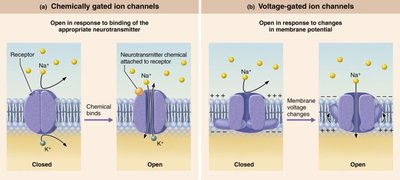
Leakage (nongated) channels: Always open, allowing ions to move according to their concentration gradients.
Gated channels: Open or close in response to specific stimuli.
Chemically gated (ligand-gated) channels: Open when a specific chemical (e.g., neurotransmitter) binds to the receptor.
Voltage-gated channels: Open or close in response to changes in membrane potential.
Mechanically gated channels: Open in response to physical deformation of the receptor (e.g., touch, pressure).
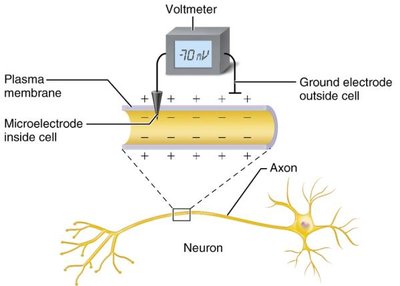
Resting Membrane Potential
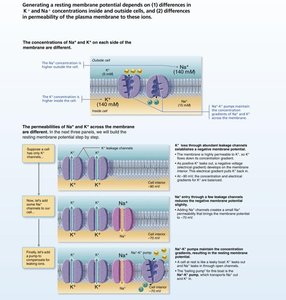
The resting membrane potential is the voltage difference across the plasma membrane of a resting neuron, typically around -70 mV. This potential is established by differences in ion concentrations and membrane permeability to Na+ and K+.
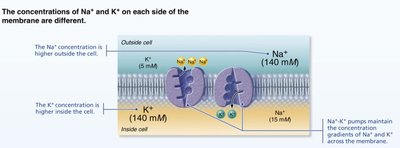
K+: Higher concentration inside the cell; diffuses out, making the inside more negative.
Na+: Higher concentration outside the cell; diffuses in, but less permeable than K+.
Na+/K+ ATPase pump: Maintains gradients by pumping 3 Na+ out and 2 K+ in per ATP hydrolyzed.
Graded Potentials and Action Potentials
Graded Potentials
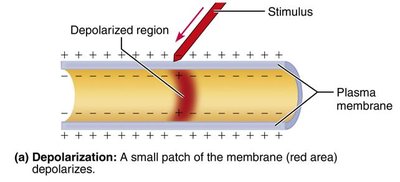
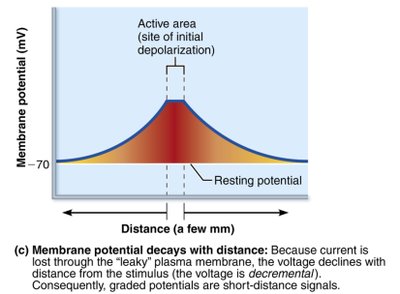
Graded potentials are short-distance, localized changes in membrane potential, typically occurring in dendrites and cell bodies. They are essential for initiating action potentials.
Triggered by the opening of gated ion channels.
Can result in depolarization or hyperpolarization.
Magnitude varies with stimulus strength and decays with distance.
Action Potentials
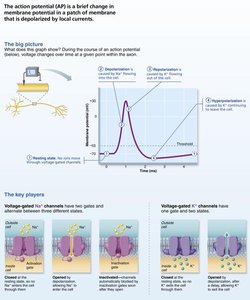
An action potential (AP) is a rapid, long-distance electrical signal generated in axons. It is an all-or-none phenomenon, meaning it either occurs fully or not at all.
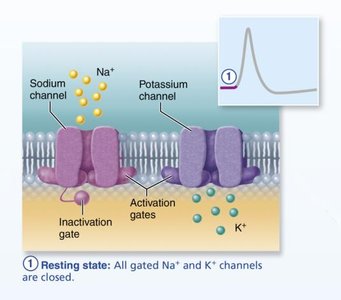
Resting state: All voltage-gated Na+ and K+ channels are closed; only leakage channels are open.
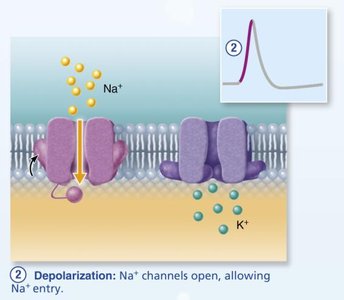
Depolarization: Voltage-gated Na+ channels open, Na+ enters, and the membrane potential becomes positive.
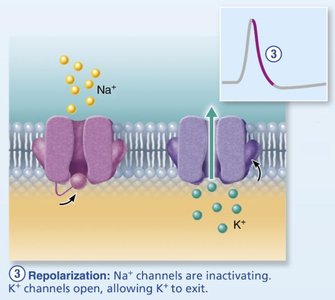
Repolarization: Na+ channels inactivate, K+ channels open, and K+ exits, returning the membrane to a negative potential.
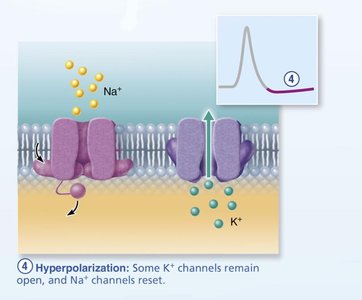
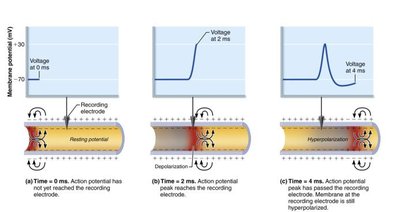
Hyperpolarization: Some K+ channels remain open, causing the membrane potential to become more negative than the resting state before returning to baseline.
Action Potential Propagation and Refractory Periods
Once initiated, an action potential propagates along the axon without decrement. The refractory period ensures unidirectional propagation and limits the frequency of action potentials.
Absolute refractory period: No new AP can be generated, regardless of stimulus strength.
Relative refractory period: A stronger-than-usual stimulus can initiate another AP.
Synaptic Transmission
Structure and Function of Synapses
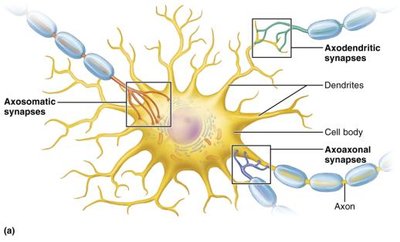
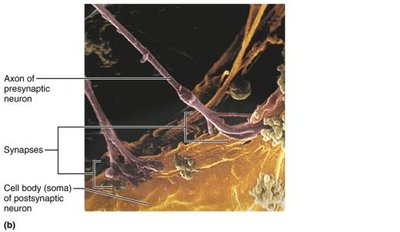
Synapses are specialized junctions where neurons communicate with other neurons, muscle cells, or glands. They can be classified as chemical or electrical synapses.
Chemical synapses: Use neurotransmitters to transmit signals across a synaptic cleft; unidirectional and most common.
Electrical synapses: Use gap junctions for direct cytoplasmic connections; allow rapid, bidirectional communication.
Neurotransmitters
Neurotransmitters are chemical messengers that transmit signals across synapses. They are classified by chemical structure and function.
Acetylcholine (ACh): Released at neuromuscular junctions; degraded by acetylcholinesterase.
Catecholamines: Dopamine, norepinephrine, epinephrine; involved in stress response.
Indolamines: Serotonin (from tryptophan), histamine (from histidine); regulate mood, sleep, and other physiological processes.
Clinical Implications
Multiple sclerosis (MS): Autoimmune destruction of CNS myelin, leading to impaired nerve conduction.
Local anesthetics: Block voltage-gated Na+ channels, preventing action potential propagation.
Opioid use disorder: Chronic opioid use reduces endogenous opiate production; overdose can suppress breathing, treatable with naloxone.
Summary Table: Key Differences Between Graded and Action Potentials
Feature | Graded Potential | Action Potential |
|---|---|---|
Location | Dendrites, cell body | Axon |
Distance | Short (local) | Long (entire axon) |
Decay with distance? | Yes | No |
Amplitude | Varies with stimulus | All-or-none |
Initiation | Stimulus opens gated channels | Threshold depolarization opens voltage-gated channels |
