 Indietro
Fundamentals of the Nervous System and Nervous Tissue: Study Notes
Guida di studio - Note intelligenti
 Appunti personalizzati basati sui tuoi materiali, ampliati con definizioni chiave, esempi e contesto.
Characteristics and Functions of the Nervous System
Overview of the Nervous System
The nervous system is the master controlling and communicating system of the body. It utilizes both electrical and chemical signals to coordinate rapid and specific responses, often resulting in immediate effects. The nervous system is essential for perceiving environmental changes, processing information, and initiating actions.
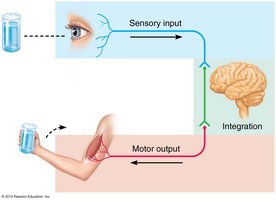
Sensory Input: Information is gathered by sensory receptors regarding internal and external changes.
Integration: The processing and interpretation of sensory input occur in the central nervous system.
Motor Output: Activation of effector organs (muscles and glands) produces a response.
Example: When you see a glass of water, your nervous system processes this visual information and then activates muscles to reach for the glass.
Key Functions of the Nervous System
Communication: Transmits signals throughout the body.
Control: Regulates bodily functions and responses.
Coordination: Integrates sensory information and directs motor activity.
Organization of the Nervous System
Principal Divisions
The nervous system is divided into two main parts:
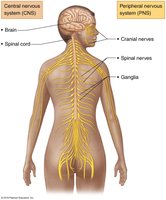
Central Nervous System (CNS): Consists of the brain and spinal cord, located in the dorsal body cavity. It serves as the integration and control center, interpreting sensory input and dictating motor output.
Peripheral Nervous System (PNS): Comprises nerves outside the CNS, including spinal nerves (to and from the spinal cord) and cranial nerves (to and from the brain).
Levels of Organization
The nervous system is organized hierarchically, with subdivisions based on structure and function:
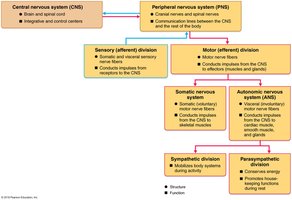
Sensory (Afferent) Division: Conducts impulses from sensory receptors to the CNS.
Motor (Efferent) Division: Conducts impulses from the CNS to effector organs.
Somatic Nervous System: Controls voluntary movements (skeletal muscles).
Autonomic Nervous System (ANS): Regulates involuntary functions (smooth muscle, cardiac muscle, glands).
Sympathetic Division: Mobilizes body systems during activity.
Parasympathetic Division: Conserves energy and promotes housekeeping functions during rest.
Cell Types in Nervous Tissue
Neuroglia (Glial Cells) and Neurons
Nervous tissue consists of two principal cell types:
Neuroglia (Glial Cells): Small cells that surround and support neurons.
Neurons: Excitable cells that transmit electrical signals.
Neuroglia of the Central Nervous System (CNS)
Four main types of neuroglia support CNS neurons:
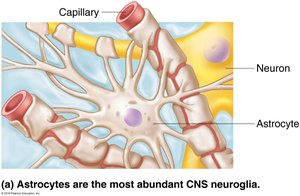
Astrocytes: Most abundant, versatile, and highly branched glial cells. They support and brace neurons, facilitate exchanges between capillaries and neurons, guide migration of young neurons, and control the chemical environment around neurons.
Microglial Cells: Small, ovoid cells with thorny processes. They monitor neuron health, migrate toward injured neurons, and can transform to phagocytize microorganisms and neuronal debris.
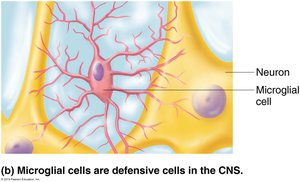
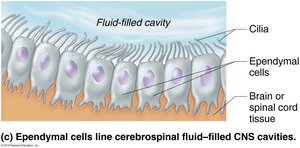
Ependymal Cells: Range in shape from squamous to columnar and may be ciliated. Their cilia help circulate cerebrospinal fluid (CSF), and they line the central cavities of the brain and spinal cord, forming a permeable barrier between CSF and tissue fluid.
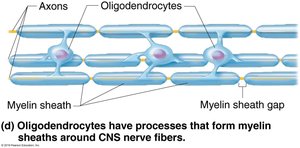
Oligodendrocytes: Branched cells whose processes wrap CNS nerve fibers, forming insulating myelin sheaths in thicker nerve fibers.
Neuroglia of the Peripheral Nervous System (PNS)
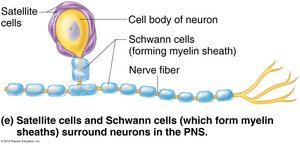
Satellite Cells: Surround neuron cell bodies in the PNS and function similarly to astrocytes in the CNS.
Schwann Cells (Neurolemmocytes): Surround all peripheral nerve fibers and form myelin sheaths in thicker nerve fibers. They are vital for the regeneration of damaged peripheral nerve fibers and function similarly to oligodendrocytes in the CNS.
Summary Table: Neuroglia Types and Functions
Cell Type | Location | Main Function |
|---|---|---|
Astrocytes | CNS | Support neurons, regulate environment, guide migration |
Microglial Cells | CNS | Defensive, phagocytize debris |
Ependymal Cells | CNS | Line cavities, circulate CSF |
Oligodendrocytes | CNS | Form myelin sheaths |
Satellite Cells | PNS | Support neuron cell bodies |
Schwann Cells | PNS | Form myelin sheaths, aid regeneration |
Key Terms and Definitions
Neuron: Excitable cell that transmits electrical signals.
Neuroglia: Supporting cells in nervous tissue.
Myelin Sheath: Insulating layer around nerve fibers, increases speed of signal transmission.
Cerebrospinal Fluid (CSF): Fluid that circulates in CNS cavities, providing cushioning and nutrient transport.
