 Indietro
Fundamentals of the Nervous System and Nervous Tissue: Histology and Classification of Neurons
Guida di studio - Note intelligenti
 Appunti personalizzati basati sui tuoi materiali, ampliati con definizioni chiave, esempi e contesto.
Histology of Nervous Tissue
Overview of Nervous Tissue
The nervous system is composed of highly specialized cells called neurons and supporting cells known as glial cells. Neurons are the structural and functional units responsible for transmitting electrical impulses throughout the body. Nervous tissue is found in both the central nervous system (CNS) and peripheral nervous system (PNS).
Neurons: Structure and Function
Special Characteristics of Neurons
Extreme longevity: Neurons can last a person's lifetime.
Amitotic: Most neurons do not divide after maturation, with few exceptions.
High metabolic rate: Neurons require a continuous supply of oxygen and glucose to function.
Major Structures of a Typical Neuron
Each neuron consists of a cell body and one or more processes (dendrites and axons). The cell body contains the nucleus and is the biosynthetic center, while processes extend from the cell body to receive and transmit signals.
Dendrites: Receive input signals from other neurons or sensory receptors.
Axon: Conducts impulses away from the cell body toward other neurons or effectors.
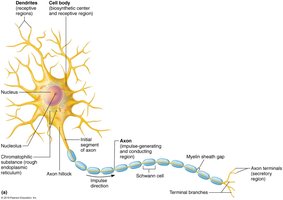
Neuron Processes in CNS and PNS
Tracts: Bundles of neuron processes in the CNS.
Nerves: Bundles of neuron processes in the PNS.
Myelin Sheath: Structure and Function
Myelin in the PNS
The myelin sheath is a segmented, protein-lipid layer that surrounds axons, providing electrical insulation and increasing the speed of nerve impulse transmission. In the PNS, myelin is formed by Schwann cells wrapping around the axon in a jelly roll fashion. Myelinated fibers conduct impulses rapidly, while nonmyelinated fibers conduct more slowly.
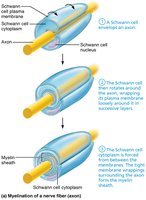
Myelin in the CNS
In the CNS, myelin sheaths are formed by oligodendrocytes, which can wrap multiple axons simultaneously. Myelin sheath gaps (nodes of Ranvier) are present, and the thinnest fibers are unmyelinated but covered by extensions of neuroglia. White matter consists of myelinated fibers, while gray matter is composed mainly of neuron cell bodies and nonmyelinated fibers.
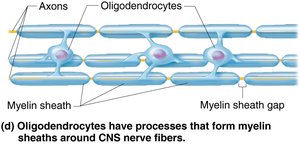
Classification of Neurons
Structural Classification
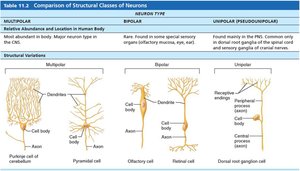
Neurons are classified based on the number and arrangement of their processes:
Multipolar: Three or more processes (one axon, multiple dendrites); most common in CNS.
Bipolar: Two processes (one axon, one dendrite); rare, found in retina and olfactory mucosa.
Unipolar (pseudounipolar): One T-like process (two axons); found mainly in PNS, associated with sensory receptors.
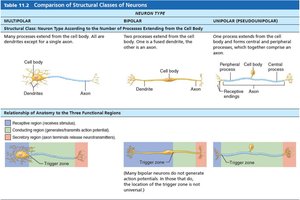
Functional Classification
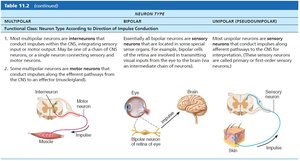
Neurons are also classified by the direction in which they transmit impulses relative to the CNS:
Sensory (afferent) neurons: Transmit impulses from sensory receptors toward the CNS; mostly unipolar, cell bodies in PNS ganglia.
Motor (efferent) neurons: Carry impulses from CNS to effectors (muscles/glands); multipolar, cell bodies in CNS.
Interneurons (association neurons): Lie between motor and sensory neurons, shuttle signals within CNS; most abundant, entirely within CNS.
Summary Table: Structural and Functional Classes of Neurons
Neuron Type | Structural Features | Location | Function |
|---|---|---|---|
Multipolar | Three or more processes (1 axon, multiple dendrites) | Most abundant in CNS | Motor neurons, interneurons |
Bipolar | Two processes (1 axon, 1 dendrite) | Retina, olfactory mucosa | Sensory neurons (special senses) |
Unipolar | One T-like process (two axons) | PNS, dorsal root ganglia | Sensory neurons |
Key Terms and Definitions
Neuron: A nerve cell specialized for transmitting electrical impulses.
Glial cells: Supporting cells in nervous tissue, including astrocytes, oligodendrocytes, microglia, ependymal cells (CNS), Schwann cells, and satellite cells (PNS).
Myelin sheath: Insulating layer around axons, increases speed of impulse transmission.
Tracts: Bundles of neuron processes in CNS.
Nerves: Bundles of neuron processes in PNS.
White matter: Regions with dense collections of myelinated fibers.
Gray matter: Regions with neuron cell bodies and nonmyelinated fibers.
Additional info:
Glial cells play essential roles in supporting neurons, maintaining homeostasis, forming myelin, and participating in signal transmission.
Myelination is crucial for rapid and efficient communication in the nervous system; demyelinating diseases (e.g., multiple sclerosis) disrupt this process.
