 Indietro
Fundamentals of the Nervous System and Nervous Tissue: Action Potentials and Synaptic Transmission
Guida di studio - Note intelligenti
 Appunti personalizzati basati sui tuoi materiali, ampliati con definizioni chiave, esempi e contesto.
Fundamentals of the Nervous System and Nervous Tissue
Overview of the Nervous System
The nervous system is a complex network responsible for coordinating the body's activities by transmitting signals to and from different parts of the body. It is composed of two main cell types: neurons and neuroglia, and is subdivided into the central and peripheral nervous systems.
Membrane Ion Channels and Resting Membrane Potential
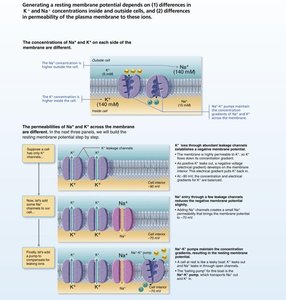
Neurons maintain a resting membrane potential, typically around -70 mV, due to differences in ion concentrations and membrane permeability. Ion channels in the plasma membrane play a crucial role in establishing and altering this potential.
Leakage (nongated) channels: Always open, allowing ions to move according to their gradients.
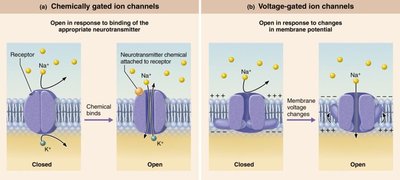
Gated channels: Open or close in response to specific stimuli.
Chemically gated (ligand-gated) channels: Open when a neurotransmitter binds.
Voltage-gated channels: Open in response to changes in membrane potential.
Mechanically gated channels: Open in response to physical deformation.
Resting Membrane Potential
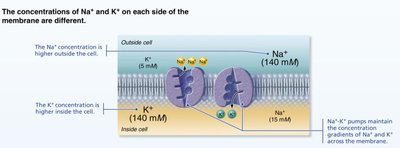
The resting membrane potential is generated by differences in the concentrations of Na+ and K+ across the membrane and the selective permeability of the membrane to these ions. The Na+/K+ pump helps maintain these gradients.
K+: Higher concentration inside the cell; diffuses out, making the inside more negative.
Na+: Higher concentration outside the cell; diffuses in, but less permeable than K+.
Graded Potentials
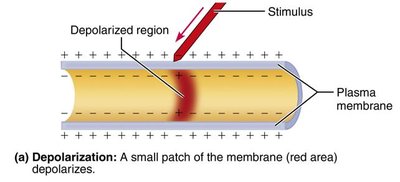
Graded potentials are short-distance signals that result from the opening of gated ion channels. They can lead to depolarization or hyperpolarization and are essential for initiating action potentials.
Depolarization: Membrane potential becomes less negative.
Hyperpolarization: Membrane potential becomes more negative.
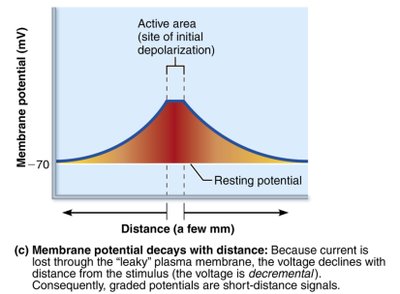
Graded potentials decay with distance due to leaky plasma membranes.
Action Potentials
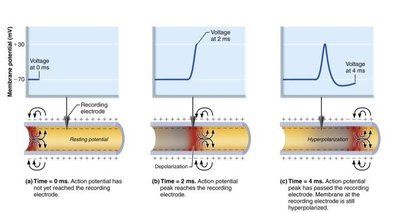
Action potentials (APs) are long-distance signals of axons, characterized by a rapid reversal of membrane potential (from -70 mV to +30 mV). They are generated only in excitable membranes and do not decay over distance.
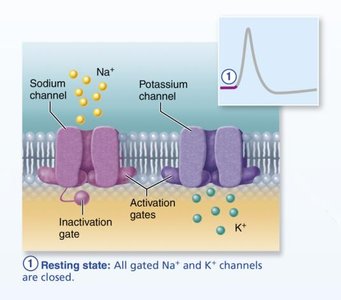
Resting state: All voltage-gated Na+ and K+ channels are closed.
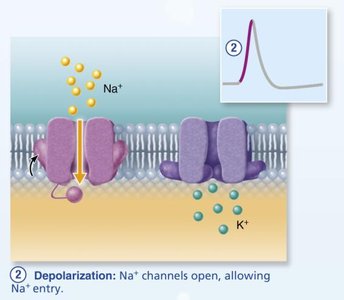
Depolarization: Voltage-gated Na+ channels open, Na+ enters the cell.
Repolarization: Na+ channels inactivate, K+ channels open, K+ exits the cell.
Hyperpolarization: Some K+ channels remain open, Na+ channels reset.
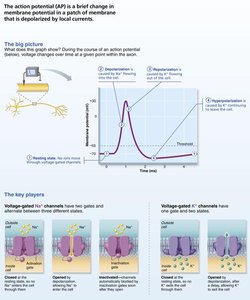
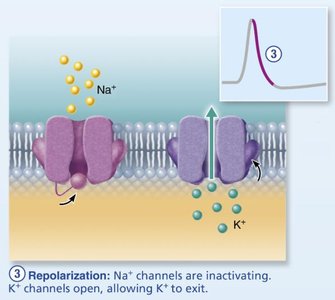
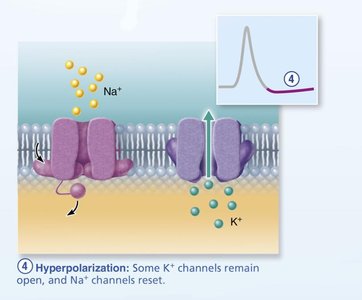
All-or-None Principle: An action potential either occurs completely or not at all, depending on whether the threshold is reached.
Propagation of Action Potentials
Once initiated, an action potential is self-propagating and travels along the axon. In nonmyelinated axons, each segment depolarizes and repolarizes in sequence. In myelinated axons, propagation is faster due to saltatory conduction.
Refractory Periods
The refractory period ensures unidirectional propagation and limits the frequency of action potentials.
Absolute refractory period: No new AP can be initiated.
Relative refractory period: A stronger stimulus is required to initiate another AP.
Clinical Implications
Multiple sclerosis (MS): Autoimmune destruction of CNS myelin slows or blocks nerve conduction.
Local anesthetics: Block voltage-gated Na+ channels, preventing AP generation.
Cold/pressure: Interrupts blood flow and oxygen delivery, causing numbness or paresthesia.
Synaptic Transmission
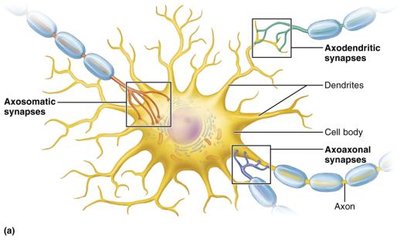
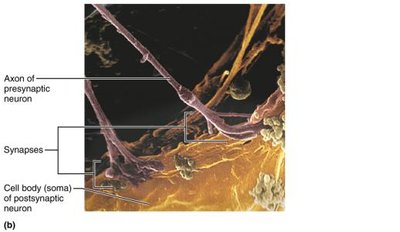
Synapses are junctions that mediate information transfer between neurons or between a neuron and an effector cell. There are two main types: chemical and electrical synapses.
Chemical synapses: Use neurotransmitters to transmit signals across a synaptic cleft; unidirectional.
Electrical synapses: Use gap junctions for direct cytoplasmic connections; rapid and can be bidirectional.
Neurotransmitters
Neurotransmitters are the chemical messengers of the nervous system. They can be classified by structure and function:
Acetylcholine (ACh): Used at neuromuscular junctions and by the autonomic nervous system.
Catecholamines: Dopamine, norepinephrine, epinephrine; involved in stress response.
Indolamines: Serotonin (from tryptophan), histamine (from histidine); regulate mood, sleep, and other functions.
Clinical Implications: Opioids
Opioids: Synthetic and natural compounds that bind to opiate receptors to relieve pain.
Long-term use reduces endogenous opiate production and receptor sensitivity, leading to tolerance and dependence.
Overdose can suppress breathing; naloxone can reverse effects.
Summary Table: Types of Ion Channels
Channel Type | Stimulus | Location | Function |
|---|---|---|---|
Chemically gated | Neurotransmitter binding | Dendrites, cell body | Initiate graded potentials |
Voltage-gated | Change in membrane potential | Axon hillock, axon | Generate and propagate action potentials |
Mechanically gated | Physical deformation | Sensory receptors | Initiate receptor potentials |
