 Indietro
Unit 4- Ch19.1 Gas Exchange and Transport: Mechanisms and Regulation in Human Physiology
Guida di studio - Note intelligenti
 Appunti personalizzati basati sui tuoi materiali, ampliati con definizioni chiave, esempi e contesto.
Gas Exchange and Transport
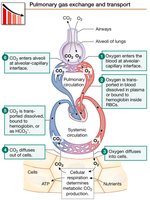
Overview of Gas Exchange
Gas exchange in the human body involves the movement of oxygen (O2) and carbon dioxide (CO2) between the atmosphere, lungs, blood, and tissues. This process is essential for aerobic cellular respiration and maintaining homeostasis of blood gases.
Pulmonary ventilation: Movement of air into and out of the lungs.
Alveolar gas exchange: O2 diffuses from alveoli to blood; CO2 diffuses from blood to alveoli.
Gas transport: O2 and CO2 are transported in the blood to and from tissues.
Systemic gas exchange: O2 diffuses from blood to cells; CO2 diffuses from cells to blood.
Aerobic cellular respiration: Cells use O2 and produce CO2 as a metabolic byproduct.
Chemoreceptor Function in Gas Exchange
Chemoreceptors play a critical role in monitoring and regulating the partial pressures of blood gases to prevent hypoxia (low O2) and hypercapnia (high CO2), and to maintain acid-base balance.
Systemic arterial PO2: Normal value is 95 mm Hg (range: 85-100 mm Hg).
Systemic arterial PCO2: Normal value is 40 mm Hg (range: 35-45 mm Hg).
Systemic arterial pH: Normal range is 7.38-7.42.
CO2 + H2O \(\leftrightarrow\) H2CO3 \(\leftrightarrow\) H+ + HCO3-\ (catalyzed by carbonic anhydrase)
Alveolar Gas Exchange
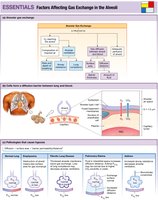
Key Factors Affecting Alveolar Gas Exchange
Three main factors influence the efficiency of gas exchange in the alveoli:
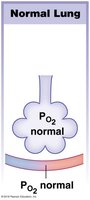
Alveolar PO2 & O2 availability: Determined by inspired air and alveolar ventilation.
Gas diffusion between alveoli and blood: Influenced by surface area, membrane permeability, and diffusion distance.
Perfusion of alveoli: Adequate blood flow is necessary for effective gas exchange.
Alveolar PO2 & Availability of O2
PO2 in inspired air: Decreases with altitude (sea level: 150 mm Hg; 1 mile elevation: 122 mm Hg).
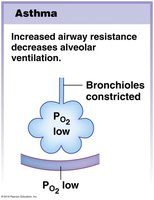
Alveolar ventilation (VA): Reduced by decreased lung compliance, increased airway resistance (e.g., asthma, chronic bronchitis), or CNS depression.
Factors Affecting Diffusion
Alveolar surface area: Loss of type I cells (e.g., emphysema) reduces surface area, decreasing diffusion rate.
Diffusion barrier permeability: Thickening of the respiratory membrane (e.g., pulmonary fibrosis) impairs diffusion.
Diffusion distance: Increased by pulmonary edema or inflammation, reducing O2 diffusion.
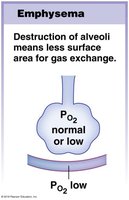
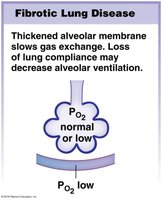
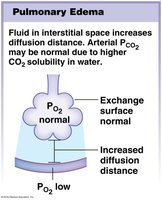
Perfusion, Partial Pressure Gradient, and Gas Solubility
Perfusion: Adequate blood supply to alveoli is essential for gas exchange.
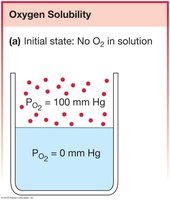
Partial pressure gradient: Drives diffusion (e.g., alveolar PO2 = 100 mm Hg vs. pulmonary capillary PO2 ≤ 40 mm Hg).
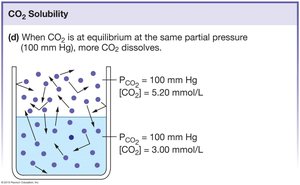
Gas solubility: CO2 is 20 times more soluble in plasma than O2, facilitating its transport.
Gas Transport in Blood
Oxygen Transport
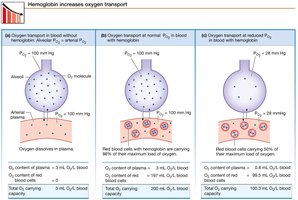
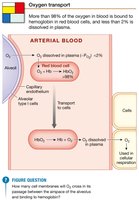
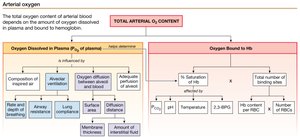
Oxygen is transported in the blood in two forms: dissolved in plasma and bound to hemoglobin (Hb). The majority of O2 is carried by Hb due to its low solubility in plasma.
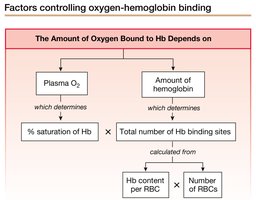
Plasma PO2: Determines the amount of O2 available to bind Hb.
Amount of Hb: Determines the total O2 carrying capacity of blood.
Hemoglobin and Oxygen Binding
Each Hb molecule can bind up to 4 O2 molecules.
O2 carrying capacity: 1.34 mL O2/g Hb.
Cooperative binding: Binding of one O2 increases Hb's affinity for additional O2.
% Saturation = (O2 bound to Hb / max possible) × 100
Total Blood Oxygen Content
Total blood O2 = dissolved O2 + HbO2
At the lungs: O2 diffuses from alveoli to plasma, then to RBCs where it binds Hb.
At systemic tissues: O2 is released from Hb and diffuses into cells.
Oxygen-Hemoglobin Dissociation Curve
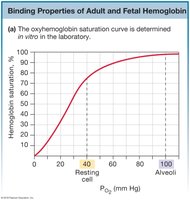
The O2-Hb dissociation curve describes the relationship between PO2 and Hb saturation. It is sigmoidal due to cooperative binding.
At alveolar PO2 (100 mm Hg): Hb is 98-100% saturated.
At systemic tissue PO2 (40 mm Hg): Hb is 75% saturated; 25% O2 is released to tissues.
During exercise: Lower tissue PO2 increases O2 unloading.
Maternal vs. Fetal Hemoglobin
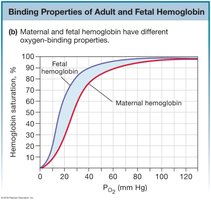
Fetal Hb (HbF) has higher affinity for O2 than adult Hb (HbA), facilitating O2 transfer from mother to fetus.
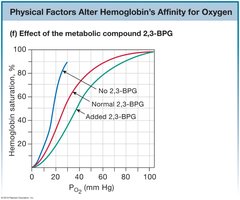
Factors Shifting the O2-Hb Dissociation Curve
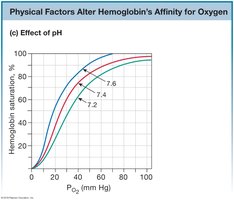
pH: Decreased pH (increased H+) shifts curve right (Bohr effect), enhancing O2 release in tissues.
PCO2: Increased PCO2 also shifts curve right.
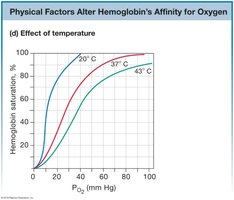
Temperature: Increased temperature shifts curve right; decreased temperature shifts curve left.
2,3-BPG: Increased 2,3-biphosphoglycerate (BPG) shifts curve right, common in chronic hypoxia or anemia.
Summary Tables
Key Values for Gas Exchange
Location | PO2 (mm Hg) | PCO2 (mm Hg) | Hb Saturation (%) | pH |
|---|---|---|---|---|
Pulmonary veins / Systemic arteries | 100 | 40 | 98-100 | 7.4 |
Systemic veins / Pulmonary arteries | ≤ 40 | ≥ 46 | 75 | 7.37 |
Factors Affecting Arterial O2 Content
Factor | Effect |
|---|---|
Alveolar gas exchange | Diffusion from alveoli to blood; determines PO2 |
Oxygen transport | Ability and availability of Hb to transport O2 |
Summary Figures
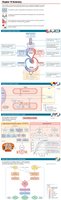
These figures summarize the locations and mechanisms of O2 and CO2 exchange and transport in the body.
Additional info: The above notes integrate textbook-level explanations, definitions, and context for all major concepts in gas exchange and transport, including the effects of disease states (asthma, emphysema, fibrosis, edema), and the physiological significance of the O2-Hb dissociation curve and its modifiers.
