Indietro
Gas Exchange and Transport: Study Notes for Anatomy & Physiology
Guida di studio - Note intelligenti
 Appunti personalizzati basati sui tuoi materiali, ampliati con definizioni chiave, esempi e contesto.
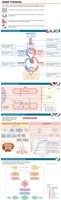
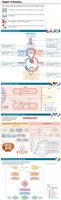
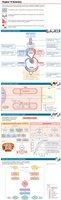
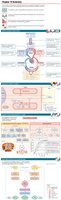
Gas Exchange and Transport
Core Concepts and Overview
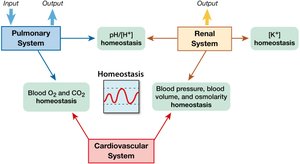
This chapter explores the physiological mechanisms of gas exchange and transport, focusing on oxygen and carbon dioxide movement between the external environment and body tissues. It integrates concepts of gradients, compartmentation, mass balance, molecular interactions, communication, and homeostasis as they relate to respiratory function.
Hypoxia: Condition of insufficient oxygen in tissues.
Hypercapnia: Elevated carbon dioxide levels in the blood.
Three regulated variables: Oxygen, Carbon Dioxide, and pH.
19.1 Gas Exchange in the Lungs and Tissues
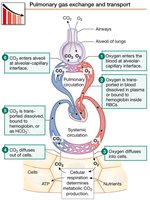
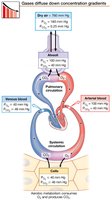
Gas exchange occurs via bulk flow and diffusion, driven by partial pressure gradients. The total pressure of a mixed gas equals the sum of partial pressures of individual gases. Exchange occurs at two main sites: alveoli-blood and blood-tissue interfaces.
Bulk Flow: Movement of air into and out of lungs.
Diffusion: Individual gases move along partial pressure gradients until equilibrium is reached.
Partial Pressure: The pressure exerted by a single gas in a mixture.
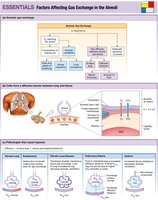
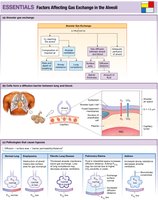
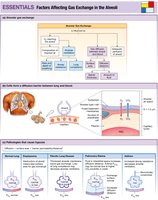
Factors Affecting Gas Exchange in the Alveoli
Gas exchange efficiency depends on alveolar oxygen content, ventilation, lung compliance, airway resistance, and CNS function. Pathological changes such as decreased alveolar surface area (emphysema), increased membrane thickness (fibrotic lung disease), and increased diffusion distance (pulmonary edema) can cause hypoxia.
Low Alveolar PO2: Decreases oxygen uptake.
Diffusion Rate: Depends on surface area, barrier permeability, diffusion distance, and concentration gradient.
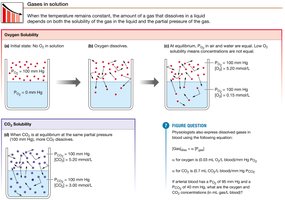
Gas Solubility: Affects diffusion; movement is proportional to pressure gradient, solubility, and temperature.
19.2 Gas Transport in the Blood
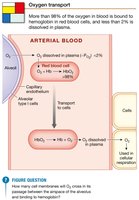
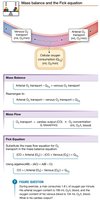
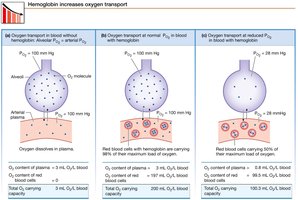
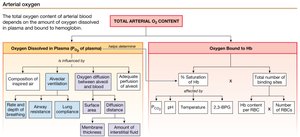
Oxygen and carbon dioxide are transported in the blood via dissolution in plasma and binding to hemoglobin. The Fick equation estimates oxygen consumption, and hemoglobin increases oxygen transport capacity.
Hemoglobin: Protein in red blood cells with four heme groups, each binding one oxygen molecule.
Law of Mass Action: Governs oxygen binding and release from hemoglobin.
Percent Saturation: Amount of oxygen bound to hemoglobin relative to maximum capacity.
Factors Controlling Oxygen-Hemoglobin Binding
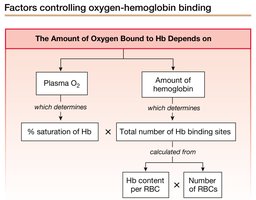
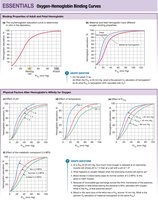
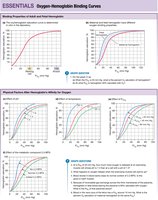
The amount of oxygen bound to hemoglobin depends on plasma oxygen concentration and the amount of hemoglobin available. Physiological changes in pH, temperature, and 2,3-BPG affect hemoglobin's affinity for oxygen (Bohr effect).
Shift Right: Decreased affinity, more oxygen released (increased metabolic activity).
Shift Left: Increased affinity, less oxygen released (decreased metabolic activity).
2,3-BPG: Produced in response to chronic hypoxia, decreases hemoglobin affinity for oxygen.
Carbon Dioxide Transport
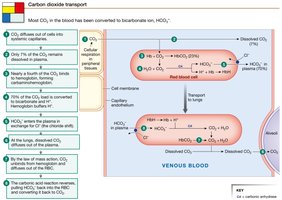
Carbon dioxide is transported in three ways: dissolved in plasma (7%), bound to hemoglobin (23%), and converted to bicarbonate ions (70%). Carbonic anhydrase catalyzes the conversion of CO2 to bicarbonate. The chloride shift maintains electrical neutrality.
Respiratory Acidosis: Occurs when CO2 accumulates, lowering blood pH.
Removal at Lungs: CO2 diffuses down its concentration gradient from blood to alveoli.
19.3 Control of Ventilation
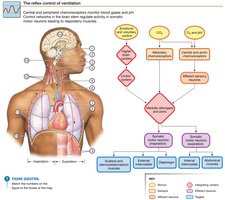
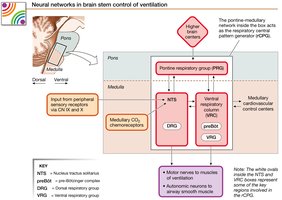
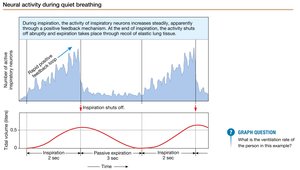
Ventilation is regulated by neural networks in the brainstem, including the medulla and pons. These networks generate rhythmic breathing patterns and integrate sensory input from chemoreceptors and mechanoreceptors.
Dorsal Respiratory Group (DRG): Controls inspiratory muscles via the phrenic and intercostal nerves.
Ventral Respiratory Group (VRG): Controls active expiration and greater-than-normal inspiration.
Pre-Bötzinger Complex: Acts as a pacemaker for breathing rhythm.
Chemoreceptor Regulation
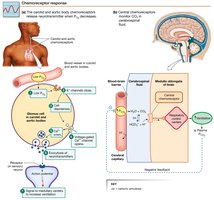
Peripheral chemoreceptors in carotid bodies and central chemoreceptors in the CNS monitor blood gases and pH. Glomus cells in carotid bodies respond to low oxygen, while central chemoreceptors respond to changes in CO2 and pH.
Peripheral Chemoreceptors: Trigger increased ventilation when PO2 falls below 60 mmHg.
Central Chemoreceptors: Detect changes in pH due to CO2 crossing into brain ECF.
Protective Reflexes and Higher Brain Centers
Protective reflexes such as bronchoconstriction, sneezing, coughing, and the Hering-Breuer inflation reflex guard the lungs. Higher brain centers (cerebrum, hypothalamus, limbic system) can modulate breathing patterns but cannot override chemoreceptor reflexes.
Summary Tables
Classification of Hypoxias
Type | Description |
|---|---|
Hypoxic | Low arterial PO2 |
Anemic | Low O2 content due to reduced hemoglobin |
Ischemic | Reduced blood flow |
Histotoxic | Cells unable to use O2 |
Normal Blood Values in Pulmonary Medicine
Parameter | Normal Value |
|---|---|
Arterial PO2 | 95 mmHg |
Arterial PCO2 | 40 mmHg |
pH | 7.4 |
Oxyhemoglobin Saturation | 98% |
Key Equations
Partial Pressure:
Fick Equation for Oxygen Consumption:
Percent Saturation of Hemoglobin:
Summary
Gas exchange and transport are essential for maintaining homeostasis and supporting cellular metabolism. The efficiency of these processes depends on physical, chemical, and physiological factors, including partial pressure gradients, hemoglobin affinity, and neural control mechanisms. Understanding these concepts is fundamental for students of anatomy and physiology.