 Indietro
Gross Muscle Anatomy: Structure, Organization, and Naming
Guida di studio - Note intelligenti
 Appunti personalizzati basati sui tuoi materiali, ampliati con definizioni chiave, esempi e contesto.
Gross Muscle Anatomy
Muscle Organization
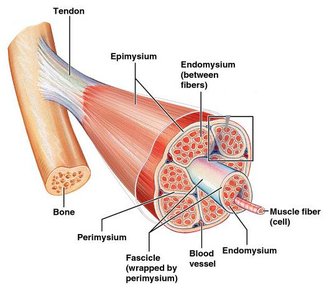
Muscles are complex organs composed of multiple tissue types, primarily skeletal muscle tissue and dense regular connective tissue. The connective tissue organizes muscle fibers into distinct bundles, providing structural integrity and facilitating muscle function.
Endomysium: A connective tissue sheath that surrounds each individual muscle fiber (cell).
Fascicles: Bundles of muscle fibers grouped together, each wrapped by the perimysium.
Perimysium: Connective tissue sheath covering fascicles; blood vessels and nerves travel through this layer.
Epimysium: The outermost connective tissue sheath that covers the entire muscle.
Tendon: Formed by the joining of collagen fibers from all sheaths; connects muscle to bone or other muscles.
Aponeuroses: Flat sheets of tendon that connect muscles.
Muscle Attachments
Muscles attach to bones or other muscles via tendons. The attachment sites are classified as follows:
Origin: The immovable attachment site of a muscle.
Insertion: The movable attachment site of a muscle.
Types of Muscles and Their Roles in Movement
Body movements are typically produced by several muscles acting together. The roles of muscles in movement are defined as:
Prime mover (agonist): The main muscle responsible for a specific movement.
Antagonist: Muscle that opposes the action of the agonist.
Synergist: Muscle that assists the agonist by preventing unwanted movement at a joint.
Fixator: A special type of synergist that immobilizes the origin of another muscle.
Agonists and antagonists often work together to provide fine motor control. A muscle may act as an agonist for one movement and an antagonist for another.
Naming Muscles
Anatomists use seven criteria to name muscles, which help describe their characteristics and functions:
Direction of muscle fibers: Orientation of fascicles relative to the longitudinal axis (e.g., rectus for parallel, transverse for perpendicular, oblique for angled).
Relative size: Terms like maximus (largest), minimus (smallest), longus (longest), brevis (shortest).
Location: Named for body region or bone (e.g., brachialis for the arm, frontalis for the frontal bone).
Number of origins: The root -ceps means head or origin (e.g., biceps for two origins).
Location of origin and insertion: The origin is listed first in the name (e.g., sternocleidomastoid has origins at the sternum and clavicle, insertion at the mastoid process).
Shape: Named for shape (e.g., deltoid is triangular, rhomboideus is rhomboid-shaped, trapezius is trapezoid-shaped).
Action: Named for the movement produced (e.g., flexor digitorum causes flexion of fingers, adductor longus adducts the thigh).
General Considerations for Studying Muscles
To effectively learn muscle anatomy, students should:
Study muscles using anatomical figures and laboratory models.
Know the origin, insertion, and action of muscles highlighted in bold type on the structure list.
Provide the full name of each muscle on exams; partial credit is not given for incomplete names.
Example Table: Muscle Naming Criteria
Criterion | Example |
|---|---|
Direction of fibers | Rectus abdominis (parallel) |
Relative size | Gluteus maximus (largest) |
Location | Brachialis (arm) |
Number of origins | Biceps brachii (two origins) |
Origin & insertion | Sternocleidomastoid (sternum, clavicle, mastoid) |
Shape | Deltoid (triangular) |
Action | Flexor digitorum (flexes fingers) |
Additional info: The connective tissue sheaths (endomysium, perimysium, epimysium) not only provide structural support but also play a role in transmitting force generated by muscle contraction to the tendon and ultimately to the bone, facilitating movement.
