 Indietro
Homeostasis, Nervous System Divisions, and Endocrine Regulation: Study Notes for Anatomy & Physiology I
Guida di studio - Note intelligenti
 Appunti personalizzati basati sui tuoi materiali, ampliati con definizioni chiave, esempi e contesto.
Homeostasis
Definition and Components
Homeostasis is the process by which the body maintains a stable internal environment despite external changes. It is essential for the survival and proper functioning of cells and organs.
Receptor: Detects changes (stimuli) in the environment.
Control Centre: Receives input from the receptor and determines the appropriate response.
Effector: Executes the response to restore balance.
Stimulus: Any change that disrupts homeostasis.
Afferent Pathway: Carries information from the receptor to the control centre.
Efferent Pathway: Carries instructions from the control centre to the effector.
Example: Regulation of body temperature. 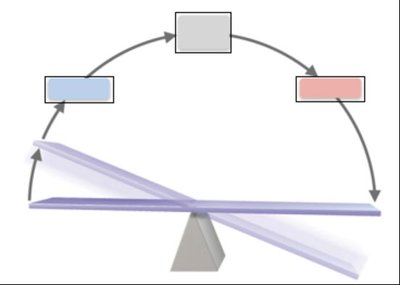
Feedback Mechanisms
Negative Feedback: The response reduces or eliminates the original stimulus (e.g., temperature regulation).
Positive Feedback: The response enhances the original stimulus (e.g., blood clotting).
Homeostatic Imbalance: Occurs when the body cannot maintain homeostasis, leading to disease or dysfunction.
Nervous System Divisions
Central and Peripheral Nervous Systems
The nervous system is divided into the central nervous system (CNS) and peripheral nervous system (PNS).
CNS: Consists of the brain and spinal cord; processes and integrates information.
PNS: Connects the CNS to the rest of the body; includes sensory and motor divisions.
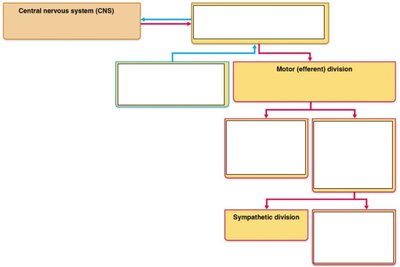
Subdivisions of the Autonomic Nervous System (ANS)
The ANS is a part of the PNS that controls involuntary functions. It is divided into:
Sympathetic Division: Prepares the body for 'fight or flight' responses.
Parasympathetic Division: Promotes 'rest and digest' activities.
Dual Innervation: Most organs receive input from both divisions, which can be antagonistic or cooperative.
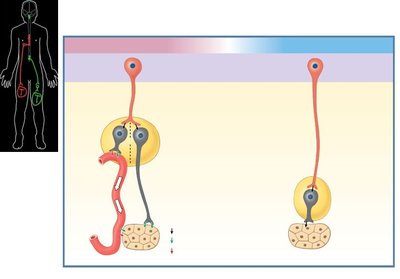
Somatic vs Autonomic Nervous System
Comparison and Functions
The somatic nervous system controls voluntary movements, while the autonomic nervous system regulates involuntary functions.
Somatic Nervous System: Controls skeletal muscles; voluntary.
Autonomic Nervous System: Controls smooth muscle, cardiac muscle, and glands; involuntary.
Sympathetic vs Parasympathetic: Sympathetic increases heart rate, dilates pupils; parasympathetic decreases heart rate, stimulates digestion.
System | Effectors | Neurotransmitters | Effects |
|---|---|---|---|
Somatic | Skeletal muscle | Acetylcholine (Ach) | Stimulatory |
Autonomic (Sympathetic) | Cardiac, smooth muscle, glands | Ach, Norepinephrine (NE) | Stimulatory or inhibitory |
Autonomic (Parasympathetic) | Cardiac, smooth muscle, glands | Ach | Stimulatory or inhibitory |
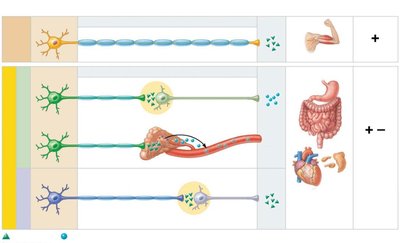
Hormones and Endocrine Regulation
Hormone Types and Mechanisms
Hormones are chemical messengers secreted by endocrine glands. They regulate various physiological processes.
Water-soluble Hormones: Usually amino acid-based; act via second-messenger systems (e.g., insulin).
Lipid-soluble Hormones: Usually steroids; act via direct gene activation (e.g., aldosterone).
Endocrine vs Exocrine: Endocrine glands release hormones into the bloodstream; exocrine glands release substances via ducts.
Example: Parathyroid hormone regulates calcium levels; insulin regulates blood glucose.
Hormone Release Mechanisms
Humoral Stimulus: Changes in blood levels of ions/nutrients trigger hormone release.
Neural Stimulus: Nerve fibers stimulate hormone release.
Hormonal Stimulus: Hormones stimulate other glands to release hormones.
Hypothalamus-Pituitary-Target Endocrine Organ Axis
Regulation and Feedback
The hypothalamus and pituitary gland coordinate the release of hormones to target organs. This axis is crucial for endocrine regulation.
Hypothalamus: Releases hormones that control the pituitary gland.
Anterior Pituitary: Releases hormones that stimulate other endocrine glands.
Posterior Pituitary: Releases hormones produced by the hypothalamus.
Target Organs: Respond to pituitary hormones by releasing their own hormones.
Feedback Mechanisms: Hormone levels are regulated by negative and positive feedback.
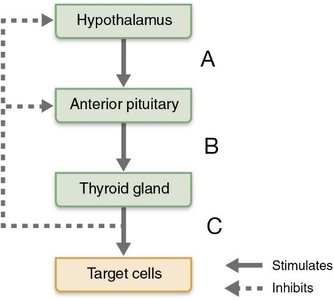
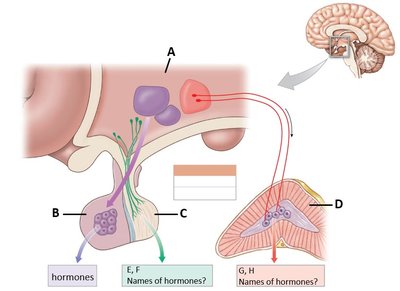 Example: The hypothalamus releases thyrotropin-releasing hormone (TRH), which stimulates the anterior pituitary to release thyroid-stimulating hormone (TSH), which then stimulates the thyroid gland to release thyroid hormones.
Key Hormones and Functions
Oxytocin: Stimulates uterine contractions and milk ejection.
Antidiuretic Hormone (ADH): Regulates water balance by increasing water reabsorption in kidneys.
Aldosterone: Regulates sodium and potassium balance.
Summary Table: Hormone Types and Mechanisms
Type | Sub-type | Examples | Mechanism | Notes |
|---|---|---|---|---|
Water-soluble | Amino acid-based | Insulin, ADH | Second-messenger system | Cannot cross cell membrane |
Lipid-soluble | Steroids | Aldosterone, estrogen | Direct gene activation | Can cross cell membrane |
Additional info: The notes have been expanded to provide academic context and explanations for each keyword and diagram, ensuring completeness and clarity for exam preparation.
