 Indietro
Immunity: Antibodies, T Cells, and MHC Proteins
Guida di studio - Note intelligenti
 Appunti personalizzati basati sui tuoi materiali, ampliati con definizioni chiave, esempi e contesto.
Immunity and the Immune System
Overview of Blood and Immune System Functions
The blood and immune system play critical roles in maintaining health by defending the body against pathogens and foreign substances. The immune system is divided into innate and adaptive defenses, each with specialized cells and mechanisms.
Innate Defenses: Include white blood cells (WBCs), inflammation, and antimicrobial proteins. These provide immediate, non-specific protection.
Adaptive Defenses: Include humoral (antibody-mediated) and cellular (T cell-mediated) immunity, which are specific and have memory.
Antibodies and Humoral Immunity
Antibody Structure and Function
Antibodies, also known as immunoglobulins (Igs), are proteins secreted by plasma cells. They make up the gamma globulin portion of blood and are capable of binding specifically to antigens detected by B cells. Antibodies are grouped into five classes, each with distinct functions and structures.
Basic Structure: Antibody monomers are T- or Y-shaped, consisting of four polypeptide chains linked by disulfide bonds. Each antibody has variable and constant regions, heavy and light chains, a hinge region, and a stem region.
Antigen-Binding Site: The variable regions of the heavy and light chains form the antigen-binding site, allowing specificity for different antigens.
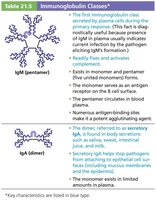
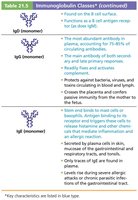
Immunoglobulin Classes
There are five major classes of immunoglobulins, each with unique roles:
IgM: First antibody class secreted during the primary immune response; exists as a pentamer; potent agglutinating agent.
IgA: Found in body secretions (saliva, tears, milk); protects mucosal surfaces; exists as a dimer.
IgG: Most abundant in plasma; main antibody of secondary responses; crosses placenta to protect fetus.
IgD: Functions as a B cell antigen receptor.
IgE: Binds to mast cells and basophils; involved in allergic reactions and defense against parasitic worms.
Antibody Actions and Clinical Relevance
Antibodies do not directly destroy antigens but inactivate and tag them for destruction by other immune mechanisms. They form antigen-antibody complexes, which facilitate various immune responses.
Neutralization: Blocks dangerous parts of bacterial toxins or viruses.
Agglutination: Causes cell-bound antigens to clump.
Precipitation: Soluble antigens are cross-linked and precipitated.
Complement Activation: Triggers cell lysis and enhances phagocytosis and inflammation.
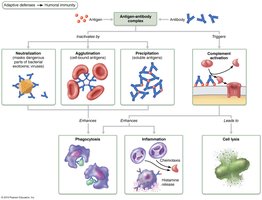
Clinical Homeostatic Imbalance
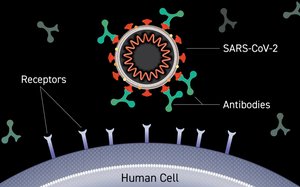
IgE antibodies play a critical role in defense against parasitic worms by marking them for destruction by eosinophils. Eosinophils release toxic contents onto the parasite, lysing it externally. Antibodies primarily target extracellular pathogens, but recent findings show they can act intracellularly if attached to viruses before cell entry.
Monoclonal Antibodies
Monoclonal antibodies are commercially prepared pure antibodies specific for a single antigenic determinant. They are valuable tools in clinical diagnostics and research.
Cellular Immune Response
T Cells and Their Functions
T cells provide defense against intracellular antigens, such as cells infected with viruses or bacteria, cancerous cells, and transplanted cells. T cells are more complex than B cells in classification and function.
CD4 Cells: Become helper T cells (TH) that activate B cells, other T cells, and macrophages; direct adaptive immune response; can also become memory T cells.
CD8 Cells: Become cytotoxic T cells (TC) capable of destroying cells harboring foreign antigens; also become memory T cells.
Activated T Cells: Include helper, cytotoxic, and regulatory T cells. Naive T cells are termed CD4 or CD8 cells.
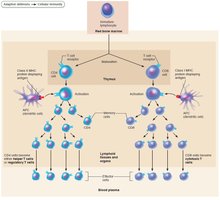
MHC Proteins and Antigen Presentation
Role of MHC Proteins
T cells respond only to processed fragments of antigens displayed on cell surfaces by major histocompatibility complex (MHC) proteins. There are two classes of MHC proteins:
Class I MHC Proteins: Displayed by all cells except red blood cells; crucial for CD8 cell activation; act as antigen holders and form the "self" part recognized by T cells.
Class II MHC Proteins: Displayed by antigen-presenting cells (APCs) such as dendritic cells, macrophages, and B cells; recognized by helper T cells; signal CD4 cells that help is required.
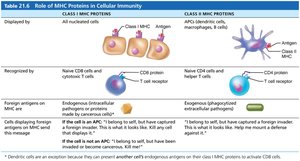
Roles of Specific Effector T Cells
Helper T (TH) cells activate both humoral and cellular arms of the immune system. Once primed by APC presentation of antigen, helper T cells:
Help activate B cells and other T cells
Induce T and B cell proliferation
Secrete cytokines that recruit other immune cells
Summary Table: Immunoglobulin Classes
Class | Structure | Main Functions |
|---|---|---|
IgM | Pentamer | First antibody secreted; potent agglutinating agent; activates complement |
IgA | Dimer | Protects mucosal surfaces; found in secretions |
IgG | Monomer | Most abundant; crosses placenta; main secondary response antibody |
IgD | Monomer | B cell receptor |
IgE | Monomer | Allergic reactions; defense against parasites |
Key Equations and Concepts
Antigen-Antibody Complex Formation:
Complement Activation:
Additional info: Expanded explanations and table content were inferred from textbook context to ensure completeness and clarity for exam preparation.
