 Indietro
Innate and Adaptive Immunity: Anatomy & Physiology Study Guide
Guida di studio - Note intelligenti
 Appunti personalizzati basati sui tuoi materiali, ampliati con definizioni chiave, esempi e contesto.
Q1. Trace the path of a pencil through the digestive tract and determine if it ever enters the body’s interior.
Background
Topic: Digestive System Anatomy & Physiology
This question tests your understanding of the structure of the gastrointestinal (GI) tract and the concept of what is considered "inside" versus "outside" the body in anatomical terms.
Key Terms:
GI tract: The continuous tube from mouth to anus, including the esophagus, stomach, and intestines.
Lumen: The inside space of a tubular structure, such as the GI tract.
Step-by-Step Guidance
Visualize the path a pencil would take if placed in the esophagus and moved through the stomach, intestines, and out the anus.
Consider the anatomical definition of "inside the body"—does the lumen of the GI tract count as inside or outside the body?
Think about whether the pencil ever crosses a membrane or barrier that would make it truly "internal" to the body’s tissues.
Try solving on your own before revealing the answer!
Final Answer:
The pencil would travel through the lumen of the GI tract, which is technically considered outside the body. It never crosses into the body’s internal tissues unless it is absorbed through the intestinal wall.
Q2. What would your pencil have to do to actually enter the body’s interior?
Background
Topic: Absorption and Barriers in the Digestive System
This question explores the concept of absorption and what it means for substances to cross from the GI tract into the body’s internal environment.
Key Terms:
Absorption: The process by which substances move from the GI tract into the bloodstream or lymphatic system.
Barrier: The epithelial lining of the GI tract that separates the lumen from the body’s internal tissues.
Step-by-Step Guidance
Recall the structure of the GI tract wall, especially the epithelial lining.
Think about the process by which nutrients and other substances are absorbed into the body.
Consider what would need to happen for the pencil (or any object) to cross this barrier and enter the body’s internal environment.
Try solving on your own before revealing the answer!
Final Answer:
The pencil would have to cross the epithelial lining of the GI tract and enter the bloodstream or lymphatic system to be considered inside the body’s interior.
Q3. Why are objects inside the alimentary canal not considered to be inside the body?
Background
Topic: Body Compartments and Barriers
This question addresses the anatomical and physiological distinction between the lumen of the GI tract and the body’s internal environment.
Key Terms:
Alimentary canal: Another term for the GI tract.
Internal environment: The body’s tissues, blood, and cells, separated from the external environment by epithelial barriers.
Step-by-Step Guidance
Review the definition of the alimentary canal and its relationship to the external environment.
Consider the function of the epithelial lining as a barrier.
Think about how the body protects itself from pathogens and toxins in the GI tract by keeping them separated from internal tissues.
Try solving on your own before revealing the answer!
Final Answer:
Objects in the alimentary canal are not considered inside the body because they are separated from the body’s internal environment by the epithelial lining and have not been absorbed into the bloodstream or tissues.
Q4. Do the same rules apply for tissues in the lower respiratory or upper respiratory tract? Have they crossed the skin or a mucous membrane?
Background
Topic: Mucous Membranes and Body Barriers
This question asks you to apply the concept of body barriers to the respiratory system and consider whether substances in the respiratory tract are inside or outside the body.
Key Terms:
Mucous membrane: A lining found in body passages that open to the outside, such as the respiratory and digestive tracts.
Respiratory tract: The passageways that carry air to and from the lungs.
Step-by-Step Guidance
Recall the structure of the respiratory tract and its mucous membrane lining.
Consider whether air, particles, or pathogens in the respiratory tract have crossed into the body’s internal environment.
Think about the similarities and differences between the GI tract and respiratory tract in terms of barriers.
Try solving on your own before revealing the answer!
Final Answer:
No, substances in the respiratory tract have not crossed into the body’s internal environment until they pass through the mucous membrane lining and enter the bloodstream or tissues.
Q5. Which components of innate immunity are considered barrier defenses, and why?
Background
Topic: Innate Immunity and Barrier Defenses
This question focuses on identifying which parts of the innate immune system act as physical or chemical barriers to prevent pathogen entry.
Key Terms:
Barrier defenses: Physical or chemical structures that block pathogens from entering the body.
Innate immunity: The body’s first line of defense, present from birth and non-specific.
Step-by-Step Guidance
Review the list of innate immunity components (e.g., skin, mucous membranes, secretions).
Identify which of these act as barriers to pathogen entry.
Consider the function of each barrier and how it prevents infection.
Try solving on your own before revealing the answer!
Final Answer:
Barrier defenses include the skin, mucous membranes, and secretions (such as saliva and stomach acid) because they physically or chemically block pathogens from entering the body.
Q6. Which barrier defenses are physical, and which are chemical?
Background
Topic: Types of Barrier Defenses
This question asks you to distinguish between physical and chemical barriers in the innate immune system.
Key Terms:
Physical barrier: A structure that physically blocks pathogen entry (e.g., skin).
Chemical barrier: A substance that destroys or inhibits pathogens (e.g., stomach acid, enzymes).
Step-by-Step Guidance
List the barrier defenses you identified in the previous question.
Classify each as either a physical or chemical barrier based on its mode of action.
Consider examples such as skin (physical) and stomach acid (chemical).
Try solving on your own before revealing the answer!
Final Answer:
Physical barriers include the skin and mucous membranes; chemical barriers include stomach acid, enzymes in saliva, and antimicrobial peptides.
Q7. Which components of innate immunity fight pathogens after they have penetrated the barriers?
Background
Topic: Internal Defenses of Innate Immunity
This question focuses on the components of innate immunity that act after pathogens have breached the body’s barriers.
Key Terms:
Phagocytes: Cells that engulf and destroy pathogens.
Inflammation: A response to tissue damage or infection that recruits immune cells.
Step-by-Step Guidance
Review the list of innate immunity components beyond barrier defenses.
Identify which cells or processes act internally to eliminate pathogens.
Consider the roles of phagocytes, inflammation, and antimicrobial proteins.
Try solving on your own before revealing the answer!
Final Answer:
Components such as phagocytic cells (neutrophils, macrophages), inflammation, and antimicrobial proteins act after pathogens have penetrated the barriers.
Q8. Are any components of innate immunity specific to any particular invading species?
Background
Topic: Specificity of Innate Immunity
This question examines whether innate immunity targets specific pathogens or acts more generally.
Key Terms:
Specific immunity: Targets particular pathogens (adaptive immunity).
Non-specific immunity: Acts against a broad range of pathogens (innate immunity).
Step-by-Step Guidance
Recall the definition of innate immunity and its general mechanisms.
Consider whether any innate immune components are tailored to specific pathogens.
Compare this to the adaptive immune system, which is highly specific.
Try solving on your own before revealing the answer!
Final Answer:
No, innate immunity is non-specific and acts against a wide variety of pathogens, unlike adaptive immunity which is specific.
Q9. Why do large openings in the body have extra fluid?
Background
Topic: Barrier Defenses and Secretions
This question explores the role of fluids (such as mucus and tears) in protecting body openings from infection.
Key Terms:
Mucus: A thick fluid that traps pathogens and particles.
Secretions: Fluids produced by glands that can have antimicrobial properties.
Step-by-Step Guidance
Think about the function of fluids at body openings (e.g., eyes, mouth, nose).
Consider how these fluids help prevent pathogen entry.
Relate this to the concept of barrier defenses in innate immunity.
Try solving on your own before revealing the answer!
Final Answer:
Large openings have extra fluid (like mucus or tears) to trap and flush out pathogens, providing an additional barrier to infection.
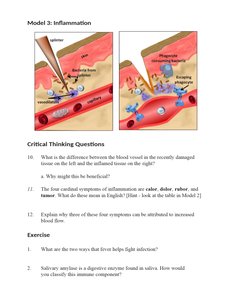
Q10. What is the difference between the blood vessel in the recently damaged tissue on the left and the inflamed tissue on the right?
Background
Topic: Inflammation and Blood Vessel Changes
This question examines the physiological changes in blood vessels during inflammation, such as increased permeability and blood flow.
Key Terms:
Vasodilation: Widening of blood vessels.
Permeability: The ability of substances to pass through vessel walls.
Step-by-Step Guidance
Observe the differences in the images of blood vessels before and after inflammation.
Identify changes in vessel diameter and the movement of immune cells or fluid.
Consider how these changes help the immune response.
Try solving on your own before revealing the answer!
Final Answer:
The inflamed blood vessel is wider (vasodilation) and more permeable, allowing immune cells and fluid to move into the tissue to fight infection.
Q11. What are the four cardinal symptoms of inflammation, and what do they mean in English?
Background
Topic: Signs of Inflammation
This question tests your knowledge of the classic signs of inflammation and their meanings.
Key Terms:
Rubor: Redness
Calor: Heat
Dolor: Pain
Tumor: Swelling
Step-by-Step Guidance
Recall the Latin terms for the four cardinal signs of inflammation.
Translate each term into its English equivalent.
Think about why each symptom occurs during inflammation.
Try solving on your own before revealing the answer!
Final Answer:
The four cardinal symptoms are rubor (redness), calor (heat), dolor (pain), and tumor (swelling).
Q12. Why does each of these four symptoms occur in inflamed tissue?
Background
Topic: Mechanisms of Inflammation
This question asks you to explain the physiological basis for each symptom of inflammation.
Key Terms:
Vasodilation: Causes redness and heat.
Increased permeability: Leads to swelling and pain.
Step-by-Step Guidance
For each symptom, identify the underlying physiological change (e.g., increased blood flow, fluid leakage).
Explain how these changes result in the observed symptoms.
Relate each symptom to the body’s defense mechanisms.
Try solving on your own before revealing the answer!
Final Answer:
Redness and heat are due to increased blood flow (vasodilation); swelling is from fluid leakage (increased permeability); pain results from pressure on nerves and chemical mediators.
Q13. What are two ways that fever helps fight infection?
Background
Topic: Fever and Immune Response
This question explores the beneficial effects of fever during infection.
Key Terms:
Fever: An increase in body temperature as part of the immune response.
Pathogen: A microorganism that causes disease.
Step-by-Step Guidance
Recall the physiological effects of fever on pathogens and the immune system.
Consider how higher temperatures affect pathogen growth and immune cell activity.
List two specific ways fever contributes to fighting infection.
Try solving on your own before revealing the answer!
Final Answer:
Fever inhibits pathogen growth and enhances the activity of immune cells, helping the body fight infection more effectively.
Q14. How would you classify salivary amylase in terms of immune components?
Background
Topic: Chemical Barriers in Innate Immunity
This question asks you to classify a digestive enzyme (salivary amylase) as part of the immune system’s defenses.
Key Terms:
Salivary amylase: An enzyme in saliva that breaks down starches.
Chemical barrier: A substance that helps protect against pathogens.
Step-by-Step Guidance
Consider the function of salivary amylase in the mouth.
Think about whether it has antimicrobial properties or acts as a chemical barrier.
Classify it as a component of innate immunity if appropriate.
Try solving on your own before revealing the answer!
Final Answer:
Salivary amylase is a chemical barrier in innate immunity, as it helps break down food and may inhibit some pathogens in the mouth.
