 Indietro
Introduction to Anatomy & Physiology: Foundational Concepts and Homeostasis
Guida di studio - Note intelligenti
 Appunti personalizzati basati sui tuoi materiali, ampliati con definizioni chiave, esempi e contesto.
Introduction to Anatomy & Physiology
Definition and Scope
Anatomy and physiology are foundational sciences in understanding the human body. Anatomy describes the structures of the body, including their composition, location, and associated structures. Physiology is the study of the functions of anatomical structures, both individually and cooperatively.
Anatomy: Focuses on structure; includes gross (macroscopic) and microscopic anatomy.
Physiology: Focuses on function; includes cell, organ, systemic, and pathological physiology.
Branches of Anatomy
Gross Anatomy: Examines large, visible structures (e.g., organs, muscles).
Surface Anatomy: Studies exterior features.
Regional Anatomy: Focuses on specific body areas.
Sectional Anatomy: Uses cross sections for internal visualization.
Systemic Anatomy: Studies organ systems.
Clinical Anatomy: Applies anatomical knowledge to medical specialties.
Developmental Anatomy: Studies changes from conception to adulthood, including embryology.
Microscopic Anatomy: Examines cells (cytology) and tissues (histology).
Branches of Physiology
Cell Physiology: Functions of cells.
Organ Physiology: Functions of specific organs.
Systemic Physiology: Functions of organ systems.
Pathological Physiology: Effects of diseases on organs or systems.
Levels of Organization in the Human Body
Hierarchical Structure
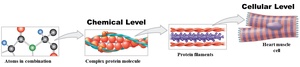
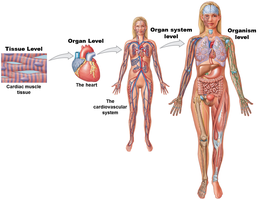
The human body is organized into several levels, each building upon the previous. Understanding these levels is essential for grasping both anatomy and physiology.
Chemical Level: Atoms and molecules form the basis of all matter.
Cellular Level: Cells are the smallest living units in the body.
Tissue Level: Groups of cells working together to perform specific functions.
Organ Level: Organs are made of two or more tissues working together.
Organ System Level: Groups of interacting organs form organ systems.
Organism Level: The individual life form, composed of all organ systems.
The Human Organ Systems
Overview of Major Organ Systems
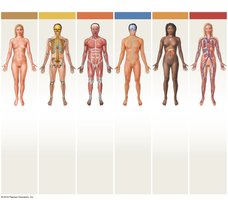
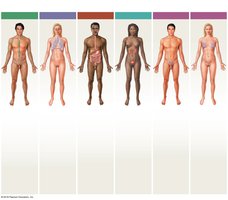
Humans have 11 major organ systems, each with distinct structures and functions. These systems work together to maintain life and homeostasis.
Integumentary System: Skin, hair, sweat glands, nails. Protects against environmental hazards, regulates temperature, provides sensory information.
Skeletal System: Bones, cartilages, ligaments, bone marrow. Provides support, stores minerals, forms blood cells.
Muscular System: Skeletal muscles, tendons. Provides movement, generates heat, supports tissues.
Nervous System: Brain, spinal cord, nerves, sense organs. Directs responses, coordinates activities, interprets sensory information.
Endocrine System: Glands (pituitary, thyroid, pancreas, adrenal, gonads). Directs long-term changes, adjusts metabolism, controls development.
Cardiovascular System: Heart, blood, blood vessels. Distributes blood, nutrients, waste, oxygen, and heat.
Lymphatic System: Spleen, thymus, lymphatic vessels, nodes, tonsils. Defends against infection, returns fluids to bloodstream.
Respiratory System: Nasal cavities, sinuses, larynx, trachea, bronchi, lungs, alveoli. Delivers air, provides oxygen, removes CO2, produces sounds.
Digestive System: Teeth, tongue, pharynx, esophagus, stomach, intestines, liver, gallbladder, pancreas. Processes food, absorbs nutrients and water, stores energy.
Urinary System: Kidneys, ureters, bladder, urethra. Excretes waste, regulates water and ions, stores urine.
Reproductive System: Male (testes, ducts, glands, penis, scrotum), Female (ovaries, tubes, uterus, vagina, labia, clitoris, mammary glands). Produces sex cells and hormones, supports embryo, provides milk.
Medical Terminology and Anatomical Landmarks
Medical Terminology
Precise terms are used to describe the body in health and disease, replacing eponyms for clarity (e.g., gingiva instead of gums).
Anatomical Position and Landmarks
Anatomical Position: Hands at sides, palms forward.
Supine: Lying face up.
Prone: Lying face down.
Anatomical Regions and Directions
Body Regions and Quadrants
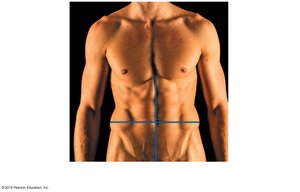
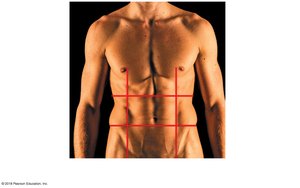
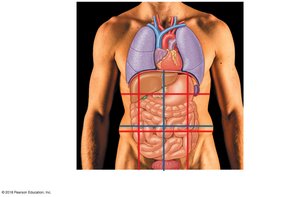
The body is divided into regions and quadrants for clinical and anatomical reference.
Abdominopelvic Quadrants: RUQ, RLQ, LUQ, LLQ.
Abdominopelvic Regions: Nine regions for more precise localization.
Directional Terms
Superior: Above; toward the head.
Inferior: Below; toward the feet.
Cranial/Cephalic: Toward the head.
Caudal: Toward the tail (coccyx).
Anterior/Ventral: Toward the front.
Posterior/Dorsal: Toward the back.
Medial: Toward the midline.
Lateral: Away from the midline.
Proximal: Toward the point of attachment.
Distal: Away from the point of attachment.
Superficial: Near the surface.
Deep: Farther from the surface.
Sectional Anatomy and Body Planes
Sectional Planes
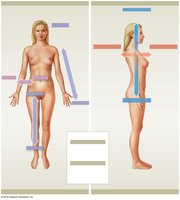
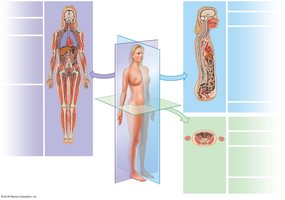
Sectional anatomy uses slices through the body to visualize internal structures, important in radiological techniques.
Frontal (Coronal) Plane: Divides body into anterior and posterior portions.
Sagittal Plane: Divides body into left and right portions. Midsagittal is at the midline; parasagittal is offset.
Transverse (Horizontal) Plane: Divides body into superior and inferior portions.
Body Cavities and Serous Membranes
Functions of Body Cavities
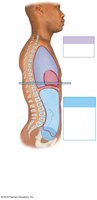
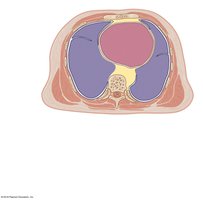
Body cavities protect internal organs and allow changes in size and shape. The ventral body cavity is divided by the diaphragm into thoracic and abdominopelvic cavities.
Thoracic Cavity: Contains pleural cavities (lungs) and pericardial cavity (heart).
Abdominopelvic Cavity: Contains digestive, reproductive, and urinary organs.
Serous Membranes
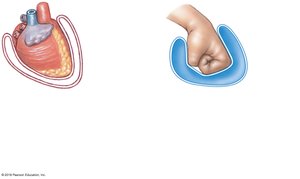
Serous membranes line body cavities and cover organs, consisting of parietal (lines cavity) and visceral (covers organ) layers.
Pleura: Surrounds lungs.
Pericardium: Surrounds heart.
Peritoneum: Surrounds abdominal organs.
Homeostasis and Regulatory Mechanisms
Concept of Homeostasis
Homeostasis is the maintenance of a stable internal environment. All body systems contribute to keeping variables within normal ranges, such as temperature and fluid balance.
Autoregulation: Automatic response in a cell, tissue, or organ to environmental change.
Extrinsic Regulation: Responses controlled by nervous and endocrine systems.
Components of Homeostatic Regulation
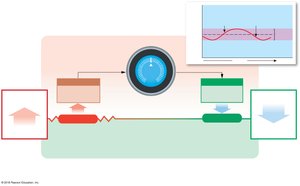
Receptor: Receives the stimulus.
Control Center: Processes the signal and sends instructions.
Effector: Carries out instructions.
Negative Feedback
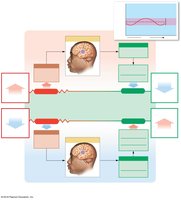
Negative feedback mechanisms restore homeostasis by negating the original stimulus, keeping variables within a normal range.
Example: Body temperature regulation via vasodilation, sweating, vasoconstriction, and shivering.
Positive Feedback
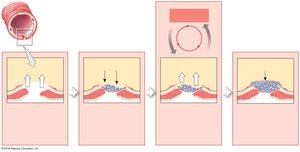
Positive feedback amplifies the original change, moving the body away from homeostasis. It is used to complete processes quickly, such as blood clotting.
Example: Blood clotting cascade accelerates until bleeding stops.
Systems Integration and Dynamic Equilibrium
Integration of Physiological Systems
All physiological systems work together to maintain homeostasis, a state of dynamic equilibrium. Failure to maintain balance results in disease.
Dynamic Equilibrium: Continual adaptation to internal and external changes.
Systems Integration: Coordination among organ systems is essential for health.
