 Indietro
Introduction to Human Anatomy: Anatomical Language, Body Planes, and Joint Movements
Guida di studio - Note intelligenti
 Appunti personalizzati basati sui tuoi materiali, ampliati con definizioni chiave, esempi e contesto.
The Language of Anatomy
Anatomical Position and Landmarks
The anatomical position is a standardized posture used as a reference in anatomy to describe locations and relationships of body parts. Understanding anatomical landmarks and directional terms is essential for accurately relating structures within the human body.
Anatomical Position: Standing upright, arms at sides, palms facing forward, feet flat on the floor, facing straight ahead.
Supine: Lying with the face up.
Prone: Lying with the face down.
Directional Terms
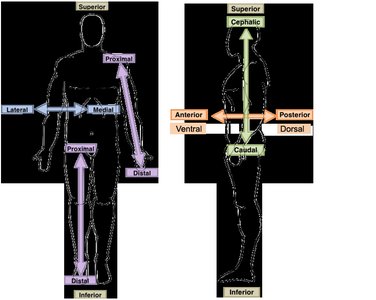
Directional terms are used to describe the locations of structures relative to other structures or locations in the body. These terms are fundamental for anatomical communication.
Superior: Toward the head or upper part of a structure.
Inferior: Away from the head or toward the lower part of a structure.
Anterior (Ventral): Toward the front of the body.
Posterior (Dorsal): Toward the back of the body.
Medial: Toward the midline of the body.
Lateral: Away from the midline of the body.
Proximal: Closer to the point of attachment or origin.
Distal: Farther from the point of attachment or origin.
Cephalic: Toward the head.
Caudal: Toward the tail or lower part of the body.
Sectional Anatomy (Body Planes)
Body Planes and Sections
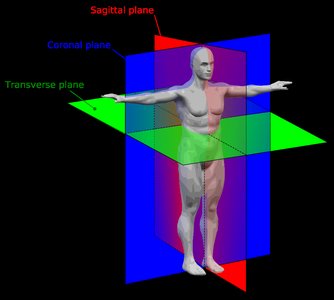
Body planes are imaginary lines that divide the body into sections, which are useful for describing locations and movements. Understanding these planes is crucial for interpreting anatomical images and performing medical procedures.
Sagittal Plane: Divides the body into right and left portions.
Midsagittal Plane: Sagittal plane that lies exactly on the midline.
Frontal (Coronal) Plane: Divides the body into anterior (front) and posterior (back) portions.
Transverse Plane: Divides the body into superior (upper) and inferior (lower) portions.
Joint Movements
Types of Joint Movements
Joint movements describe the ways in which bones move at their articulations. These movements are essential for understanding human motion and biomechanics.
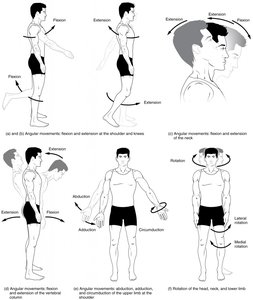
Flexion: Decreases the angle between two body parts.
Extension: Increases the angle between two body parts.
Abduction: Movement away from the midline.
Adduction: Movement toward the midline.
Internal (Medial) Rotation: Rotation toward the midline.
External (Lateral) Rotation: Rotation away from the midline.
Horizontal Abduction/Adduction: Movement of limbs in the horizontal plane.
Circumduction: Circular movement combining flexion, extension, abduction, and adduction (e.g., shoulder, hip).
Side Flexion: Bending of the spine to the side.
Pronation: Rotation of the forearm or foot so the palm or sole faces downward.
Supination: Rotation of the forearm or foot so the palm or sole faces upward.
Inversion: Turning the sole of the foot inward.
Eversion: Turning the sole of the foot outward.
Dorsiflexion: Bending the foot upward at the ankle.
Plantar Flexion: Bending the foot downward at the ankle.
Examples and Applications
Flexion and Extension: Bending and straightening the elbow or knee.
Abduction and Adduction: Raising the arm sideways away from the body and bringing it back.
Circumduction: Moving the arm in a circular motion at the shoulder.
Pronation and Supination: Rotating the forearm to turn the palm down or up.
Summary Table: Directional Terms
The following table summarizes the main directional terms used in anatomy:
Term | Definition |
|---|---|
Superior | Toward the head |
Inferior | Toward the feet |
Anterior (Ventral) | Toward the front |
Posterior (Dorsal) | Toward the back |
Medial | Toward the midline |
Lateral | Away from the midline |
Proximal | Closer to point of attachment |
Distal | Farther from point of attachment |
Cephalic | Toward the head |
Caudal | Toward the tail/lower part |
Additional info: Academic context and definitions have been expanded for clarity and completeness.
