 Indietro
Joint Types and Movements: Anatomy Study Guide
Guida di studio - Note intelligenti
 Appunti personalizzati basati sui tuoi materiali, ampliati con definizioni chiave, esempi e contesto.
Joints: Structure, Function, and Movement
Definition and Importance of Joints
A joint (also called an articulation) is the location where two or more bones meet. Joints are essential for providing stability to the skeleton and, depending on their structure, allow varying degrees of movement. Understanding joint types is fundamental for anatomy and physiology students, as it relates to both skeletal structure and body movement.
Structural Classification of Joints
Joints are classified by the material connecting the bones and the presence or absence of a cavity:
Fibrous Joints: Bones are connected by dense fibrous connective tissue. These joints are typically immovable or allow very limited movement. Examples: Skull sutures, distal tibiofibular syndesmosis, tooth sockets (gomphosis).
Cartilaginous Joints: Bones are joined by cartilage (either hyaline or fibrocartilage). These joints allow slight movement or are immovable. Examples: Growth plate (synchondrosis), pubic symphysis, intervertebral discs.
Synovial Joints: Bones are separated by a fluid-filled joint cavity containing synovial fluid. These joints are freely movable. Examples: Knee, shoulder, hip, elbow.
Functional Classification of Joints
Joints are also classified by their degree of movement:
Synarthrosis: Little or no movement (e.g., skull sutures).
Amphiarthrosis: Slight movement (e.g., pubic symphysis).
Diarthrosis: Freely movable (all synovial joints).
Exam alert: Structural and functional classifications are different systems. Not every fibrous joint is immovable, and not every cartilaginous joint is slightly movable.
Types of Synovial Joints and Their Movements
Synovial joints are categorized by their shape, which determines their movement:
Plane Joint: Allows gliding movements. Example: Intercarpal joints.
Hinge Joint: Permits flexion and extension. Example: Elbow, knee (modified hinge).
Pivot Joint: Enables rotation. Example: Atlas-axis (C1-C2).
Condyloid Joint: Allows flexion/extension and abduction/adduction. Example: Knuckles (metacarpophalangeal joints).
Saddle Joint: Permits movement in two planes and opposition. Example: Thumb carpometacarpal joint.
Ball-and-Socket Joint: Allows multiaxial movement and rotation. Example: Shoulder, hip.
Movement Vocabulary
Flexion: Decreases the joint angle.
Extension: Increases the joint angle.
Abduction: Moves a limb away from the midline.
Adduction: Moves a limb toward the midline.
Rotation: Turns a bone around its axis.
Circumduction: Circular, cone-shaped movement.
Opposition: Thumb touches a fingertip.
Comparison Table: Structural and Functional Joint Types
Structural Type | What Connects Bones? | Functional Type | Examples |
|---|---|---|---|
Fibrous | Dense fibrous connective tissue | Synarthrosis (mostly immovable) | Skull sutures, syndesmosis, gomphosis |
Cartilaginous | Cartilage (hyaline or fibrocartilage) | Amphiarthrosis (slightly movable) | Pubic symphysis, intervertebral discs, growth plate |
Synovial | Joint cavity with synovial fluid | Diarthrosis (freely movable) | Knee, shoulder, hip, elbow |
Practice Questions and Answers
What are the three structural joint categories? Answer: Fibrous, cartilaginous, synovial.
Which joint type has a fluid-filled cavity? Answer: Synovial.
What connects bones in a symphysis? Answer: Fibrocartilage.
What functional category means freely movable? Answer: Diarthrosis.
Which synovial joint type is found at the elbow? Answer: Hinge.
Which joint allows rotation of the head from side to side? Answer: Pivot (atlantoaxial).
Which joint shape is found at the base of the thumb? Answer: Saddle.
Which type of joint is found at the shoulder? Answer: Ball-and-socket.
What movement takes the arm away from the body midline? Answer: Abduction.
What is the difference between structural and functional classification? Answer: Structural = material/anatomy connecting bones; functional = degree of movement.
Visual Reference: Joint Types in the Human Body
The following image illustrates the main structural and functional types of joints, including examples and typical movements for each synovial joint shape. It visually reinforces the classification and movement concepts described above.
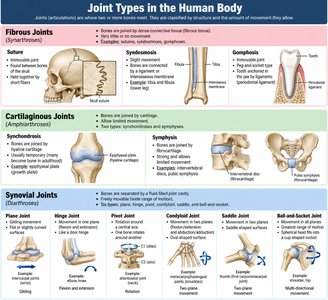
Additional info: Cartilaginous synchondroses are generally immovable, while symphyses allow slight movement. Fibrous joints are not all synarthroses; syndesmoses may permit slight movement.
