 Indietro
Joints: Classification, Structure, and Types of Synovial Joints
Guida di studio - Note intelligenti
 Appunti personalizzati basati sui tuoi materiali, ampliati con definizioni chiave, esempi e contesto.
Joints
Classification of Joints
Joints, also known as articulations, are the sites where two or more bones meet. They are classified based on their movability and the material binding them together.
By Movability: Joints are categorized as immovable (synarthroses), slightly movable (amphiarthroses), and freely movable (diarthroses).
By Material Binding: Joints are classified as fibrous, cartilaginous, or synovial, depending on the tissue connecting the bones.
Synovial Joints: Structure and Features
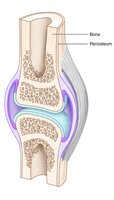
Synovial joints are the most common and most movable type of joint in the body. They are characterized by a joint cavity filled with synovial fluid, which reduces friction and allows for smooth movement.
Joint Capsule: A tough, fibrous structure that encloses the joint.
Synovial Membrane: Lines the joint capsule and secretes synovial fluid.
Joint Cavity: The space within the joint capsule containing synovial fluid.
Articular Cartilage: Smooth cartilage covering the ends of bones, providing cushioning.
Ligaments: Strong bands of connective tissue that reinforce the joint.
Types of Synovial Joints
Synovial joints are classified by the shapes of their articulating surfaces and the movements they allow.
Pivot Joint: Allows rotational movement (e.g., atlantoaxial joint in the neck).
Hinge Joint: Permits flexion and extension (e.g., elbow, knee).
Gliding Joint: Allows limited sliding movements (e.g., intercarpal joints in the wrist).
Ball-and-Socket Joint: Offers the widest range of motion, including rotation, flexion, extension, abduction, and adduction (e.g., shoulder, hip).
Saddle Joint: Allows movement in two planes (e.g., thumb joint).
Condyloid Joint: Permits flexion, extension, and side-to-side movement (e.g., wrist joint).
Movements of Synovial Joints
The range and type of movement at synovial joints depend on the shape of the joint and the involvement of nearby muscles, tendons, and ligaments.
Shape of Joint: Determines the possible directions of movement.
Muscles, Tendons, Ligaments: Stabilize the joint and influence its mobility.
Major Synovial Joints of the Body
Shoulder Joint
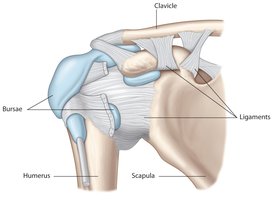
The shoulder is a ball-and-socket joint, providing a wide range of motion but less stability. It is supported by ligaments and bursae, which reduce friction and cushion the joint.
Elbow Joint
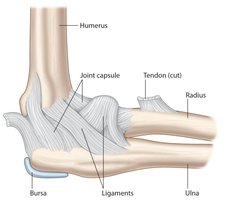
The elbow is a hinge joint, allowing flexion and extension. It is stabilized by ligaments, a joint capsule, and bursae.
Knee Joint
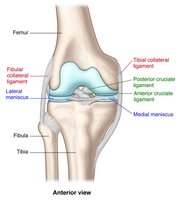
The knee is a hinge joint, reinforced by several ligaments and menisci that provide stability and absorb shock.
Hip Joint
The hip is a ball-and-socket joint, offering a wide range of motion and high stability due to its deep socket and strong ligaments.
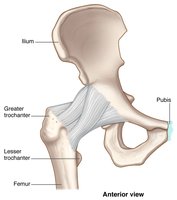
Comparative Stability and Mobility of Joints
Shoulder Joint: Most likely to be dislocated due to its shallow socket and high mobility.
Hip Joint: More stable than the shoulder because of its deep socket.
Elbow and Knee Joints: Less prone to dislocation due to their structural reinforcement.
Summary Table: Types of Synovial Joints and Their Movements
Type of Joint | Movement Allowed | Example |
|---|---|---|
Pivot | Rotation | Atlantoaxial joint |
Hinge | Flexion/Extension | Elbow, Knee |
Gliding | Sliding | Intercarpal joints |
Ball-and-Socket | All directions | Shoulder, Hip |
Saddle | Two planes | Thumb joint |
Condyloid | Flexion/Extension, Side-to-side | Wrist joint |
Key Definitions
Synarthroses: Immovable joints, typically fibrous.
Amphiarthroses: Slightly movable joints, often cartilaginous.
Diarthroses: Freely movable joints, usually synovial.
Ligament: Connective tissue that connects bone to bone.
Bursa: Fluid-filled sac that reduces friction in joints.
Example Question and Answer
Question: Most of the joints in the body are:
Answer: Synovial joints.
Rationale: Synovial joints outnumber fibrous and cartilaginous joints. Synarthroses is another name for fibrous joints.
Example Question and Answer
Question: Which joint offers the widest range of motion?
Answer: Ball-and-socket joint.
Rationale: Ball-and-socket joints allow movement in all directions, unlike hinge, gliding, or condyloid joints.
Example Question and Answer
Question: Which joint is most likely to be dislocated?
Answer: Shoulder joint.
Rationale: The hip is more stable than the shoulder because it has a deep socket. Neither the elbow nor the knee is prone to dislocation.
Equations and Formulas
Joint Stability Equation: $\text{Stability} \propto \frac{\text{Depth of Socket} \times \text{Ligament Strength}}{\text{Range of Motion}}$
Additional info: Academic context was added to expand brief points and provide definitions, examples, and a summary table for clarity.
